

208
2
Mining of Hydrothermal
Deposits
2.1
Japanese Seafl oor Mining
Project
In contrast to offshore oil fi elds, the resources
from hydrothermal deposits are solid and heavier
than seawater. In this case, the major technical
challenge is not only drilling but also rifting. To
date, a range of technical challenges has prevented the commercialization of deep-sea mining, but it has recently become regarded as viable,
along with the development of deep-sea exploration and drilling techniques.
Within the Japanese exclusive economic zone
(EEZ), identifi ed hydrothermal deposits are distributed between depths of 500–2,000 m, which is
a relatively shallower zone for hydrothermal
deposits and therefore advantageous for mining.
In Japan, research into the understanding of
hydrothermal vents and hydrothermal deposits is
mainly conducted by Japan Agency for MarineEarth Science and Technology (JAMSTEC). They
operate the “Artifi cial Hydrothermal Vents” project in the Iheya North fi eld in Okinawa Trough
(Takai et al. 2013 ). The technical development of
marine mining is mainly conducted by Japan Oil,
Gas and Metals National Corporation (JOGMEC).
They operate test mining of the hydrothermal
deposits at Izena Hole in Okinawa Trough in
2012. The Japanese government proposes to begin
commercialised mining within the next 10 years
or so (The fi nal report of the fi rst term in development program of hydrothermal deposits 2013 ).
2.2
Ecosystem Investigation,
Model Building and Impact
Assessment
Prior to the discovery of hydrothermal vents, the
deep-sea fl oor was thought to have negligible
bio-productivity. Naturally, there are no phytoplankton (the marine primary producer) in such
dark areas. However, deep-sea hydrothermal
vents host another type of marine primary producer (chemosynthetic bacteria) that utilises sulphides and other chemical components. Rich
ecosystems develop around hydrothermal vents
including shrimps, crabs, etc. based on chemosynthetic bacteria.
As a procedure for mining these areas, it is fi rst
necessary to conduct detailed ecological investigation from a position of natural science; second, to
build ecosystem models to estimate the impact of
a proposed mining project from a position of environmental conservation; and third, to obtain social
consensus on the deep-sea mining project based
on the environmental impact assessment. Figure 2
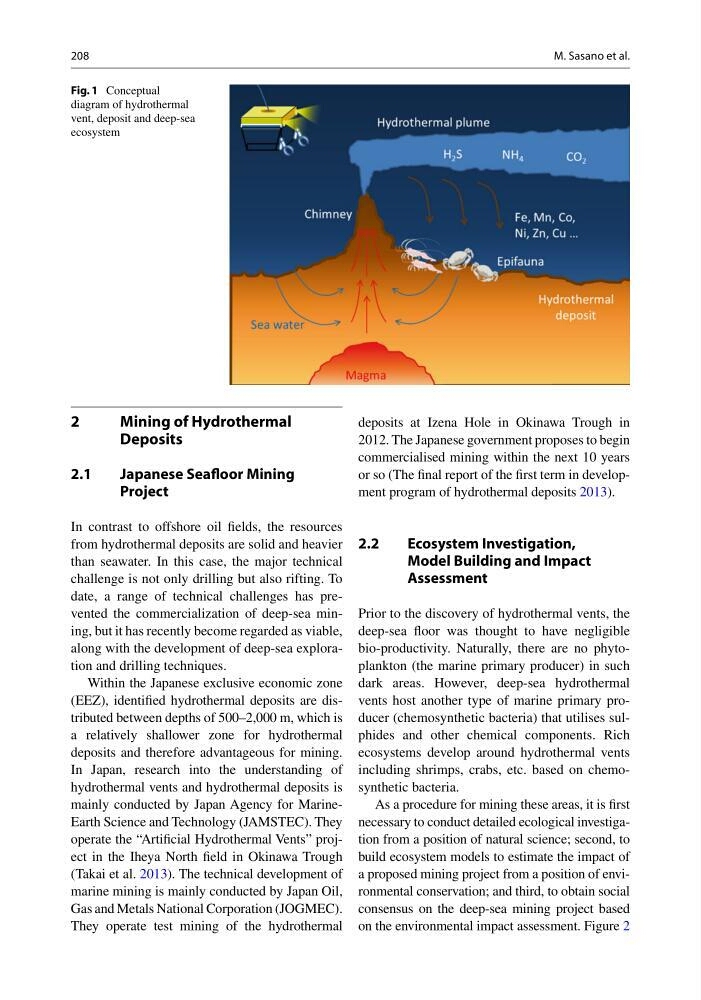
Fig. 1 Conceptual
diagram of hydrothermal
vent, deposit and deep-sea
ecosystem
M. Sasano et al.
2
Mining of Hydrothermal
Deposits
2.1
Japanese Seafl oor Mining
Project
In contrast to offshore oil fi elds, the resources
from hydrothermal deposits are solid and heavier
than seawater. In this case, the major technical
challenge is not only drilling but also rifting. To
date, a range of technical challenges has prevented the commercialization of deep-sea mining, but it has recently become regarded as viable,
along with the development of deep-sea exploration and drilling techniques.
Within the Japanese exclusive economic zone
(EEZ), identifi ed hydrothermal deposits are distributed between depths of 500–2,000 m, which is
a relatively shallower zone for hydrothermal
deposits and therefore advantageous for mining.
In Japan, research into the understanding of
hydrothermal vents and hydrothermal deposits is
mainly conducted by Japan Agency for MarineEarth Science and Technology (JAMSTEC). They
operate the “Artifi cial Hydrothermal Vents” project in the Iheya North fi eld in Okinawa Trough
(Takai et al. 2013 ). The technical development of
marine mining is mainly conducted by Japan Oil,
Gas and Metals National Corporation (JOGMEC).
They operate test mining of the hydrothermal
deposits at Izena Hole in Okinawa Trough in
2012. The Japanese government proposes to begin
commercialised mining within the next 10 years
or so (The fi nal report of the fi rst term in development program of hydrothermal deposits 2013 ).
2.2
Ecosystem Investigation,
Model Building and Impact
Assessment
Prior to the discovery of hydrothermal vents, the
deep-sea fl oor was thought to have negligible
bio-productivity. Naturally, there are no phytoplankton (the marine primary producer) in such
dark areas. However, deep-sea hydrothermal
vents host another type of marine primary producer (chemosynthetic bacteria) that utilises sulphides and other chemical components. Rich
ecosystems develop around hydrothermal vents
including shrimps, crabs, etc. based on chemosynthetic bacteria.
As a procedure for mining these areas, it is fi rst
necessary to conduct detailed ecological investigation from a position of natural science; second, to
build ecosystem models to estimate the impact of
a proposed mining project from a position of environmental conservation; and third, to obtain social
consensus on the deep-sea mining project based
on the environmental impact assessment. Figure 2
Fig. 1 Conceptual
diagram of hydrothermal
vent, deposit and deep-sea
ecosystem
M. Sasano et al.