

164
decision- makers in the English Channel area and
(3) stimulating cooperation that addresses strategic issues at stake. To meet these objectives, the
project integrated the contribution of other projects which developed scientifi c knowledge, in
particular the CHARM project (see below), or
sector- based strategies for the English Channel
area, e.g. ports and transport and maritime safety.
3.2
CRESH Project
The CRESH project (Cephalopod Recruitment
from English Channel Habitats) addresses the
Priority 4 of the INTERREG IVA programme
which concerns the sustainable environmental
development of the common space.
3 Cephalopods
are short-living species; their abundance depends
on the annual recruitment (juveniles entering the
exploited stage), and they are directly concerned
by this topic. The project gathers eight FrenchBritish partners from universities, research institutes and fi shermen’s organisations. This brief
introduction underlines complementary skills
3 http://www.unicaen.fr/ufr/ibfa/cresh/?lang=en
gathered to better understand these animals and
the part that they play in the English Channel
ecosystem.
3.3
CHARM1, CHARM2
and CHARM3 Projects
CHARM1 and CHARM2 have been two successive French-British cooperation projects, cofunded under the UE INTERREG programme,
through the Haute-Normandie Region and the
UK Government Offi ce for the South-East. Each
of these projects developed an atlas as a ‘toolbox’
to support decision-making and spatial planning
in relation to the sustainable management of the
English Channel marine resources. The fi rst
phase (2003–2005) covered the Dover Strait and
the second one (2006–2008) covered the whole
Eastern English Channel. These projects have
also been a good opportunity to gather and harmonise French and UK ecological and environmental data. The Channel Habitat Atlas for
marine Resource Management produced during
CHARM2 can be downloaded on http://archimer.
ifremer.fr/doc/2009/rapport-7377.pdf
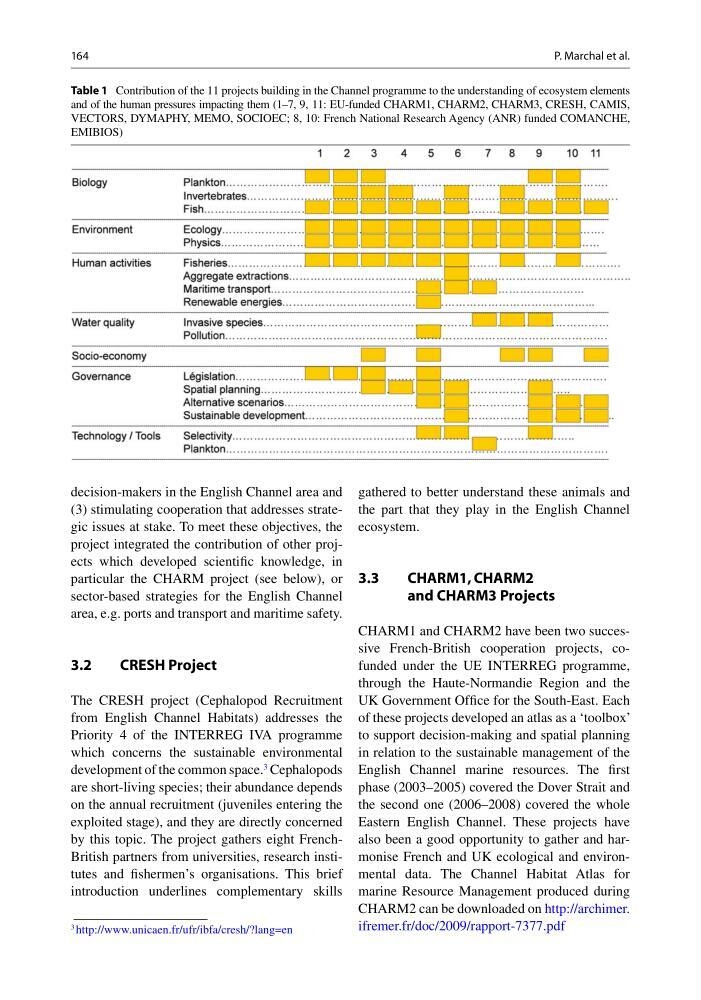
Table 1 Contribution of the 11 projects building in the Channel programme to the understanding of ecosystem elements
and of the human pressures impacting them (1–7, 9, 11: EU-funded CHARM1, CHARM2, CHARM3, CRESH, CAMIS,
VECTORS, DYMAPHY, MEMO, SOCIOEC; 8, 10: French National Research Agency (ANR) funded COMANCHE,
EMIBIOS)
P. Marchal et al.
decision- makers in the English Channel area and
(3) stimulating cooperation that addresses strategic issues at stake. To meet these objectives, the
project integrated the contribution of other projects which developed scientifi c knowledge, in
particular the CHARM project (see below), or
sector- based strategies for the English Channel
area, e.g. ports and transport and maritime safety.
3.2
CRESH Project
The CRESH project (Cephalopod Recruitment
from English Channel Habitats) addresses the
Priority 4 of the INTERREG IVA programme
which concerns the sustainable environmental
development of the common space.
3 Cephalopods
are short-living species; their abundance depends
on the annual recruitment (juveniles entering the
exploited stage), and they are directly concerned
by this topic. The project gathers eight FrenchBritish partners from universities, research institutes and fi shermen’s organisations. This brief
introduction underlines complementary skills
3 http://www.unicaen.fr/ufr/ibfa/cresh/?lang=en
gathered to better understand these animals and
the part that they play in the English Channel
ecosystem.
3.3
CHARM1, CHARM2
and CHARM3 Projects
CHARM1 and CHARM2 have been two successive French-British cooperation projects, cofunded under the UE INTERREG programme,
through the Haute-Normandie Region and the
UK Government Offi ce for the South-East. Each
of these projects developed an atlas as a ‘toolbox’
to support decision-making and spatial planning
in relation to the sustainable management of the
English Channel marine resources. The fi rst
phase (2003–2005) covered the Dover Strait and
the second one (2006–2008) covered the whole
Eastern English Channel. These projects have
also been a good opportunity to gather and harmonise French and UK ecological and environmental data. The Channel Habitat Atlas for
marine Resource Management produced during
CHARM2 can be downloaded on http://archimer.
ifremer.fr/doc/2009/rapport-7377.pdf
Table 1 Contribution of the 11 projects building in the Channel programme to the understanding of ecosystem elements
and of the human pressures impacting them (1–7, 9, 11: EU-funded CHARM1, CHARM2, CHARM3, CRESH, CAMIS,
VECTORS, DYMAPHY, MEMO, SOCIOEC; 8, 10: French National Research Agency (ANR) funded COMANCHE,
EMIBIOS)
P. Marchal et al.