

135
3.2
Multifractals as a Diagnostic
Tool to Assess a Family
of Swimming Behaviours
The strongly non-Gaussian fluctuations perceptible in zooplankton successive displacements
that range from very likely slow steps to rare and
extremely rapid displacements (Fig. 1b) are
inherently incompatible with classical self-affine
approaches based, e.g., on the scaling behaviour
of the power spectral density described above
that are fundamentally limited to second-order
moments. A more general approach is based on
the analysis of qth order long-range correlations
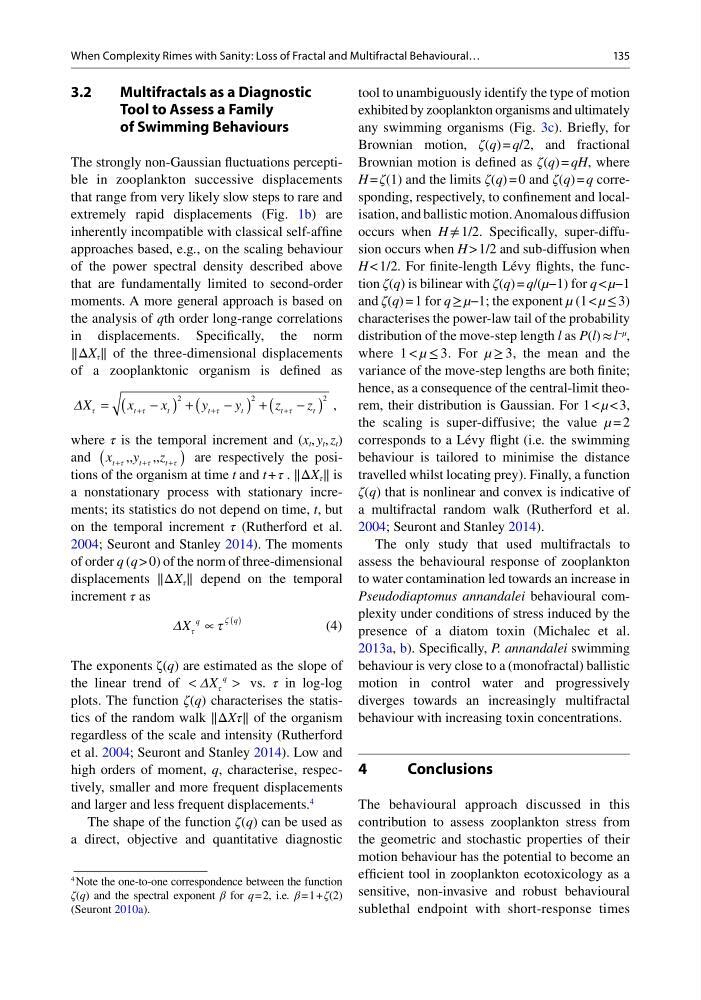
in displacements. Specifically, the norm
‖ΔX τ ‖ of the three-dimensional displacements
of a zooplanktonic organism is defined as
∆ τ
τ
τ
τ
X
x
x
y
y
z
z
t
t
t
t
t
t
=
−
(
) +
−
(
) +
−
(
)
+
+
+
2
2
2 ,
where τ is the temporal increment and (x t , y t , z t )
and x y z
t
t
t
+
+
+
(
)
τ
τ
τ
,, ,,
are respectively the positions of the organism at time t and t + τ . ‖ΔX τ ‖ is
a nonstationary process with stationary increments; its statistics do not depend on time, t, but
on the temporal increment τ (Rutherford et al.
2004; Seuront and Stanley 2014). The moments
of order q (q > 0) of the norm of three- dimensional
displacements ‖ΔX τ ‖ depend on the temporal
increment τ as
∆
τ
τ
ζ
X
q
q
∝
( )
(4)
The exponents ζ(q) are estimated as the slope of
the linear trend of <
>
∆ τ
X
q
vs. τ in log-log
plots. The function ζ(q) characterises the statistics of the random walk ‖ΔXτ‖ of the organism
regardless of the scale and intensity (Rutherford
et al. 2004; Seuront and Stanley 2014). Low and
high orders of moment, q, characterise, respectively, smaller and more frequent displacements
and larger and less frequent displacements.
4
The shape of the function ζ(q) can be used as
a direct, objective and quantitative diagnostic
4 Note the one-to-one correspondence between the function
ζ(q) and the spectral exponent β for q = 2, i.e. β = 1 + ζ(2)
(Seuront 2010a).
tool to unambiguously identify the type of motion
exhibited by zooplankton organisms and ultimately
any swimming organisms (Fig. 3c). Briefly, for
Brownian motion, ζ(q) = q/2, and fractional
Brownian motion is defined as ζ(q) = qH, where
H = ζ(1) and the limits ζ(q) = 0 and ζ(q) = q corresponding, respectively, to confinement and localisation, and ballistic motion. Anomalous diffusion
occurs when H ≠ 1/2. Specifically, super-diffusion occurs when H > 1/2 and sub- diffusion when
H < 1/2. For finite-length Lévy flights, the function ζ(q) is bilinear with ζ(q) = q/(μ−1) for q < μ−1
and ζ(q) = 1 for q ≥ μ−1; the exponent μ (1 < μ ≤ 3)
characterises the power-law tail of the probability
distribution of the move- step length l as P(l) ≈ l
−μ
,
where 1 < μ ≤ 3. For μ ≥ 3, the mean and the
variance of the move-step lengths are both finite;
hence, as a consequence of the central-limit theorem, their distribution is Gaussian. For 1 < μ < 3,
the scaling is super- diffusive; the value μ = 2
corresponds to a Lévy flight (i.e. the swimming
behaviour is tailored to minimise the distance
travelled whilst locating prey). Finally, a function
ζ(q) that is nonlinear and convex is indicative of
a multifractal random walk (Rutherford et al.
2004; Seuront and Stanley 2014).
The only study that used multifractals to
assess the behavioural response of zooplankton
to water contamination led towards an increase in
Pseudodiaptomus annandalei behavioural complexity under conditions of stress induced by the
presence of a diatom toxin (Michalec et al.
2013a, b). Specifically, P. annandalei swimming
behaviour is very close to a (monofractal) ballistic
motion in control water and progressively
diverges towards an increasingly multifractal
behaviour with increasing toxin concentrations.
4
Conclusions
The behavioural approach discussed in this
contribution to assess zooplankton stress from
the geometric and stochastic properties of their
motion behaviour has the potential to become an
efficient tool in zooplankton ecotoxicology as a
sensitive, non-invasive and robust behavioural
sublethal endpoint with short-response times
When Complexity Rimes with Sanity: Loss of Fractal and Multifractal Behavioural…
3.2
Multifractals as a Diagnostic
Tool to Assess a Family
of Swimming Behaviours
The strongly non-Gaussian fluctuations perceptible in zooplankton successive displacements
that range from very likely slow steps to rare and
extremely rapid displacements (Fig. 1b) are
inherently incompatible with classical self-affine
approaches based, e.g., on the scaling behaviour
of the power spectral density described above
that are fundamentally limited to second-order
moments. A more general approach is based on
the analysis of qth order long-range correlations
in displacements. Specifically, the norm
‖ΔX τ ‖ of the three-dimensional displacements
of a zooplanktonic organism is defined as
∆ τ
τ
τ
τ
X
x
x
y
y
z
z
t
t
t
t
t
t
=
−
(
) +
−
(
) +
−
(
)
+
+
+
2
2
2 ,
where τ is the temporal increment and (x t , y t , z t )
and x y z
t
t
t
+
+
+
(
)
τ
τ
τ
,, ,,
are respectively the positions of the organism at time t and t + τ . ‖ΔX τ ‖ is
a nonstationary process with stationary increments; its statistics do not depend on time, t, but
on the temporal increment τ (Rutherford et al.
2004; Seuront and Stanley 2014). The moments
of order q (q > 0) of the norm of three- dimensional
displacements ‖ΔX τ ‖ depend on the temporal
increment τ as
∆
τ
τ
ζ
X
q
q
∝
( )
(4)
The exponents ζ(q) are estimated as the slope of
the linear trend of <
>
∆ τ
X
q
vs. τ in log-log
plots. The function ζ(q) characterises the statistics of the random walk ‖ΔXτ‖ of the organism
regardless of the scale and intensity (Rutherford
et al. 2004; Seuront and Stanley 2014). Low and
high orders of moment, q, characterise, respectively, smaller and more frequent displacements
and larger and less frequent displacements.
4
The shape of the function ζ(q) can be used as
a direct, objective and quantitative diagnostic
4 Note the one-to-one correspondence between the function
ζ(q) and the spectral exponent β for q = 2, i.e. β = 1 + ζ(2)
(Seuront 2010a).
tool to unambiguously identify the type of motion
exhibited by zooplankton organisms and ultimately
any swimming organisms (Fig. 3c). Briefly, for
Brownian motion, ζ(q) = q/2, and fractional
Brownian motion is defined as ζ(q) = qH, where
H = ζ(1) and the limits ζ(q) = 0 and ζ(q) = q corresponding, respectively, to confinement and localisation, and ballistic motion. Anomalous diffusion
occurs when H ≠ 1/2. Specifically, super-diffusion occurs when H > 1/2 and sub- diffusion when
H < 1/2. For finite-length Lévy flights, the function ζ(q) is bilinear with ζ(q) = q/(μ−1) for q < μ−1
and ζ(q) = 1 for q ≥ μ−1; the exponent μ (1 < μ ≤ 3)
characterises the power-law tail of the probability
distribution of the move- step length l as P(l) ≈ l
−μ
,
where 1 < μ ≤ 3. For μ ≥ 3, the mean and the
variance of the move-step lengths are both finite;
hence, as a consequence of the central-limit theorem, their distribution is Gaussian. For 1 < μ < 3,
the scaling is super- diffusive; the value μ = 2
corresponds to a Lévy flight (i.e. the swimming
behaviour is tailored to minimise the distance
travelled whilst locating prey). Finally, a function
ζ(q) that is nonlinear and convex is indicative of
a multifractal random walk (Rutherford et al.
2004; Seuront and Stanley 2014).
The only study that used multifractals to
assess the behavioural response of zooplankton
to water contamination led towards an increase in
Pseudodiaptomus annandalei behavioural complexity under conditions of stress induced by the
presence of a diatom toxin (Michalec et al.
2013a, b). Specifically, P. annandalei swimming
behaviour is very close to a (monofractal) ballistic
motion in control water and progressively
diverges towards an increasingly multifractal
behaviour with increasing toxin concentrations.
4
Conclusions
The behavioural approach discussed in this
contribution to assess zooplankton stress from
the geometric and stochastic properties of their
motion behaviour has the potential to become an
efficient tool in zooplankton ecotoxicology as a
sensitive, non-invasive and robust behavioural
sublethal endpoint with short-response times
When Complexity Rimes with Sanity: Loss of Fractal and Multifractal Behavioural…