

115
After the contact with ephyra, cypris stopped
swimming and made the body curled to sink.
They restarted swimming after a delay ranging from several seconds and 2 min after the
contact.
3.4
Zoea
Zoea larvae of decapods were often in contact
with ephyra , but never eaten. It seems they were
not seriously infl uenced by the ephyral venomous
stings, probably having harder shell to avoid
stings of the jellyfi sh tentacles.
3.5
Rathkea
In the vicinity of ephyra , the small hydromedusa
Rathkea octopunctata seemed to try escaping. A
single hit of ephyra seemed to be was enough to
paralyze and capture Rathkea .
3.6
Artemia
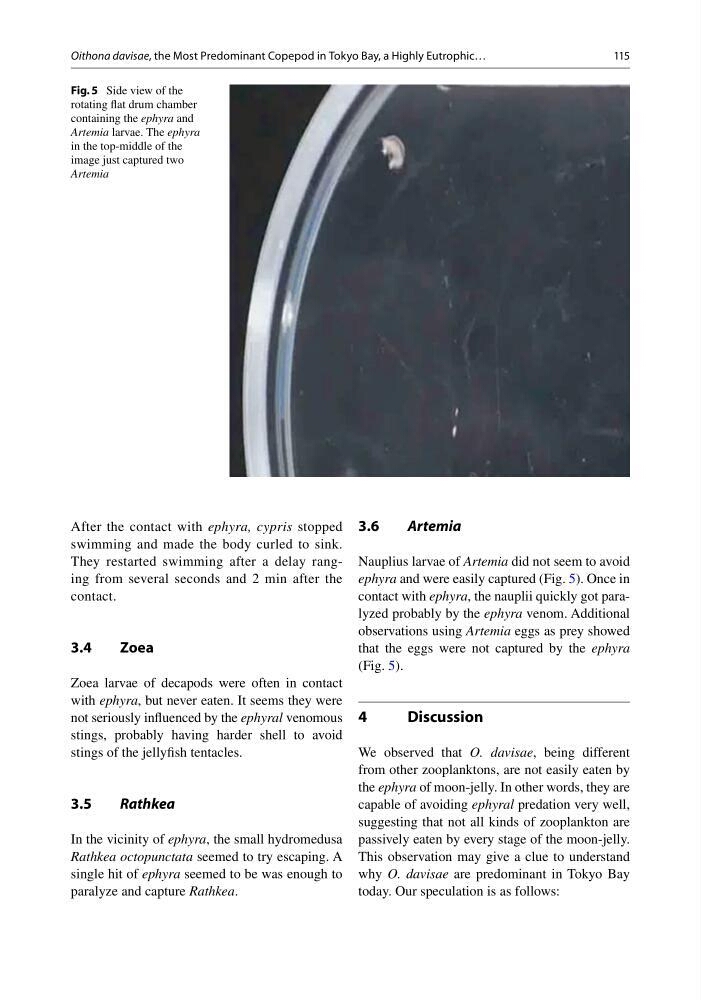
Nauplius larvae of Artemia did not seem to avoid
ephyra and were easily captured (Fig. 5 ). Once in
contact with ephyra , the nauplii quickly got paralyzed probably by the ephyra venom. Additional
observations using Artemia eggs as prey showed
that the eggs were not captured by the ephyra
(Fig. 5 ).
4
Discussion
We observed that O. davisae , being different
from other zooplanktons, are not easily eaten by
the ephyra of moon-jelly. In other words, they are
capable of avoiding ephyral predation very well,
suggesting that not all kinds of zooplankton are
passively eaten by every stage of the moon-jelly.
This observation may give a clue to understand
why O. davisae are predominant in Tokyo Bay
today. Our speculation is as follows:
Fig. 5 Side view of the
rotating fl at drum chamber
containing the ephyra and
Artemia larvae. The ephyra
in the top-middle of the
image just captured two
Artemia
Oithona davisae, the Most Predominant Copepod in Tokyo Bay, a Highly Eutrophic…
After the contact with ephyra, cypris stopped
swimming and made the body curled to sink.
They restarted swimming after a delay ranging from several seconds and 2 min after the
contact.
3.4
Zoea
Zoea larvae of decapods were often in contact
with ephyra , but never eaten. It seems they were
not seriously infl uenced by the ephyral venomous
stings, probably having harder shell to avoid
stings of the jellyfi sh tentacles.
3.5
Rathkea
In the vicinity of ephyra , the small hydromedusa
Rathkea octopunctata seemed to try escaping. A
single hit of ephyra seemed to be was enough to
paralyze and capture Rathkea .
3.6
Artemia
Nauplius larvae of Artemia did not seem to avoid
ephyra and were easily captured (Fig. 5 ). Once in
contact with ephyra , the nauplii quickly got paralyzed probably by the ephyra venom. Additional
observations using Artemia eggs as prey showed
that the eggs were not captured by the ephyra
(Fig. 5 ).
4
Discussion
We observed that O. davisae , being different
from other zooplanktons, are not easily eaten by
the ephyra of moon-jelly. In other words, they are
capable of avoiding ephyral predation very well,
suggesting that not all kinds of zooplankton are
passively eaten by every stage of the moon-jelly.
This observation may give a clue to understand
why O. davisae are predominant in Tokyo Bay
today. Our speculation is as follows:
Fig. 5 Side view of the
rotating fl at drum chamber
containing the ephyra and
Artemia larvae. The ephyra
in the top-middle of the
image just captured two
Artemia
Oithona davisae, the Most Predominant Copepod in Tokyo Bay, a Highly Eutrophic…