

108
species that can decompose cellulose materials,
such as members of the wood-boring mussel
subfamily Xylophagidae, which were retrieved in
a sample from this area. In the case of nets or wire
debris, a negative effect on fi sheries has already
been reported by Goto ( 2012 ). For sustainable
fi sheries, as a fi rst step the number of ghost fi shing
nets and plastics of ingestible sizes should be
reduced. The next step should be to track the stage/
status of fl ustering in plastics and determine the
distribution of various marine debris materials.
Acknowledgments We would like to thank all members
of cruises for their kind help before, after, and during surveys. Especially, Yasuo Furushima, Katsunori Fujikura,
Shuro Yoshikawa, and Haruka Shibata helped us to access
data from each cruise. We also would like to thank two
reviewers for their helpful comments. This research was
partially supported by the Tohoku Ecosystem-Associated
Marine Sciences (TEAMS) research program funded by
the Ministry of Education, Culture, Sports, Science and
Technology (MEXT).
References
Andrady A (2011) Microplastics in the marine environment. Mar Pollut Bull 62:1596–1605
Arai K, Naruse H, Miura R, Kawamura K, Hino R, Ito Y,
Inazu D, Yokokawa M, Izumi N, Murayama M, Kasaya
T (2013) Tsunami-generated turbidity current of the
2011 Tohoku-Oki earthquake. Geology 41:1195–1198
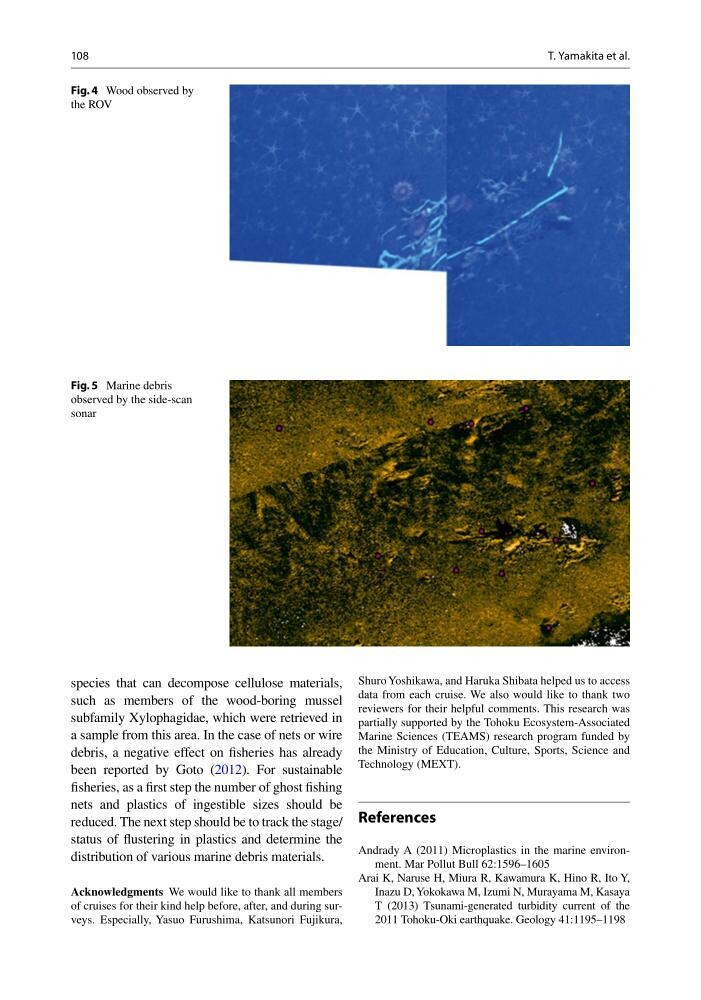
Fig. 4 Wood observed by
the ROV
Fig. 5 Marine debris
observed by the side-scan
sonar
T. Yamakita et al.
species that can decompose cellulose materials,
such as members of the wood-boring mussel
subfamily Xylophagidae, which were retrieved in
a sample from this area. In the case of nets or wire
debris, a negative effect on fi sheries has already
been reported by Goto ( 2012 ). For sustainable
fi sheries, as a fi rst step the number of ghost fi shing
nets and plastics of ingestible sizes should be
reduced. The next step should be to track the stage/
status of fl ustering in plastics and determine the
distribution of various marine debris materials.
Acknowledgments We would like to thank all members
of cruises for their kind help before, after, and during surveys. Especially, Yasuo Furushima, Katsunori Fujikura,
Shuro Yoshikawa, and Haruka Shibata helped us to access
data from each cruise. We also would like to thank two
reviewers for their helpful comments. This research was
partially supported by the Tohoku Ecosystem-Associated
Marine Sciences (TEAMS) research program funded by
the Ministry of Education, Culture, Sports, Science and
Technology (MEXT).
References
Andrady A (2011) Microplastics in the marine environment. Mar Pollut Bull 62:1596–1605
Arai K, Naruse H, Miura R, Kawamura K, Hino R, Ito Y,
Inazu D, Yokokawa M, Izumi N, Murayama M, Kasaya
T (2013) Tsunami-generated turbidity current of the
2011 Tohoku-Oki earthquake. Geology 41:1195–1198
Fig. 4 Wood observed by
the ROV
Fig. 5 Marine debris
observed by the side-scan
sonar
T. Yamakita et al.