

103
to May 20 and July 31 to August 7, 2012. The
4KC was equipped with a Super-HARP (highgain avalanche rushing photoconductor) video
camera recording in NTSC (National Television
System Committee specifi cation) format for
downward-facing seafl oor observations, and this
allowed observation of an area of approximately
3 × 3 m at an altitude of 3 m above the seafl oor.
The YKDT was equipped with a similar camera
confi guration but with a less light-sensitive CCD
(charge-coupled device) camera and also recording in NTSC format. An ROV (remotely operated
vehicle) survey was carried out during June 30 to
July 5 in 2013. The ROV Crambon was equipped
with a pan-tiltable, forward-facing, highdefi nition (1080i) video camera with a 67° view
fi eld angle and with video recorded onto a hard
disk cartridge (AJA WZZ-KiPro2400) at ProRes
4:2:2HQ resolution via HD-SDI and saved in
QuickTime format (.mov). Video and other data
were time-stamped and recorded synchronously
using an Ethernet-enabled logging/playback system based on that developed by Lindsay et al.
( 2012 ). We assumed 2 m as the observation width
for the calculation of the approximate number of
debris items per km
2 . Side-scan sonar (EdgeTech
4200MP, 400/100 kHz) was used to obtain topographic data and marine debris occurrence information. In the case of coastal areas, another
side-scan sonar system (System 3000, Klein Inc.,
500/100 kHz) was deployed from a fi shing boat.
3
Results
The deep-tow camera survey from May 16 to
May 20, 2012, revealed a broad distribution of
the brittle star Ophiura sarsii (Lütken 1855). It
was especially dense during transect DT-6C but
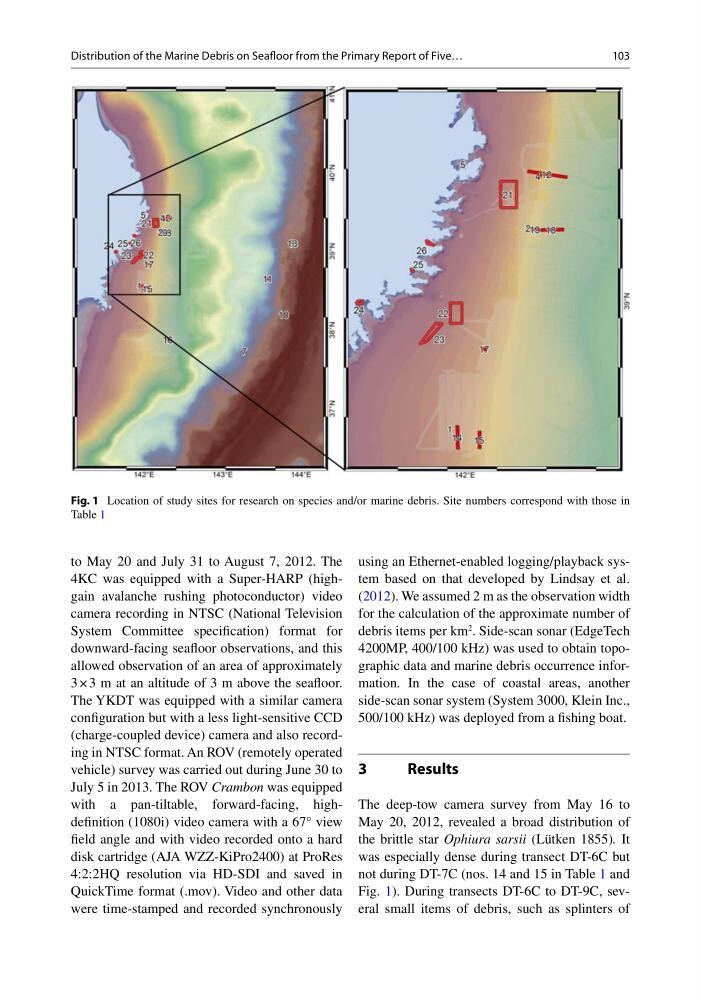
not during DT-7C (nos. 14 and 15 in Table 1 and
Fig. 1 ). During transects DT-6C to DT-9C, several small items of debris, such as splinters of
Fig. 1 Location of study sites for research on species and/or marine debris. Site numbers correspond with those in
Table 1
Distribution of the Marine Debris on Seafl oor from the Primary Report of Five…
to May 20 and July 31 to August 7, 2012. The
4KC was equipped with a Super-HARP (highgain avalanche rushing photoconductor) video
camera recording in NTSC (National Television
System Committee specifi cation) format for
downward-facing seafl oor observations, and this
allowed observation of an area of approximately
3 × 3 m at an altitude of 3 m above the seafl oor.
The YKDT was equipped with a similar camera
confi guration but with a less light-sensitive CCD
(charge-coupled device) camera and also recording in NTSC format. An ROV (remotely operated
vehicle) survey was carried out during June 30 to
July 5 in 2013. The ROV Crambon was equipped
with a pan-tiltable, forward-facing, highdefi nition (1080i) video camera with a 67° view
fi eld angle and with video recorded onto a hard
disk cartridge (AJA WZZ-KiPro2400) at ProRes
4:2:2HQ resolution via HD-SDI and saved in
QuickTime format (.mov). Video and other data
were time-stamped and recorded synchronously
using an Ethernet-enabled logging/playback system based on that developed by Lindsay et al.
( 2012 ). We assumed 2 m as the observation width
for the calculation of the approximate number of
debris items per km
2 . Side-scan sonar (EdgeTech
4200MP, 400/100 kHz) was used to obtain topographic data and marine debris occurrence information. In the case of coastal areas, another
side-scan sonar system (System 3000, Klein Inc.,
500/100 kHz) was deployed from a fi shing boat.
3
Results
The deep-tow camera survey from May 16 to
May 20, 2012, revealed a broad distribution of
the brittle star Ophiura sarsii (Lütken 1855). It
was especially dense during transect DT-6C but
not during DT-7C (nos. 14 and 15 in Table 1 and
Fig. 1 ). During transects DT-6C to DT-9C, several small items of debris, such as splinters of
Fig. 1 Location of study sites for research on species and/or marine debris. Site numbers correspond with those in
Table 1
Distribution of the Marine Debris on Seafl oor from the Primary Report of Five…