

73
coastal current (Honda et al. 2012 ); therefore,
bottom sediments and fi sh species in the area
south of FNPP (i.e., off Yotsukura) were most
contaminated (Otosaka and Kobayashi 2012 ;
Wada et al. 2013 ).
In general, rocky and sandy ecosystems are
populated by different species; therefore, in this
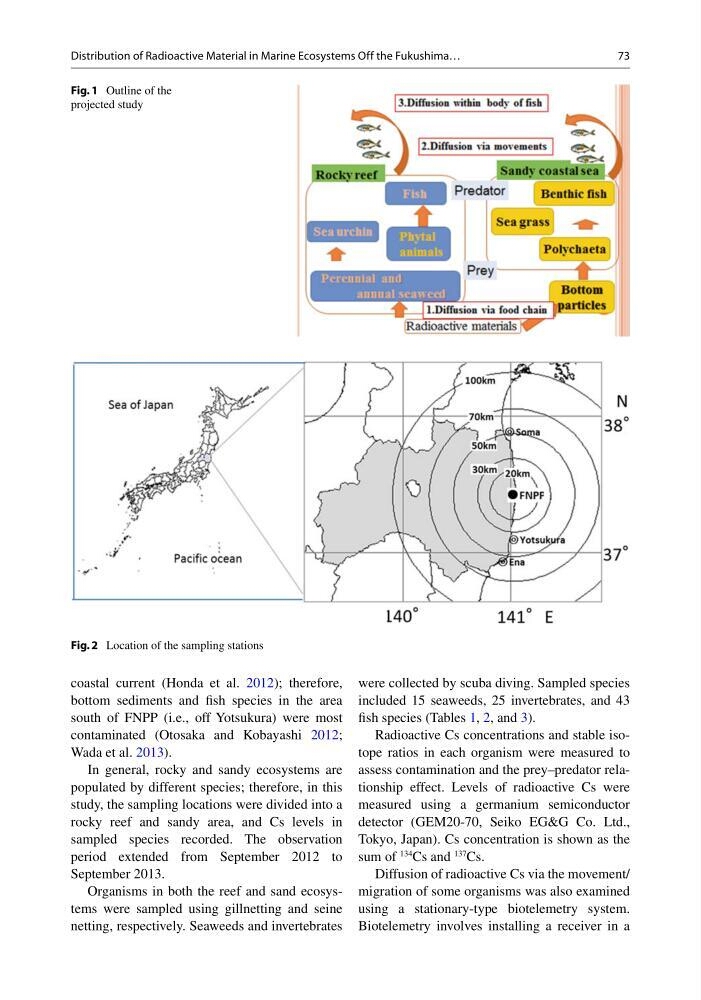
study, the sampling locations were divided into a
rocky reef and sandy area, and Cs levels in
sampled species recorded. The observation
period extended from September 2012 to
September 2013.
Organisms in both the reef and sand ecosystems were sampled using gillnetting and seine
netting, respectively. Seaweeds and invertebrates
were collected by scuba diving. Sampled species
included 15 seaweeds, 25 invertebrates, and 43
fi sh species (Tables 1 , 2 , and 3 ).
Radioactive Cs concentrations and stable isotope ratios in each organism were measured to
assess contamination and the prey–predator relationship effect. Levels of radioactive Cs were
measured using a germanium semiconductor
detector (GEM20-70, Seiko EG&G Co. Ltd.,
Tokyo, Japan). Cs concentration is shown as the
sum of
134 Cs and
137 Cs.
Diffusion of radioactive Cs via the movement/
migration of some organisms was also examined
using a stationary-type biotelemetry system.
Biotelemetry involves installing a receiver in a
Fig. 1 Outline of the
projected study
Fig. 2 Location of the sampling stations
Distribution of Radioactive Material in Marine Ecosystems Off the Fukushima…
coastal current (Honda et al. 2012 ); therefore,
bottom sediments and fi sh species in the area
south of FNPP (i.e., off Yotsukura) were most
contaminated (Otosaka and Kobayashi 2012 ;
Wada et al. 2013 ).
In general, rocky and sandy ecosystems are
populated by different species; therefore, in this
study, the sampling locations were divided into a
rocky reef and sandy area, and Cs levels in
sampled species recorded. The observation
period extended from September 2012 to
September 2013.
Organisms in both the reef and sand ecosystems were sampled using gillnetting and seine
netting, respectively. Seaweeds and invertebrates
were collected by scuba diving. Sampled species
included 15 seaweeds, 25 invertebrates, and 43
fi sh species (Tables 1 , 2 , and 3 ).
Radioactive Cs concentrations and stable isotope ratios in each organism were measured to
assess contamination and the prey–predator relationship effect. Levels of radioactive Cs were
measured using a germanium semiconductor
detector (GEM20-70, Seiko EG&G Co. Ltd.,
Tokyo, Japan). Cs concentration is shown as the
sum of
134 Cs and
137 Cs.
Diffusion of radioactive Cs via the movement/
migration of some organisms was also examined
using a stationary-type biotelemetry system.
Biotelemetry involves installing a receiver in a
Fig. 1 Outline of the
projected study
Fig. 2 Location of the sampling stations
Distribution of Radioactive Material in Marine Ecosystems Off the Fukushima…