

60
3 Economic Framework of Conservation
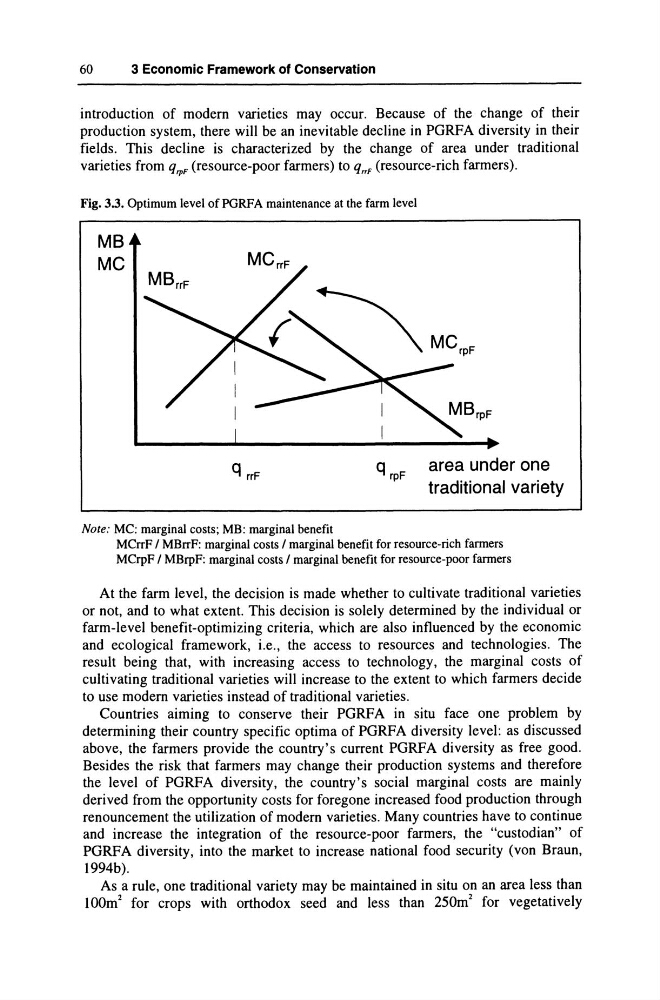
introduction of modern varietIes may occur. Because of the change of their
production system, there will be an inevitable decline in PGRFA diversity in their
fields. This decline is characterized by the change of area under traditional
varieties from qrpF (resource-poor farmers) to qrrF (resource-rich farmers).
Fig. 3.3. Optimum level of PGRFA maintenance at the farm level
MB
Me
q rrF
Note: MC: marginal costs; MB: marginal benefit
area under one
traditional variety
MCrrF I MBrrF: marginal costs I marginal benefit for resource-rich farmers
MCrpF I MBrpF: marginal costs I marginal benefit for resource-poor farmers
At the farm level, the decision is made whether to cultivate traditional varieties
or not, and to what extent. This decision is solely determined by the individual or
farm-level benefit-optimizing criteria, which are also influenced by the economic
and ecological framework, i.e., the access to resources and technologies. The
result being that, with increasing access to technology, the marginal costs of
cultivating traditional varieties will increase to the extent to which farmers decide
to use modern varieties instead of traditional varieties.
Countries aiming to conserve their PGRFA in situ face one problem by
determining their country specific optima of PGRFA diversity level: as discussed
above, the farmers provide the country's current PGRFA diversity as free good.
Besides the risk that farmers may change their production systems and therefore
the level of PGRFA diversity, the country's social marginal costs are mainly
derived from the opportunity costs for foregone increased food production through
renouncement the utilization of modern varieties. Many countries have to continue
and increase the integration of the resource-poor farmers, the "custodian" of
PGRFA diversity, into the market to increase national food security (von Braun,
1994b).
As a rule, one traditional variety may be maintained in situ on an area less than
100m 2 for crops with orthodox seed and less than 250m 2 for vegetatively
3 Economic Framework of Conservation
introduction of modern varietIes may occur. Because of the change of their
production system, there will be an inevitable decline in PGRFA diversity in their
fields. This decline is characterized by the change of area under traditional
varieties from qrpF (resource-poor farmers) to qrrF (resource-rich farmers).
Fig. 3.3. Optimum level of PGRFA maintenance at the farm level
MB
Me
q rrF
Note: MC: marginal costs; MB: marginal benefit
area under one
traditional variety
MCrrF I MBrrF: marginal costs I marginal benefit for resource-rich farmers
MCrpF I MBrpF: marginal costs I marginal benefit for resource-poor farmers
At the farm level, the decision is made whether to cultivate traditional varieties
or not, and to what extent. This decision is solely determined by the individual or
farm-level benefit-optimizing criteria, which are also influenced by the economic
and ecological framework, i.e., the access to resources and technologies. The
result being that, with increasing access to technology, the marginal costs of
cultivating traditional varieties will increase to the extent to which farmers decide
to use modern varieties instead of traditional varieties.
Countries aiming to conserve their PGRFA in situ face one problem by
determining their country specific optima of PGRFA diversity level: as discussed
above, the farmers provide the country's current PGRFA diversity as free good.
Besides the risk that farmers may change their production systems and therefore
the level of PGRFA diversity, the country's social marginal costs are mainly
derived from the opportunity costs for foregone increased food production through
renouncement the utilization of modern varieties. Many countries have to continue
and increase the integration of the resource-poor farmers, the "custodian" of
PGRFA diversity, into the market to increase national food security (von Braun,
1994b).
As a rule, one traditional variety may be maintained in situ on an area less than
100m 2 for crops with orthodox seed and less than 250m 2 for vegetatively