

3.2 Economic Valuation of Environmental Goods at a National Level
51
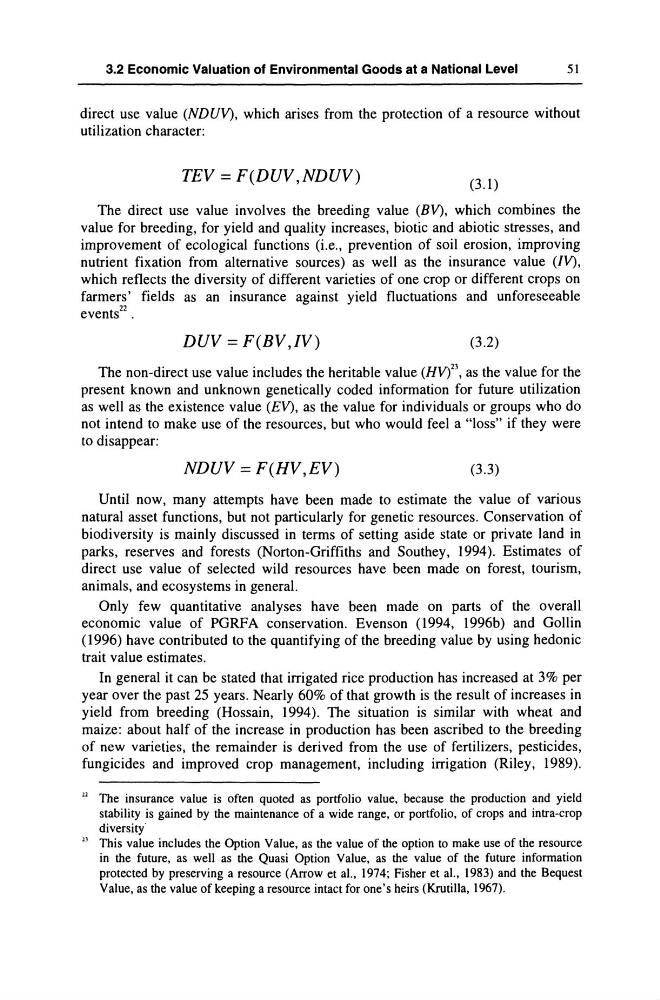
direct use value (NDUV), which arises from the protection of a resource without
utilization character:
TEV = F(DUV,NDUV)
(3.1)
The direct use value involves the breeding value (BV), which combines the
value for breeding, for yield and quality increases, biotic and abiotic stresses, and
improvement of ecological functions (i.e., prevention of soil erosion, improving
nutrient fixation from alternative sources) as well as the insurance value (IV),
which reflects the diversity of different varieties of one crop or different crops on
farmers' fields as an insurance against yield fluctuations and unforeseeable
events 22 •
DUV = F(BV,IV)
(3.2)
The non-direct use value includes the heritable value (HV)23, as the value for the
present known and unknown genetically coded information for future utilization
as well as the existence value (EV), as the value for individuals or groups who do
not intend to make use of the resources, but who would feel a "loss" if they were
to disappear:
NDUV = F(HV,EV)
(3.3)
Until now, many attempts have been made to estimate the value of various
natural asset functions, but not particularly for genetic resources. Conservation of
biodiversity is mainly discussed in terms of setting aside state or private land in
parks, reserves and forests (Norton-Griffiths and Southey, 1994). Estimates of
direct use value of selected wild resources have been made on forest, tourism,
animals, and ecosystems in general.
Only few quantitative analyses have been made on parts of the overall
economic value of PGRF A conservation. Evenson (1994, 1996b) and Gollin
(1996) have contributed to the quantifying of the breeding value by using hedonic
trait value estimates.
In general it can be stated that irrigated rice production has increased at 3% per
year over the past 25 years. Nearly 60% of that growth is the result of increases in
yield from breeding (Hossain, 1994). The situation is similar with wheat and
maize: about half of the increase in production has been ascribed to the breeding
of new varieties, the remainder is derived from the use of fertilizers, pesticides,
fungicides and improved crop management, including irrigation (Riley, 1989).
21
The insurance value is often quoted as portfolio value, because the production and yield
stability is gained by the maintenance of a wide range, or portfolio, of crops and intra-crop
diversity·
" This value includes the Option Value, as the value of the option to make use of the resource
in the future, as well as the Quasi Option Value, as the value of the future information
protected by preserving a resource (Arrow et aI., 1974; Fisher et aI., 1983) and the Bequest
Value, as the value of keeping a resource intact for one's heirs (Krutilla, 1967).
51
direct use value (NDUV), which arises from the protection of a resource without
utilization character:
TEV = F(DUV,NDUV)
(3.1)
The direct use value involves the breeding value (BV), which combines the
value for breeding, for yield and quality increases, biotic and abiotic stresses, and
improvement of ecological functions (i.e., prevention of soil erosion, improving
nutrient fixation from alternative sources) as well as the insurance value (IV),
which reflects the diversity of different varieties of one crop or different crops on
farmers' fields as an insurance against yield fluctuations and unforeseeable
events 22 •
DUV = F(BV,IV)
(3.2)
The non-direct use value includes the heritable value (HV)23, as the value for the
present known and unknown genetically coded information for future utilization
as well as the existence value (EV), as the value for individuals or groups who do
not intend to make use of the resources, but who would feel a "loss" if they were
to disappear:
NDUV = F(HV,EV)
(3.3)
Until now, many attempts have been made to estimate the value of various
natural asset functions, but not particularly for genetic resources. Conservation of
biodiversity is mainly discussed in terms of setting aside state or private land in
parks, reserves and forests (Norton-Griffiths and Southey, 1994). Estimates of
direct use value of selected wild resources have been made on forest, tourism,
animals, and ecosystems in general.
Only few quantitative analyses have been made on parts of the overall
economic value of PGRF A conservation. Evenson (1994, 1996b) and Gollin
(1996) have contributed to the quantifying of the breeding value by using hedonic
trait value estimates.
In general it can be stated that irrigated rice production has increased at 3% per
year over the past 25 years. Nearly 60% of that growth is the result of increases in
yield from breeding (Hossain, 1994). The situation is similar with wheat and
maize: about half of the increase in production has been ascribed to the breeding
of new varieties, the remainder is derived from the use of fertilizers, pesticides,
fungicides and improved crop management, including irrigation (Riley, 1989).
21
The insurance value is often quoted as portfolio value, because the production and yield
stability is gained by the maintenance of a wide range, or portfolio, of crops and intra-crop
diversity·
" This value includes the Option Value, as the value of the option to make use of the resource
in the future, as well as the Quasi Option Value, as the value of the future information
protected by preserving a resource (Arrow et aI., 1974; Fisher et aI., 1983) and the Bequest
Value, as the value of keeping a resource intact for one's heirs (Krutilla, 1967).