

36
2 Genetic Resources: Status, Development, Losses, and Conservation
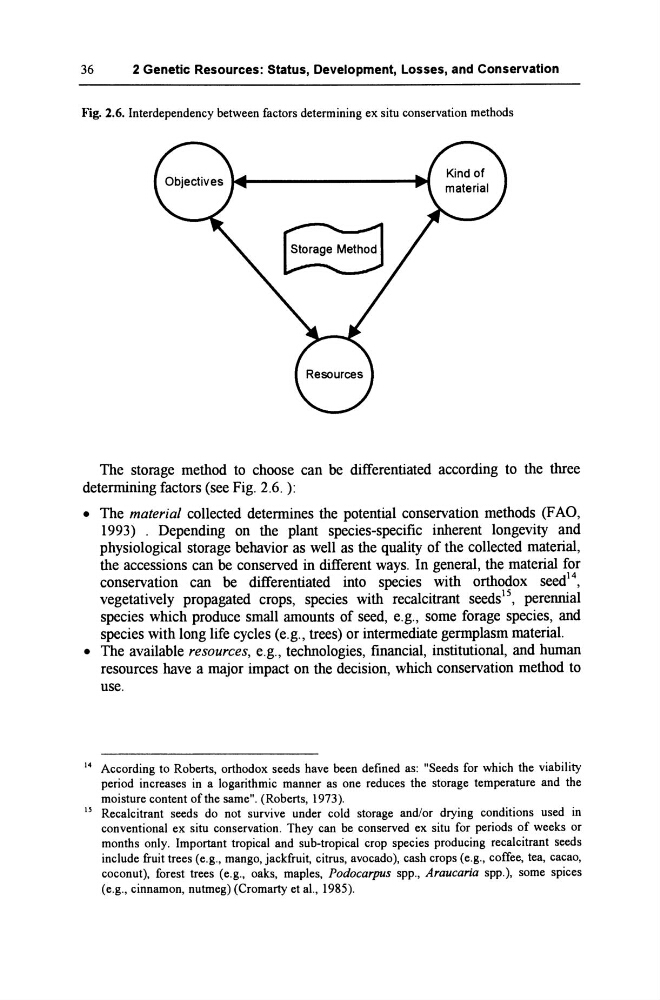
Fig. 2.6. Interdependency between factors determining ex situ conservation methods
Storage Method
The storage method to choose can be differentiated according to the three
determining factors (see Fig. 2.6. ):
• The material collected determines the potential conservation methods (F AO,
1993) . Depending on the plant species-specific inherent longevity and
physiological storage behavior as well as the quality of the collected material,
the accessions can be conserved in different ways. In general, the material for
conservation can be differentiated into species with orthodox seed l4 ,
vegetatively propagated crops, species with recalcitrant seeds l5 , perennial
species which produce small amounts of seed, e.g., some forage species, and
species with long life cycles (e.g., trees) or intermediate germplasm material.
• The available resources, e.g., technologies, financial, institutional, and human
resources have a major impact on the decision, which conservation method to
use.
14 According to Roberts, orthodox seeds have been defined as: "Seeds for which the viability
period increases in a logarithmic manner as one reduces the storage temperature and the
moisture content of the same". (Roberts, 1973).
IS Recalcitrant seeds do not survive under cold storage and/or drying conditions used in
conventional ex situ conservation. They can be conserved ex situ for periods of weeks or
months only. Important tropical and sub-tropical crop species producing recalcitrant seeds
include fruit trees (e.g., mango, jackfruit, citrus, avocado), cash crops (e.g., coffee, tea, cacao,
coconut), forest trees (e.g., oaks, maples, Podocarpus spp., Araucaria spp.), some spices
(e.g., cinnamon, nutmeg) (Cromarty et aI., 1985).
2 Genetic Resources: Status, Development, Losses, and Conservation
Fig. 2.6. Interdependency between factors determining ex situ conservation methods
Storage Method
The storage method to choose can be differentiated according to the three
determining factors (see Fig. 2.6. ):
• The material collected determines the potential conservation methods (F AO,
1993) . Depending on the plant species-specific inherent longevity and
physiological storage behavior as well as the quality of the collected material,
the accessions can be conserved in different ways. In general, the material for
conservation can be differentiated into species with orthodox seed l4 ,
vegetatively propagated crops, species with recalcitrant seeds l5 , perennial
species which produce small amounts of seed, e.g., some forage species, and
species with long life cycles (e.g., trees) or intermediate germplasm material.
• The available resources, e.g., technologies, financial, institutional, and human
resources have a major impact on the decision, which conservation method to
use.
14 According to Roberts, orthodox seeds have been defined as: "Seeds for which the viability
period increases in a logarithmic manner as one reduces the storage temperature and the
moisture content of the same". (Roberts, 1973).
IS Recalcitrant seeds do not survive under cold storage and/or drying conditions used in
conventional ex situ conservation. They can be conserved ex situ for periods of weeks or
months only. Important tropical and sub-tropical crop species producing recalcitrant seeds
include fruit trees (e.g., mango, jackfruit, citrus, avocado), cash crops (e.g., coffee, tea, cacao,
coconut), forest trees (e.g., oaks, maples, Podocarpus spp., Araucaria spp.), some spices
(e.g., cinnamon, nutmeg) (Cromarty et aI., 1985).