

2.2 Extent and Determinants of Genetic Extinction
23
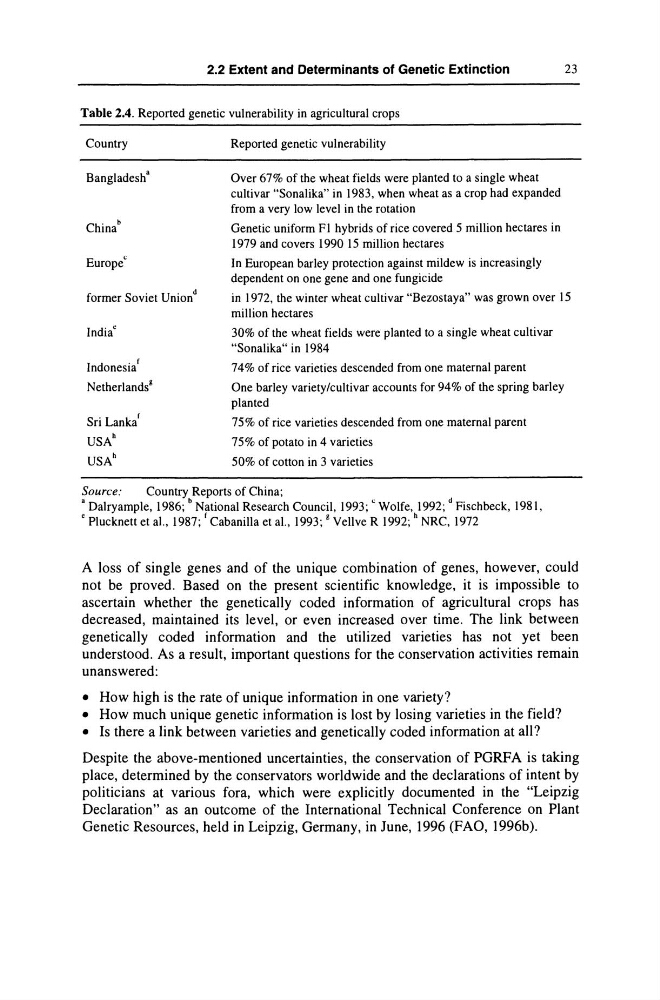
Table 2.4. Reported genetic vulnerability in agricultural crops
Country
Bangladesh"
Europe c
former Soviet Union d
India·
Indonesia f
Netherlands l
Sri Lanka
f
USA
h
USA
h
Reported genetic vulnerability
Over 67% of the wheat fields were planted to a single wheat
cultivar "Sonalika" in 1983, when wheat as a crop had expanded
from a very low level in the rotation
Genetic uniform FI hybrids ofrice covered 5 million hectares in
1979 and covers 1990 IS million hectares
In European barley protection against mildew is increasingly
dependent on one gene and one fungicide
in 1972, the winter wheat cultivar "Bezostaya" was grown over IS
million hectares
30% of the wheat fields were planted to a single wheat cultivar
"Sonalika" in 1984
74% of rice varieties descended from one maternal parent
One barley variety/cultivar accounts for 94% of the spring barley
planted
75% of rice varieties descended from one maternal parent
75% of potato in 4 varieties
50% of cotton in 3 varieties
Source:
Country Reports of China;
"Dalryample, 1986; b National Research Council, 1993; c Wolfe, 1992; d Fischbeck, 1981,
e Plucknett et aI., 1987; f Cabanilla et aI., 1993; I Vellve R 1992; h NRC, 1972
A loss of single genes and of the unique combination of genes, however, could
not be proved. Based on the present scientific knowledge, it is impossible to
ascertain whether the genetically coded information of agricultural crops has
decreased, maintained its level, or even increased over time. The link between
genetically coded information and the utilized varieties has not yet been
understood. As a result, important questions for the conservation activities remain
unanswered:
• How high is the rate of unique information in one variety?
• How much unique genetic information is lost by losing varieties in the field?
• Is there a link between varieties and genetically coded information at all?
Despite the above-mentioned uncertainties, the conservation of PGRFA is taking
place, determined by the conservators worldwide and the declarations of intent by
politicians at various fora, which were explicitly documented in the "Leipzig
Declaration" as an outcome of the International Technical Conference on Plant
Genetic Resources, held in Leipzig, Germany, in June, 1996 (FAD, 1996b).
23
Table 2.4. Reported genetic vulnerability in agricultural crops
Country
Bangladesh"
Europe c
former Soviet Union d
India·
Indonesia f
Netherlands l
Sri Lanka
f
USA
h
USA
h
Reported genetic vulnerability
Over 67% of the wheat fields were planted to a single wheat
cultivar "Sonalika" in 1983, when wheat as a crop had expanded
from a very low level in the rotation
Genetic uniform FI hybrids ofrice covered 5 million hectares in
1979 and covers 1990 IS million hectares
In European barley protection against mildew is increasingly
dependent on one gene and one fungicide
in 1972, the winter wheat cultivar "Bezostaya" was grown over IS
million hectares
30% of the wheat fields were planted to a single wheat cultivar
"Sonalika" in 1984
74% of rice varieties descended from one maternal parent
One barley variety/cultivar accounts for 94% of the spring barley
planted
75% of rice varieties descended from one maternal parent
75% of potato in 4 varieties
50% of cotton in 3 varieties
Source:
Country Reports of China;
"Dalryample, 1986; b National Research Council, 1993; c Wolfe, 1992; d Fischbeck, 1981,
e Plucknett et aI., 1987; f Cabanilla et aI., 1993; I Vellve R 1992; h NRC, 1972
A loss of single genes and of the unique combination of genes, however, could
not be proved. Based on the present scientific knowledge, it is impossible to
ascertain whether the genetically coded information of agricultural crops has
decreased, maintained its level, or even increased over time. The link between
genetically coded information and the utilized varieties has not yet been
understood. As a result, important questions for the conservation activities remain
unanswered:
• How high is the rate of unique information in one variety?
• How much unique genetic information is lost by losing varieties in the field?
• Is there a link between varieties and genetically coded information at all?
Despite the above-mentioned uncertainties, the conservation of PGRFA is taking
place, determined by the conservators worldwide and the declarations of intent by
politicians at various fora, which were explicitly documented in the "Leipzig
Declaration" as an outcome of the International Technical Conference on Plant
Genetic Resources, held in Leipzig, Germany, in June, 1996 (FAD, 1996b).