

2.2 Extent and Determinants of Genetic Extinction
21
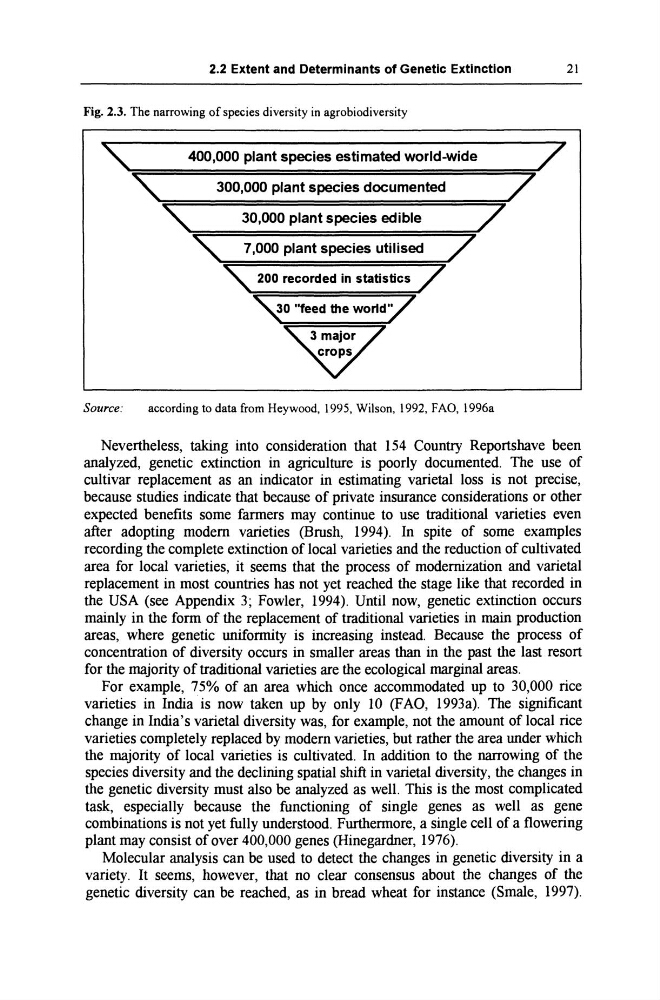
Fig. 2.3. The narrowing of species diversity in agrobiodiversity
400,000 plant species estimated world-wide
"\:
300,000 plant species documented
7
"\:
30,000 plant species edible
7
"\:
7 ,000 plant species utilised
7
' \ : 200 recorded in statistics 7
~o "feed the wortd/
Source:
according to data from Heywood, 1995, Wilson, 1992, FAD, 1996a
Nevertheless, taking into consideration that 154 Country Reportshave been
analyzed, genetic extinction in agriculture is poorly documented. The use of
cultivar replacement as an indicator in estimating varietal loss is not precise,
because studies indicate that because of private insurance considerations or other
expected benefits some farmers may continue to use traditional varieties even
after adopting modern varieties (Brush, 1994). In spite of some examples
recording the complete extinction of local varieties and the reduction of cultivated
area for local varieties, it seems that the process of modernization and varietal
replacement in most countries has not yet reached the stage like that recorded in
the USA (see Appendix 3; Fowler, 1994). Until now, genetic extinction occurs
mainly in the form of the replacement of traditional varieties in main production
areas, where genetic uniformity is increasing instead. Because the process of
concentration of diversity occurs in smaller areas than in the past the last resort
for the majority of traditional varieties are the ecological marginal areas.
For example, 75% of an area which once accommodated up to 30,000 rice
varieties in India is now taken up by only 10 (F AO, 1993a). The significant
change in India's varietal diversity was, for example, not the amount of local rice
varieties completely replaced by modern varieties, but rather the area under which
the majority of local varieties is cultivated. In addition to the narrowing of the
species diversity and the declining spatial shift in varietal diversity, the changes in
the genetic diversity must also be analyzed as well. This is the most complicated
task, especially because the functioning of single genes as well as gene
combinations is not yet fully understood. Furthermore, a single cell of a flowering
plant may consist of over 400,000 genes (Hinegardner, 1976).
Molecular analysis can be used to detect the changes in genetic diversity in a
variety. It seems, however, that no clear consensus about the changes of the
genetic diversity can be reached, as in bread wheat for instance (Smale, 1997).
21
Fig. 2.3. The narrowing of species diversity in agrobiodiversity
400,000 plant species estimated world-wide
"\:
300,000 plant species documented
7
"\:
30,000 plant species edible
7
"\:
7 ,000 plant species utilised
7
' \ : 200 recorded in statistics 7
~o "feed the wortd/
Source:
according to data from Heywood, 1995, Wilson, 1992, FAD, 1996a
Nevertheless, taking into consideration that 154 Country Reportshave been
analyzed, genetic extinction in agriculture is poorly documented. The use of
cultivar replacement as an indicator in estimating varietal loss is not precise,
because studies indicate that because of private insurance considerations or other
expected benefits some farmers may continue to use traditional varieties even
after adopting modern varieties (Brush, 1994). In spite of some examples
recording the complete extinction of local varieties and the reduction of cultivated
area for local varieties, it seems that the process of modernization and varietal
replacement in most countries has not yet reached the stage like that recorded in
the USA (see Appendix 3; Fowler, 1994). Until now, genetic extinction occurs
mainly in the form of the replacement of traditional varieties in main production
areas, where genetic uniformity is increasing instead. Because the process of
concentration of diversity occurs in smaller areas than in the past the last resort
for the majority of traditional varieties are the ecological marginal areas.
For example, 75% of an area which once accommodated up to 30,000 rice
varieties in India is now taken up by only 10 (F AO, 1993a). The significant
change in India's varietal diversity was, for example, not the amount of local rice
varieties completely replaced by modern varieties, but rather the area under which
the majority of local varieties is cultivated. In addition to the narrowing of the
species diversity and the declining spatial shift in varietal diversity, the changes in
the genetic diversity must also be analyzed as well. This is the most complicated
task, especially because the functioning of single genes as well as gene
combinations is not yet fully understood. Furthermore, a single cell of a flowering
plant may consist of over 400,000 genes (Hinegardner, 1976).
Molecular analysis can be used to detect the changes in genetic diversity in a
variety. It seems, however, that no clear consensus about the changes of the
genetic diversity can be reached, as in bread wheat for instance (Smale, 1997).