

5.4 Effectiveness of PGRFA Conservation for Analyzed Countries 149
« tl..
~
~
p..
""' 0
'"
Q)
'"
~
Q)
=
=
Q)
0
0
>
ti
~.:::
!
E
os
"E =
~
Q)
~
os e
bI)
"'0 :::s
~
=
=
.3
s 8
1Zl"'O
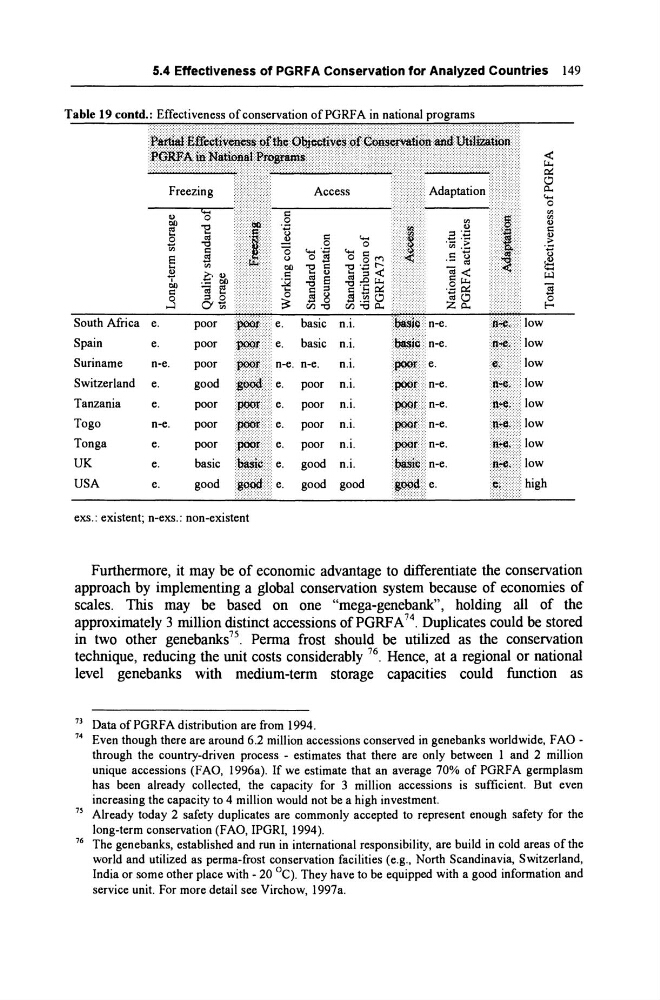
South Africa e.
poor
basic n.!.
low
Spain
e.
poor
basic n.i.
low
Suriname
n-e.
poor
n.!.
low
Switzerland e.
good
poor n.!.
low
Tanzania
e.
poor
poor n.i.
low
Togo
n-e.
poor
poor n.!.
low
Tonga
e.
poor
poor n.!.
low
UK
e.
basic
good n.i.
low
USA
e.
good
good good
high
exs.: existent; n-exs.: non-existent
Furthermore, it may be of economic advantage to differentiate the conservation
approach by implementing a global conservation system because of economies of
scales. This may be based on one "mega-genebank", holding all of the
approximately 3 million distinct accessions of PGRF A 74. Duplicates could be stored
in two other genebanks 75 . Perma frost should be utilized as the conservation
technique, reducing the unit costs considerably 76. Hence, at a regional or national
level genebanks with medium-term storage capacities could function as
73 Data ofPGRFA distribution are from 1994.
74 Even though there are around 6.2 million accessions conserved in genebanks worldwide, F AO -
through the country-driven process - estimates that there are only between 1 and 2 million
unique accessions (FAO, 1996a). If we estimate that an average 70% of PGRFA germplasm
has been already collected, the capacity for 3 million accessions is sufficient. But even
increasing the capacity to 4 million would not be a high investment.
75 Already today 2 safety duplicates are commonly accepted to represent enough safety for the
long-term conservation (FAO, IPGRI, 1994).
76 The genebanks, established and run in international responsibility, are build in cold areas of the
world and utilized as perma-frost conservation facilities (e.g., North Scandinavia, Switzerland,
India or some other place with - 20 0C). They have to be equipped with a good information and
service unit. For more detail see Virchow, 1997a.
« tl..
~
~
p..
""' 0
'"
Q)
'"
~
Q)
=
=
Q)
0
0
>
ti
~.:::
!
E
os
"E =
~
Q)
~
os e
bI)
"'0 :::s
~
=
=
.3
s 8
1Zl"'O
South Africa e.
poor
basic n.!.
low
Spain
e.
poor
basic n.i.
low
Suriname
n-e.
poor
n.!.
low
Switzerland e.
good
poor n.!.
low
Tanzania
e.
poor
poor n.i.
low
Togo
n-e.
poor
poor n.!.
low
Tonga
e.
poor
poor n.!.
low
UK
e.
basic
good n.i.
low
USA
e.
good
good good
high
exs.: existent; n-exs.: non-existent
Furthermore, it may be of economic advantage to differentiate the conservation
approach by implementing a global conservation system because of economies of
scales. This may be based on one "mega-genebank", holding all of the
approximately 3 million distinct accessions of PGRF A 74. Duplicates could be stored
in two other genebanks 75 . Perma frost should be utilized as the conservation
technique, reducing the unit costs considerably 76. Hence, at a regional or national
level genebanks with medium-term storage capacities could function as
73 Data ofPGRFA distribution are from 1994.
74 Even though there are around 6.2 million accessions conserved in genebanks worldwide, F AO -
through the country-driven process - estimates that there are only between 1 and 2 million
unique accessions (FAO, 1996a). If we estimate that an average 70% of PGRFA germplasm
has been already collected, the capacity for 3 million accessions is sufficient. But even
increasing the capacity to 4 million would not be a high investment.
75 Already today 2 safety duplicates are commonly accepted to represent enough safety for the
long-term conservation (FAO, IPGRI, 1994).
76 The genebanks, established and run in international responsibility, are build in cold areas of the
world and utilized as perma-frost conservation facilities (e.g., North Scandinavia, Switzerland,
India or some other place with - 20 0C). They have to be equipped with a good information and
service unit. For more detail see Virchow, 1997a.