

5.4 Effectiveness of PGRFA Conservation for Analyzed Countries 147
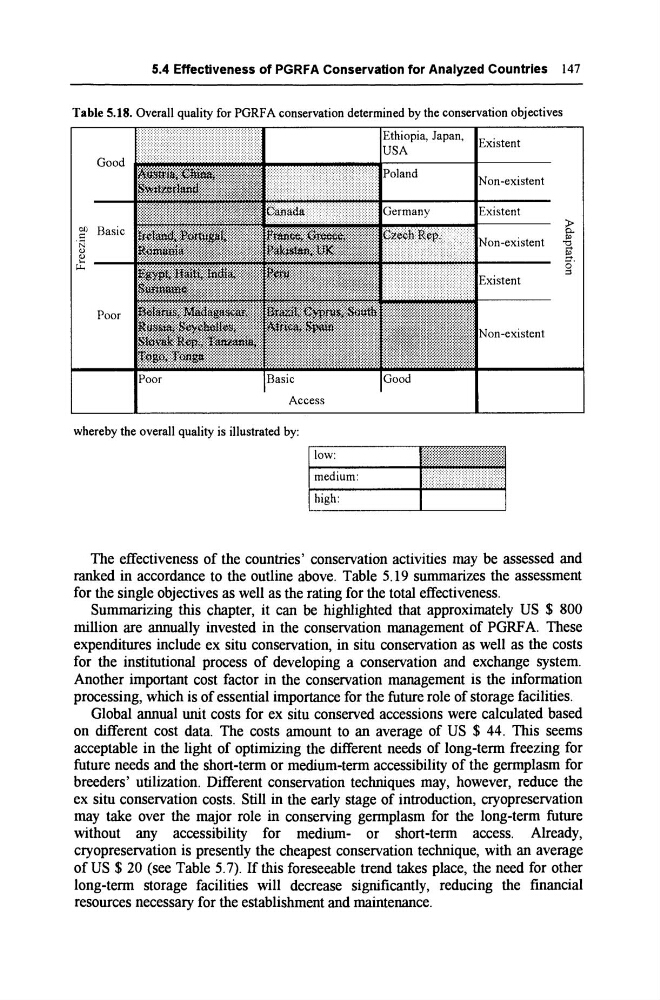
Table S.lS. Overall quality for PGRFA conservation determined by the conservation objectives
whereby the overall quality is illustrated by:
The effectiveness of the countries' conservation activities may be assessed and
ranked in accordance to the outline above. Table 5.19 summarizes the assessment
for the single objectives as well as the rating for the total effectiveness.
Summarizing this chapter, it can be highlighted that approximately US $ 800
million are annually invested in the conservation management of PGRF A. These
expenditures include ex situ conservation, in situ conservation as well as the costs
for the institutional process of developing a conservation and exchange system.
Another important cost factor in the conservation management is the information
processing, which is of essential importance for the future role of storage facilities.
Global annual unit costs for ex situ conserved accessions were calculated based
on different cost data. The costs amount to an average of US $ 44. This seems
acceptable in the light of optimizing the different needs of long-term freezing for
future needs and the short-term or medium-term accessibility of the germplasm for
breeders' utilization. Different conservation techniques may, however, reduce the
ex situ conservation costs. Still in the early stage of introduction, cryopreservation
may take over the major role in conserving germplasm for the long-term future
without any accessibility for medium- or short-term access. Already,
cryopreservation is presently the cheapest conservation technique, with an average
of US $ 20 (see Table 5.7). If this foreseeable trend takes place, the need for other
long-term storage facilities will decrease significantly, reducing the financial
resources necessary for the establishment and maintenance.
Table S.lS. Overall quality for PGRFA conservation determined by the conservation objectives
whereby the overall quality is illustrated by:
The effectiveness of the countries' conservation activities may be assessed and
ranked in accordance to the outline above. Table 5.19 summarizes the assessment
for the single objectives as well as the rating for the total effectiveness.
Summarizing this chapter, it can be highlighted that approximately US $ 800
million are annually invested in the conservation management of PGRF A. These
expenditures include ex situ conservation, in situ conservation as well as the costs
for the institutional process of developing a conservation and exchange system.
Another important cost factor in the conservation management is the information
processing, which is of essential importance for the future role of storage facilities.
Global annual unit costs for ex situ conserved accessions were calculated based
on different cost data. The costs amount to an average of US $ 44. This seems
acceptable in the light of optimizing the different needs of long-term freezing for
future needs and the short-term or medium-term accessibility of the germplasm for
breeders' utilization. Different conservation techniques may, however, reduce the
ex situ conservation costs. Still in the early stage of introduction, cryopreservation
may take over the major role in conserving germplasm for the long-term future
without any accessibility for medium- or short-term access. Already,
cryopreservation is presently the cheapest conservation technique, with an average
of US $ 20 (see Table 5.7). If this foreseeable trend takes place, the need for other
long-term storage facilities will decrease significantly, reducing the financial
resources necessary for the establishment and maintenance.