

5.4 Effectiveness of PGRFA Conservation for Analyzed Countries 143
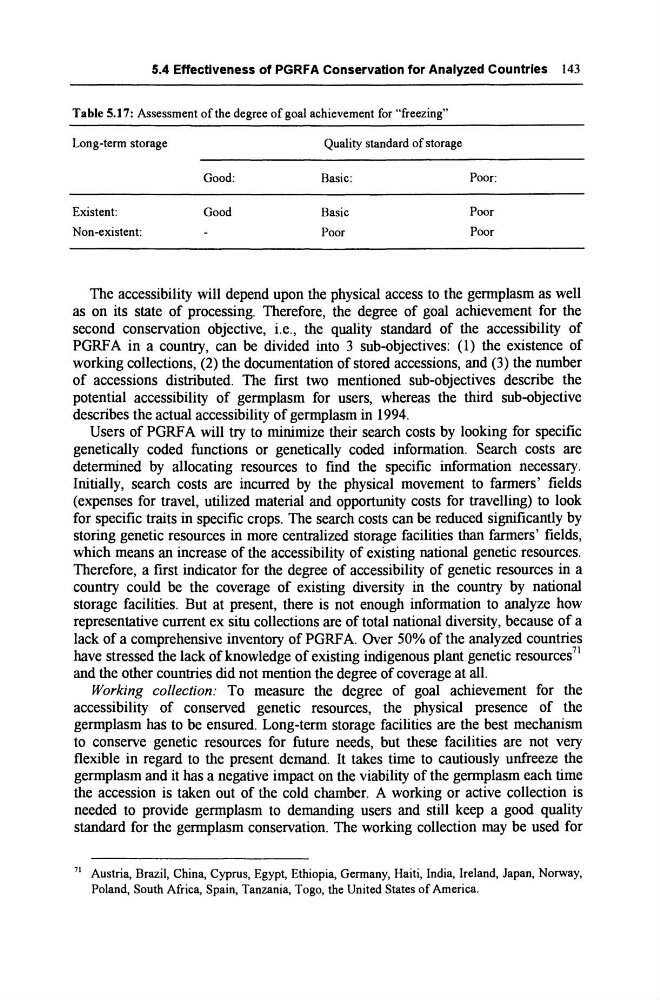
Table 5.17: Assessment of the degree of goal achievement for "freezing"
Long-term storage
Existent:
Non-existent:
Good:
Good
Quality standard of storage
Basic:
Basic
Poor
Poor:
Poor
Poor
The accessibility will depend upon the physical access to the germplasm as well
as on its state of processing. Therefore, the degree of goal achievement for the
second conservation objective, i.e., the quality standard of the accessibility of
PGRFA in a country, can be divided into 3 sub-objectives: (1) the existence of
working collections, (2) the documentation of stored accessions, and (3) the number
of accessions distributed. The first two mentioned sub-objectives describe the
potential accessibility of germplasm for users, whereas the third sub-objective
describes the actual accessibility of germplasm in 1994.
Users of PGRF A will try to minimize their search costs by looking for specific
genetically coded functions or genetically coded information. Search costs are
determined by allocating resources to find the specific information necessary.
Initially, search costs are incurred by the physical movement to farmers' fields
(expenses for travel, utilized material and opportunity costs for travelling) to look
for specific traits in specific crops. The search costs can be reduced significantly by
storing genetic resources in more centralized storage facilities than farmers' fields,
which means an increase of the accessibility of existing national genetic resources.
Therefore, a first indicator for the degree of accessibility of genetic resources in a
country could be the coverage of existing diversity in the country by national
storage facilities. But at present, there is not enough information to analyze how
representative current ex situ collections are of total national diversity, because of a
lack of a comprehensive inventory of PGRF A. Over 50% of the analyzed countries
have stressed the lack of knowledge of existing indigenous plant genetic resources 71
and the other countries did not mention the degree of coverage at all.
Working collection: To measure the degree of goal achievement for the
accessibility of conserved genetic resources, the physical presence of the
germplasm has to be ensured. Long-term storage facilities are the best mechanism
to conserve genetic resources for future needs, but these facilities are not very
flexible in regard to the present demand. It takes time to cautiously unfreeze the
germplasm and it has a negative impact on the viability of the germplasm each time
the accession is taken out of the cold chamber. A working or active collection is
needed to provide germplasm to demanding users and still keep a good quality
standard for the germplasm conservation. The working collection may be used for
71 Austria, Brazil, China, Cyprus, Egypt, Ethiopia, Germany, Haiti, India, Ireland, Japan, Norway,
Poland, South Africa, Spain, Tanzania, Togo, the United States of America.
Table 5.17: Assessment of the degree of goal achievement for "freezing"
Long-term storage
Existent:
Non-existent:
Good:
Good
Quality standard of storage
Basic:
Basic
Poor
Poor:
Poor
Poor
The accessibility will depend upon the physical access to the germplasm as well
as on its state of processing. Therefore, the degree of goal achievement for the
second conservation objective, i.e., the quality standard of the accessibility of
PGRFA in a country, can be divided into 3 sub-objectives: (1) the existence of
working collections, (2) the documentation of stored accessions, and (3) the number
of accessions distributed. The first two mentioned sub-objectives describe the
potential accessibility of germplasm for users, whereas the third sub-objective
describes the actual accessibility of germplasm in 1994.
Users of PGRF A will try to minimize their search costs by looking for specific
genetically coded functions or genetically coded information. Search costs are
determined by allocating resources to find the specific information necessary.
Initially, search costs are incurred by the physical movement to farmers' fields
(expenses for travel, utilized material and opportunity costs for travelling) to look
for specific traits in specific crops. The search costs can be reduced significantly by
storing genetic resources in more centralized storage facilities than farmers' fields,
which means an increase of the accessibility of existing national genetic resources.
Therefore, a first indicator for the degree of accessibility of genetic resources in a
country could be the coverage of existing diversity in the country by national
storage facilities. But at present, there is not enough information to analyze how
representative current ex situ collections are of total national diversity, because of a
lack of a comprehensive inventory of PGRF A. Over 50% of the analyzed countries
have stressed the lack of knowledge of existing indigenous plant genetic resources 71
and the other countries did not mention the degree of coverage at all.
Working collection: To measure the degree of goal achievement for the
accessibility of conserved genetic resources, the physical presence of the
germplasm has to be ensured. Long-term storage facilities are the best mechanism
to conserve genetic resources for future needs, but these facilities are not very
flexible in regard to the present demand. It takes time to cautiously unfreeze the
germplasm and it has a negative impact on the viability of the germplasm each time
the accession is taken out of the cold chamber. A working or active collection is
needed to provide germplasm to demanding users and still keep a good quality
standard for the germplasm conservation. The working collection may be used for
71 Austria, Brazil, China, Cyprus, Egypt, Ethiopia, Germany, Haiti, India, Ireland, Japan, Norway,
Poland, South Africa, Spain, Tanzania, Togo, the United States of America.