

5.4 Effectiveness of PGRFA Conservation for Analyzed Countries 141
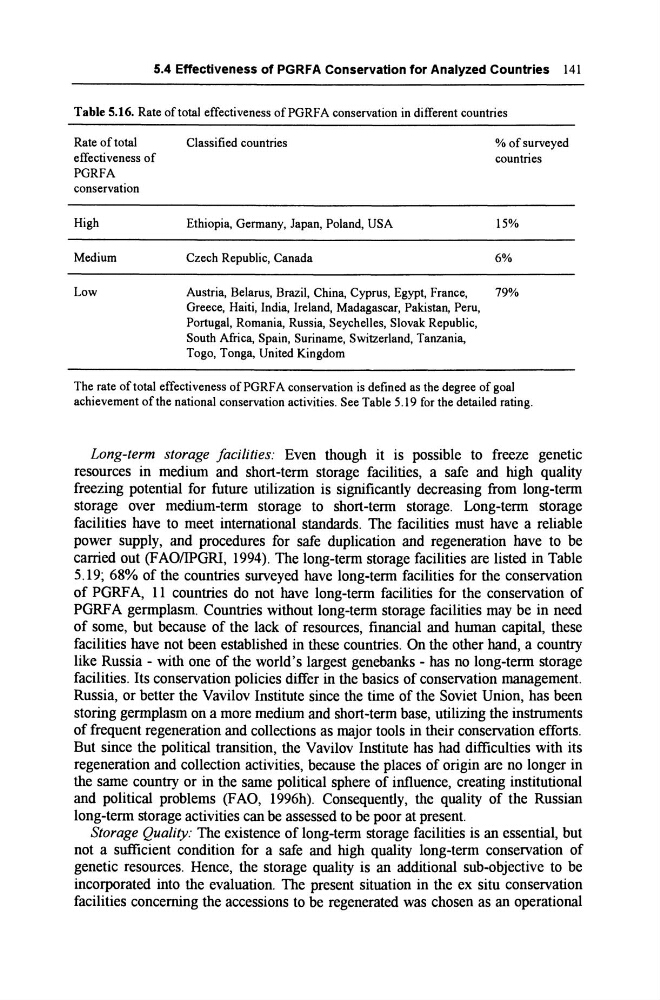
Table 5.16. Rate of total effectiveness ofPGRFA conservation in different countries
Rate of total
effectiveness of
PGRFA
conservation
High
Medium
Low
Classified countries
% of surveyed
countries
Ethiopia, Germany, Japan, Poland, USA
15%
Czech Republic, Canada
6%
Austria, Belarus, Brazil, China, Cyprus, Egypt, France,
79%
Greece, Haiti, India, Ireland, Madagascar, Pakistan, Peru,
Portugal, Romania, Russia, Seychelles, Slovak Republic,
South Africa, Spain, Suriname, Switzerland, Tanzania,
Togo, Tonga, United Kingdom
The rate of total effectiveness of PGRF A conservation is defined as the degree of goal
achievement of the national conservation activities. See Table 5.19 for the detailed rating.
Long-term storage facilities: Even though it is possible to freeze genetic
resources in medium and short-term storage facilities, a safe and high quality
freezing potential for future utilization is significantly decreasing from long-term
storage over medium-term storage to short-term storage. Long-term storage
facilities have to meet international standards. The facilities must have a reliable
power supply, and procedures for safe duplication and regeneration have to be
carried out (FAOIIPGRI, 1994). The long-term storage facilities are listed in Table
5.19; 68% of the countries surveyed have long-term facilities for the conservation
of PGRF A, 11 countries do not have long-term facilities for the conservation of
PGRF A germplasm. Countries without long-term storage facilities may be in need
of some, but because of the lack of resources, financial and human capital, these
facilities have not been established in these countries. On the other hand, a country
like Russia - with one of the world's largest genebanks - has no long-term storage
facilities. Its conservation policies differ in the basics of conservation management.
Russia, or better the Vavilov Institute since the time of the Soviet Union, has been
storing germplasm on a more medium and short -term base, utilizing the instruments
of frequent regeneration and collections as major tools in their conservation efforts.
But since the political transition, the Vavilov Institute has had difficulties with its
regeneration and collection activities, because the places of origin are no longer in
the same country or in the same political sphere of influence, creating institutional
and political problems (FAO, 1996h). Consequently, the quality of the Russian
long-term storage activities can be assessed to be poor at present.
Storage Quality: The existence of long-term storage facilities is an essential, but
not a sufficient condition for a safe and high quality long-term conservation of
genetic resources. Hence, the storage quality is an additional sub-objective to be
incorporated into the evaluation. The present situation in the ex situ conservation
facilities concerning the accessions to be regenerated was chosen as an operational
Table 5.16. Rate of total effectiveness ofPGRFA conservation in different countries
Rate of total
effectiveness of
PGRFA
conservation
High
Medium
Low
Classified countries
% of surveyed
countries
Ethiopia, Germany, Japan, Poland, USA
15%
Czech Republic, Canada
6%
Austria, Belarus, Brazil, China, Cyprus, Egypt, France,
79%
Greece, Haiti, India, Ireland, Madagascar, Pakistan, Peru,
Portugal, Romania, Russia, Seychelles, Slovak Republic,
South Africa, Spain, Suriname, Switzerland, Tanzania,
Togo, Tonga, United Kingdom
The rate of total effectiveness of PGRF A conservation is defined as the degree of goal
achievement of the national conservation activities. See Table 5.19 for the detailed rating.
Long-term storage facilities: Even though it is possible to freeze genetic
resources in medium and short-term storage facilities, a safe and high quality
freezing potential for future utilization is significantly decreasing from long-term
storage over medium-term storage to short-term storage. Long-term storage
facilities have to meet international standards. The facilities must have a reliable
power supply, and procedures for safe duplication and regeneration have to be
carried out (FAOIIPGRI, 1994). The long-term storage facilities are listed in Table
5.19; 68% of the countries surveyed have long-term facilities for the conservation
of PGRF A, 11 countries do not have long-term facilities for the conservation of
PGRF A germplasm. Countries without long-term storage facilities may be in need
of some, but because of the lack of resources, financial and human capital, these
facilities have not been established in these countries. On the other hand, a country
like Russia - with one of the world's largest genebanks - has no long-term storage
facilities. Its conservation policies differ in the basics of conservation management.
Russia, or better the Vavilov Institute since the time of the Soviet Union, has been
storing germplasm on a more medium and short -term base, utilizing the instruments
of frequent regeneration and collections as major tools in their conservation efforts.
But since the political transition, the Vavilov Institute has had difficulties with its
regeneration and collection activities, because the places of origin are no longer in
the same country or in the same political sphere of influence, creating institutional
and political problems (FAO, 1996h). Consequently, the quality of the Russian
long-term storage activities can be assessed to be poor at present.
Storage Quality: The existence of long-term storage facilities is an essential, but
not a sufficient condition for a safe and high quality long-term conservation of
genetic resources. Hence, the storage quality is an additional sub-objective to be
incorporated into the evaluation. The present situation in the ex situ conservation
facilities concerning the accessions to be regenerated was chosen as an operational