

112
5 Conservation Costs of PGRFA
and Southey, 1994). Programs and projects on in situ conservation are classified
into 5 categories: (1) on-farm conservation by farmers without any external
incentives, (2) protected areas for conservation of wild relatives of crops, (3)
projects with strong farmer participation, (4) conservation with emphasis on
utilization, and (5) community-based genebanks (Cooper et aI., 1994). It must be
noted that the last category cannot be classified as in situ conservation, resulting in
only 4 general categories. According to the information in the Country Reports,
only 17 of all 145 surveyed countries have some kind of in situ conservation or the
other (FAO, 1996a).
The costs involved in the different in situ conservation activities are:
1. the implementation and management costs for the programs and projects, e.g.,
establishment costs, running costs of infrastructure, materials and personnel;
2. the costs for compensation or incentives paid for maintaining PGRFA diversity
in farmers' fields;
3. the opportunity costs for the sacrifice of land for the maintenance of farmers'
varieties and consequently the loss of food production through the abandonment
of high-yielding varieties.
Up to the present, cost estimates for in situ conservation are rare. An interesting
new study on the costs of in situ conservation is the survey on potatoes in Peru by
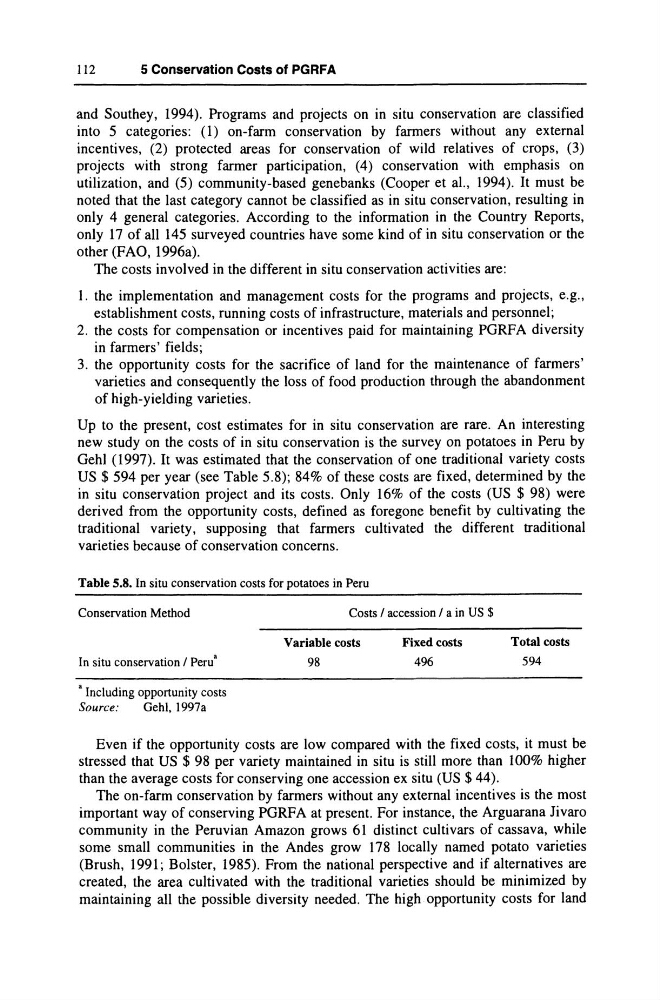
Gehl (1997). It was estimated that the conservation of one traditional variety costs
US $ 594 per year (see Table 5.8); 84% of these costs are fixed, determined by the
in situ conservation project and its costs. Only 16% of the costs (US $ 98) were
derived from the opportunity costs, defined as foregone benefit by cultivating the
traditional variety, supposing that farmers cultivated the different traditional
varieties because of conservation concerns.
Table S.S. In situ conservation costs for potatoes in Peru
Conservation Method
In situ conservation I Peru'
• Including opportunity costs
Source:
Gehl, 1997a
Costs I accession I a in US $
Variable costs
98
Fixed costs
496
Total costs
594
Even if the opportunity costs are low compared with the fixed costs, it must be
stressed that US $ 98 per variety maintained in situ is still more than 100% higher
than the average costs for conserving one accession ex situ (US $ 44).
The on-farm conservation by farmers without any external incentives is the most
important way of conserving PGRFA at present. For instance, the Arguarana Jivaro
community in the Peruvian Amazon grows 61 distinct cultivars of cassava, while
some small communities in the Andes grow 178 locally named potato varieties
(Brush, 1991; Bolster, 1985). From the national perspective and if alternatives are
created, the area cultivated with the traditional varieties should be minimized by
maintaining all the possible diversity needed. The high opportunity costs for land
5 Conservation Costs of PGRFA
and Southey, 1994). Programs and projects on in situ conservation are classified
into 5 categories: (1) on-farm conservation by farmers without any external
incentives, (2) protected areas for conservation of wild relatives of crops, (3)
projects with strong farmer participation, (4) conservation with emphasis on
utilization, and (5) community-based genebanks (Cooper et aI., 1994). It must be
noted that the last category cannot be classified as in situ conservation, resulting in
only 4 general categories. According to the information in the Country Reports,
only 17 of all 145 surveyed countries have some kind of in situ conservation or the
other (FAO, 1996a).
The costs involved in the different in situ conservation activities are:
1. the implementation and management costs for the programs and projects, e.g.,
establishment costs, running costs of infrastructure, materials and personnel;
2. the costs for compensation or incentives paid for maintaining PGRFA diversity
in farmers' fields;
3. the opportunity costs for the sacrifice of land for the maintenance of farmers'
varieties and consequently the loss of food production through the abandonment
of high-yielding varieties.
Up to the present, cost estimates for in situ conservation are rare. An interesting
new study on the costs of in situ conservation is the survey on potatoes in Peru by
Gehl (1997). It was estimated that the conservation of one traditional variety costs
US $ 594 per year (see Table 5.8); 84% of these costs are fixed, determined by the
in situ conservation project and its costs. Only 16% of the costs (US $ 98) were
derived from the opportunity costs, defined as foregone benefit by cultivating the
traditional variety, supposing that farmers cultivated the different traditional
varieties because of conservation concerns.
Table S.S. In situ conservation costs for potatoes in Peru
Conservation Method
In situ conservation I Peru'
• Including opportunity costs
Source:
Gehl, 1997a
Costs I accession I a in US $
Variable costs
98
Fixed costs
496
Total costs
594
Even if the opportunity costs are low compared with the fixed costs, it must be
stressed that US $ 98 per variety maintained in situ is still more than 100% higher
than the average costs for conserving one accession ex situ (US $ 44).
The on-farm conservation by farmers without any external incentives is the most
important way of conserving PGRFA at present. For instance, the Arguarana Jivaro
community in the Peruvian Amazon grows 61 distinct cultivars of cassava, while
some small communities in the Andes grow 178 locally named potato varieties
(Brush, 1991; Bolster, 1985). From the national perspective and if alternatives are
created, the area cultivated with the traditional varieties should be minimized by
maintaining all the possible diversity needed. The high opportunity costs for land