

5.1 Analysis of the Costs for PGRFA Conservation
109
germplasm also has to be multiplied every year. The multiplication aimed at
obtaining information of the cultivated genetic resources is more work intensive
than the pure multiplication for shipment. Multiplication, including packing and
shipping, has been calculated at US $ 0.35 under the assumption that an
accession is requested once every year (Singh, 1996).
4. Administration and other costs: In addition to the administration costs, which
are calculated as overhead costs of 10% of the other costs, the storage facilities
have to be maintained. US $ 0.19 per accession are estimated for the
administration (Rani, 1996). Furthermore, the estimated average annual capital
depreciation amounts to US $ 0.15 (Rani, 1996).
Following this approach, the annual overall costs for the ex situ conservation of an
accession in a developing country's seed genebank are estimated to be US $ 19.86.
To estimate the overall conservation costs for ex situ stored PGRFA, it is
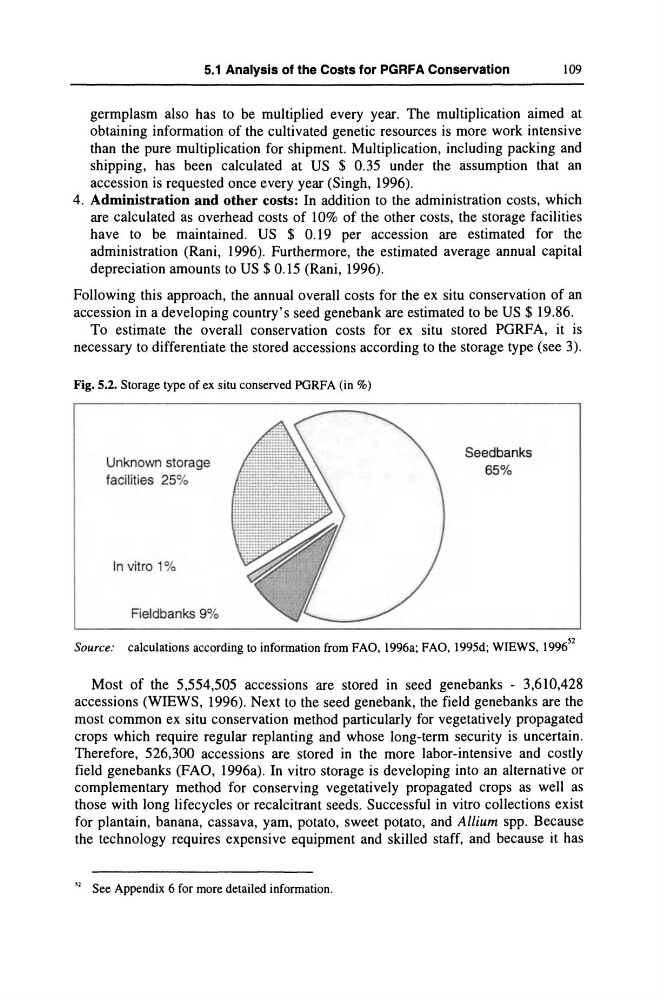
necessary to differentiate the stored accessions according to the storage type (see 3).
Fig. 5.2. Storage type of ex situ conserved PGRFA (in %)
Unknown storage
facilities 25%
In vitro 1%
Fieldbanks 9%
Seed banks
65%
Source: calculations according to information from FAO, 1996a; FAO, 1995d; WIEWS, 1996 52
Most of the 5,554,505 accessions are stored in seed genebanks - 3,610,428
accessions (WIEWS, 1996). Next to the seed genebank, the field genebanks are the
most common ex situ conservation method particularly for vegetatively propagated
crops which require regular replanting and whose long-term security is uncertain.
Therefore, 526,300 accessions are stored in the more labor-intensive and costly
field genebanks (FAO, 1996a). In vitro storage is developing into an alternative or
complementary method for conserving vegetatively propagated crops as well as
those with long Iifecycles or recalcitrant seeds. Successful in vitro collections exist
for plantain, banana, cassava, yam, potato, sweet potato, and Allium spp. Because
the technology requires expensive equipment and skilled staff, and because it has
" See Appendix 6 for more detailed information.
109
germplasm also has to be multiplied every year. The multiplication aimed at
obtaining information of the cultivated genetic resources is more work intensive
than the pure multiplication for shipment. Multiplication, including packing and
shipping, has been calculated at US $ 0.35 under the assumption that an
accession is requested once every year (Singh, 1996).
4. Administration and other costs: In addition to the administration costs, which
are calculated as overhead costs of 10% of the other costs, the storage facilities
have to be maintained. US $ 0.19 per accession are estimated for the
administration (Rani, 1996). Furthermore, the estimated average annual capital
depreciation amounts to US $ 0.15 (Rani, 1996).
Following this approach, the annual overall costs for the ex situ conservation of an
accession in a developing country's seed genebank are estimated to be US $ 19.86.
To estimate the overall conservation costs for ex situ stored PGRFA, it is
necessary to differentiate the stored accessions according to the storage type (see 3).
Fig. 5.2. Storage type of ex situ conserved PGRFA (in %)
Unknown storage
facilities 25%
In vitro 1%
Fieldbanks 9%
Seed banks
65%
Source: calculations according to information from FAO, 1996a; FAO, 1995d; WIEWS, 1996 52
Most of the 5,554,505 accessions are stored in seed genebanks - 3,610,428
accessions (WIEWS, 1996). Next to the seed genebank, the field genebanks are the
most common ex situ conservation method particularly for vegetatively propagated
crops which require regular replanting and whose long-term security is uncertain.
Therefore, 526,300 accessions are stored in the more labor-intensive and costly
field genebanks (FAO, 1996a). In vitro storage is developing into an alternative or
complementary method for conserving vegetatively propagated crops as well as
those with long Iifecycles or recalcitrant seeds. Successful in vitro collections exist
for plantain, banana, cassava, yam, potato, sweet potato, and Allium spp. Because
the technology requires expensive equipment and skilled staff, and because it has
" See Appendix 6 for more detailed information.