

Dorsoventral Patterning of the Zebrafish Embryo
2-somite
stage
20-somite
stage
wildtype
dino
(chordino)
swirl
(bmp2b)
87
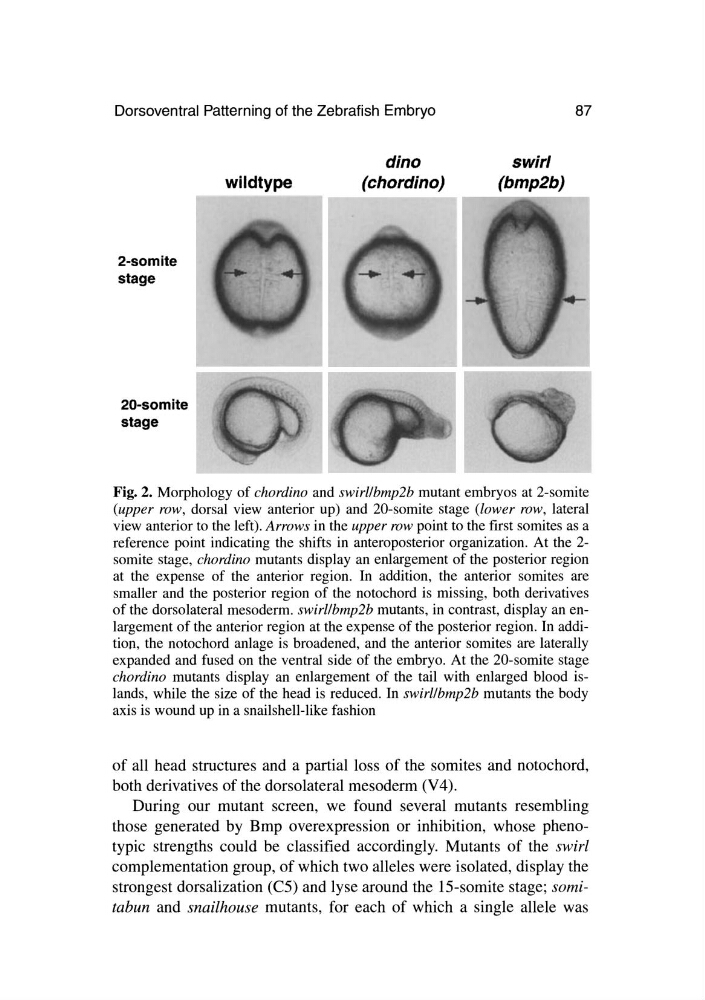
Fig. 2. Morphology of chordino and swirl/bmp2b mutant embryos at 2-somite
(upper row, dorsal view anterior up) and 20-somite stage (lower row, lateral
view anterior to the left). Arrows in the upper row point to the first somites as a
reference point indicating the shifts in anteroposterior organization. At the 2somite stage, chordino mutants display an enlargement of the posterior region
at the expense of the anterior region. In addition, the anterior somites are
smaller and the posterior region of the notochord is missing, both derivatives
of the dorsolateral mesoderm. swirl/bmp2b mutants, in contrast, display an enlargement of the anterior region at the expense of the posterior region. In addition, the notochord anlage is broadened, and the anterior somites are laterally
expanded and fused on the ventral side of the embryo. At the 20-somite stage
chordino mutants display an enlargement of the tail with enlarged blood islands, while the size of the head is reduced. In swirl/bmp2b mutants the body
axis is wound up in a snailshell-like fashion
of all head structures and a partial loss of the somites and notochord,
both derivatives of the dorsolateral mesoderm (V4).
During our mutant screen, we found several mutants resembling
those generated by Bmp overexpression or inhibition, whose phenotypic strengths could be classified accordingly. Mutants of the swirl
complementation group, of which two alleles were isolated, display the
strongest dorsalization (C5) and lyse around the 15-somite stage; somitabun and snailhouse mutants, for each of which a single allele was
2-somite
stage
20-somite
stage
wildtype
dino
(chordino)
swirl
(bmp2b)
87
Fig. 2. Morphology of chordino and swirl/bmp2b mutant embryos at 2-somite
(upper row, dorsal view anterior up) and 20-somite stage (lower row, lateral
view anterior to the left). Arrows in the upper row point to the first somites as a
reference point indicating the shifts in anteroposterior organization. At the 2somite stage, chordino mutants display an enlargement of the posterior region
at the expense of the anterior region. In addition, the anterior somites are
smaller and the posterior region of the notochord is missing, both derivatives
of the dorsolateral mesoderm. swirl/bmp2b mutants, in contrast, display an enlargement of the anterior region at the expense of the posterior region. In addition, the notochord anlage is broadened, and the anterior somites are laterally
expanded and fused on the ventral side of the embryo. At the 20-somite stage
chordino mutants display an enlargement of the tail with enlarged blood islands, while the size of the head is reduced. In swirl/bmp2b mutants the body
axis is wound up in a snailshell-like fashion
of all head structures and a partial loss of the somites and notochord,
both derivatives of the dorsolateral mesoderm (V4).
During our mutant screen, we found several mutants resembling
those generated by Bmp overexpression or inhibition, whose phenotypic strengths could be classified accordingly. Mutants of the swirl
complementation group, of which two alleles were isolated, display the
strongest dorsalization (C5) and lyse around the 15-somite stage; somitabun and snailhouse mutants, for each of which a single allele was