

46
B. Conradt
CENTRAL PATHWAY
ces-2---lces-1---legl-1-l ced-9-lced-4 - ced-3 - ell Death
NSM sister cells
All dying cells
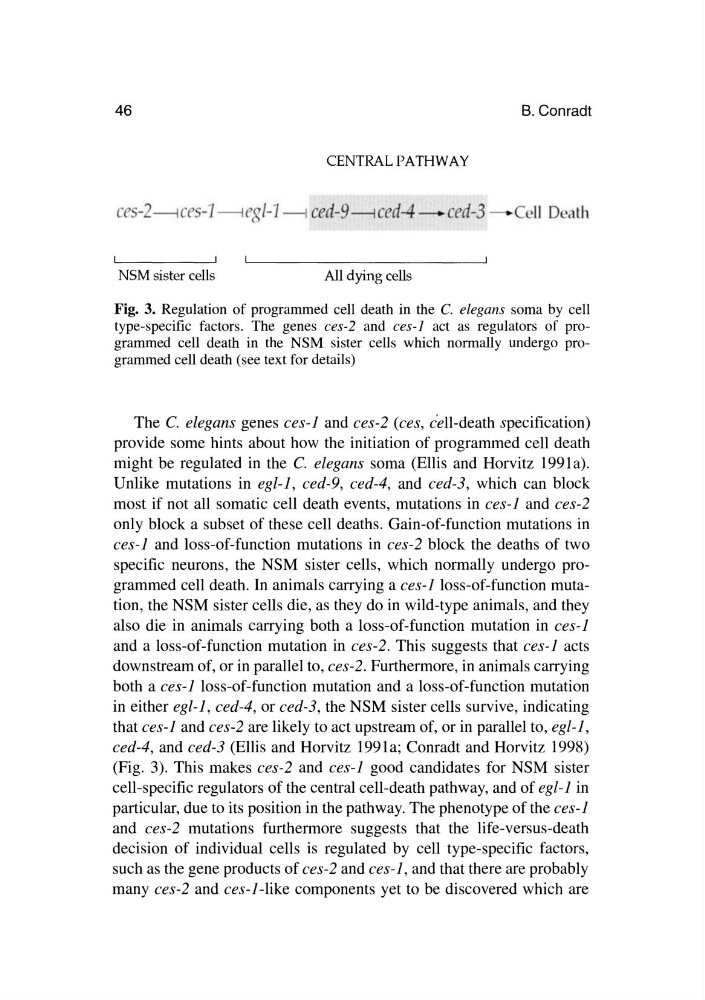
Fig. 3. Regulation of programmed cell death in the C. elegans soma by cell
type-specific factors. The genes ces-2 and ces-J act as regulators of programmed cell death in the NSM sister cells which normally undergo programmed cell death (see text for details)
The C. elegans genes ces-J and ces-2 (ces, c'ell-death specification)
provide some hints about how the initiation of programmed cell death
might be regulated in the C. elegans soma (Ellis and Horvitz 1991a).
Unlike mutations in egl-J, ced-9, ced-4, and ced-3, which can block
most if not all somatic cell death events, mutations in ces-J and ces-2
only block a subset of these cell deaths. Gain-of-function mutations in
ces-J and loss-of-function mutations in ces-2 block the deaths of two
specific neurons, the NSM sister cells, which normally undergo programmed cell death. In animals carrying a ces-lloss-of-function mutation, the NSM sister cells die, as they do in wild-type animals, and they
also die in animals carrying both a loss-of-function mutation in ces-l
and a loss-of-function mutation in ces-2. This suggests that ces-l acts
downstream of, or in parallel to, ces-2. Furthermore, in animals carrying
both a ces-J loss-of-function mutation and a loss-of-function mutation
in either egl-J, ced-4, or ced-3, the NSM sister cells survive, indicating
that ces-J and ces-2 are likely to act upstream of, or in parallel to, egl-l ,
ced-4, and ced-3 (Ellis and Horvitz 1991a; Conradt and Horvitz 1998)
(Fig. 3). This makes ces-2 and ces-J good candidates for NSM sister
cell-specific regulators of the central cell-death pathway, and of egl-l in
particular, due to its position in the pathway. The phenotype of the ces-l
and ces-2 mutations furthermore suggests that the life-versus-death
decision of individual cells is regulated by cell type-specific factors,
such as the gene products of ces-2 and ces-J, and that there are probably
many ces-2 and ces-J-like components yet to be discovered which are
B. Conradt
CENTRAL PATHWAY
ces-2---lces-1---legl-1-l ced-9-lced-4 - ced-3 - ell Death
NSM sister cells
All dying cells
Fig. 3. Regulation of programmed cell death in the C. elegans soma by cell
type-specific factors. The genes ces-2 and ces-J act as regulators of programmed cell death in the NSM sister cells which normally undergo programmed cell death (see text for details)
The C. elegans genes ces-J and ces-2 (ces, c'ell-death specification)
provide some hints about how the initiation of programmed cell death
might be regulated in the C. elegans soma (Ellis and Horvitz 1991a).
Unlike mutations in egl-J, ced-9, ced-4, and ced-3, which can block
most if not all somatic cell death events, mutations in ces-J and ces-2
only block a subset of these cell deaths. Gain-of-function mutations in
ces-J and loss-of-function mutations in ces-2 block the deaths of two
specific neurons, the NSM sister cells, which normally undergo programmed cell death. In animals carrying a ces-lloss-of-function mutation, the NSM sister cells die, as they do in wild-type animals, and they
also die in animals carrying both a loss-of-function mutation in ces-l
and a loss-of-function mutation in ces-2. This suggests that ces-l acts
downstream of, or in parallel to, ces-2. Furthermore, in animals carrying
both a ces-J loss-of-function mutation and a loss-of-function mutation
in either egl-J, ced-4, or ced-3, the NSM sister cells survive, indicating
that ces-J and ces-2 are likely to act upstream of, or in parallel to, egl-l ,
ced-4, and ced-3 (Ellis and Horvitz 1991a; Conradt and Horvitz 1998)
(Fig. 3). This makes ces-2 and ces-J good candidates for NSM sister
cell-specific regulators of the central cell-death pathway, and of egl-l in
particular, due to its position in the pathway. The phenotype of the ces-l
and ces-2 mutations furthermore suggests that the life-versus-death
decision of individual cells is regulated by cell type-specific factors,
such as the gene products of ces-2 and ces-J, and that there are probably
many ces-2 and ces-J-like components yet to be discovered which are