

38
B. Conradt
A
ced-9---1ced-4 - ced-3 - Cell D~"th
B
~
~ - @ - ~ - C"' D"th
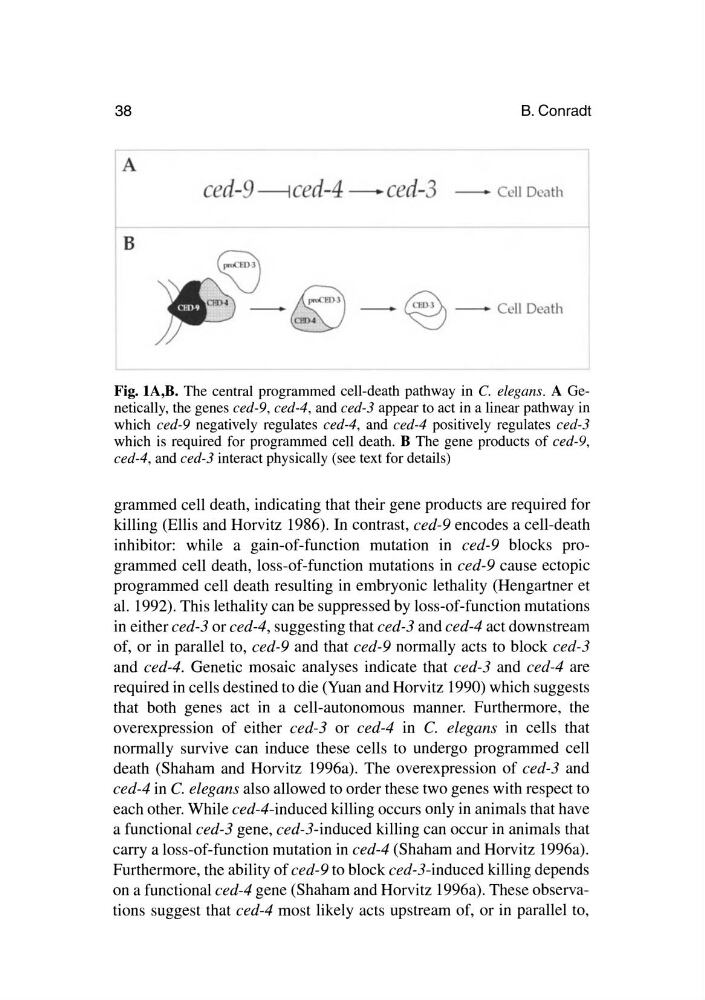
Fig. lA,B. The central programmed cell-death pathway in C. elegans. A Genetically, the genes ced-9, ced-4, and ced-3 appear to act in a linear pathway in
which ced-9 negatively regulates ced-4, and ced-4 positively regulates ced-3
which is required for programmed cell death. B The gene products of ced-9,
ced-4, and ced-3 interact physically (see text for details)
grammed cell death, indicating that their gene products are required for
killing (Ellis and Horvitz 1986). In contrast, ced-9 encodes a cell-death
inhibitor: while a gain-of-function mutation in ced-9 blocks programmed cell death, loss-of-function mutations in ced-9 cause ectopic
programmed cell death resulting in embryonic lethality (Hengartner et
al. 1992). This lethality can be suppressed by loss-of-function mutations
in either ced-3 or ced-4, suggesting that ced-3 and ced-4 act downstream
of, or in parallel to, ced-9 and that ced-9 normally acts to block ced-3
and ced-4. Genetic mosaic analyses indicate that ced-3 and ced-4 are
required in cells destined to die (Yuan and Horvitz 1990) which suggests
that both genes act in a cell-autonomous manner. Furthermore, the
overexpression of either ced-3 or ced-4 in C. elegans in cells that
normally survive can induce these cells to undergo programmed cell
death (Shaham and Horvitz 1996a). The overexpression of ced-3 and
ced-4 in C. elegans also allowed to order these two genes with respect to
each other. While ced-4-induced killing occurs only in animals that have
a functional ced-3 gene, ced-3-induced killing can occur in animals that
carry a loss-of-function mutation in ced-4 (Shaham and Horvitz 1996a).
Furthermore, the ability of ced-9 to block ced-3-induced killing depends
on a functional ced-4 gene (Shaham and Horvitz 1996a). These observations suggest that ced-4 most likely acts upstream of, or in parallel to,
B. Conradt
A
ced-9---1ced-4 - ced-3 - Cell D~"th
B
~
~ - @ - ~ - C"' D"th
Fig. lA,B. The central programmed cell-death pathway in C. elegans. A Genetically, the genes ced-9, ced-4, and ced-3 appear to act in a linear pathway in
which ced-9 negatively regulates ced-4, and ced-4 positively regulates ced-3
which is required for programmed cell death. B The gene products of ced-9,
ced-4, and ced-3 interact physically (see text for details)
grammed cell death, indicating that their gene products are required for
killing (Ellis and Horvitz 1986). In contrast, ced-9 encodes a cell-death
inhibitor: while a gain-of-function mutation in ced-9 blocks programmed cell death, loss-of-function mutations in ced-9 cause ectopic
programmed cell death resulting in embryonic lethality (Hengartner et
al. 1992). This lethality can be suppressed by loss-of-function mutations
in either ced-3 or ced-4, suggesting that ced-3 and ced-4 act downstream
of, or in parallel to, ced-9 and that ced-9 normally acts to block ced-3
and ced-4. Genetic mosaic analyses indicate that ced-3 and ced-4 are
required in cells destined to die (Yuan and Horvitz 1990) which suggests
that both genes act in a cell-autonomous manner. Furthermore, the
overexpression of either ced-3 or ced-4 in C. elegans in cells that
normally survive can induce these cells to undergo programmed cell
death (Shaham and Horvitz 1996a). The overexpression of ced-3 and
ced-4 in C. elegans also allowed to order these two genes with respect to
each other. While ced-4-induced killing occurs only in animals that have
a functional ced-3 gene, ced-3-induced killing can occur in animals that
carry a loss-of-function mutation in ced-4 (Shaham and Horvitz 1996a).
Furthermore, the ability of ced-9 to block ced-3-induced killing depends
on a functional ced-4 gene (Shaham and Horvitz 1996a). These observations suggest that ced-4 most likely acts upstream of, or in parallel to,