

Hedgehog Signaling in Animal Development and Human Disease 217
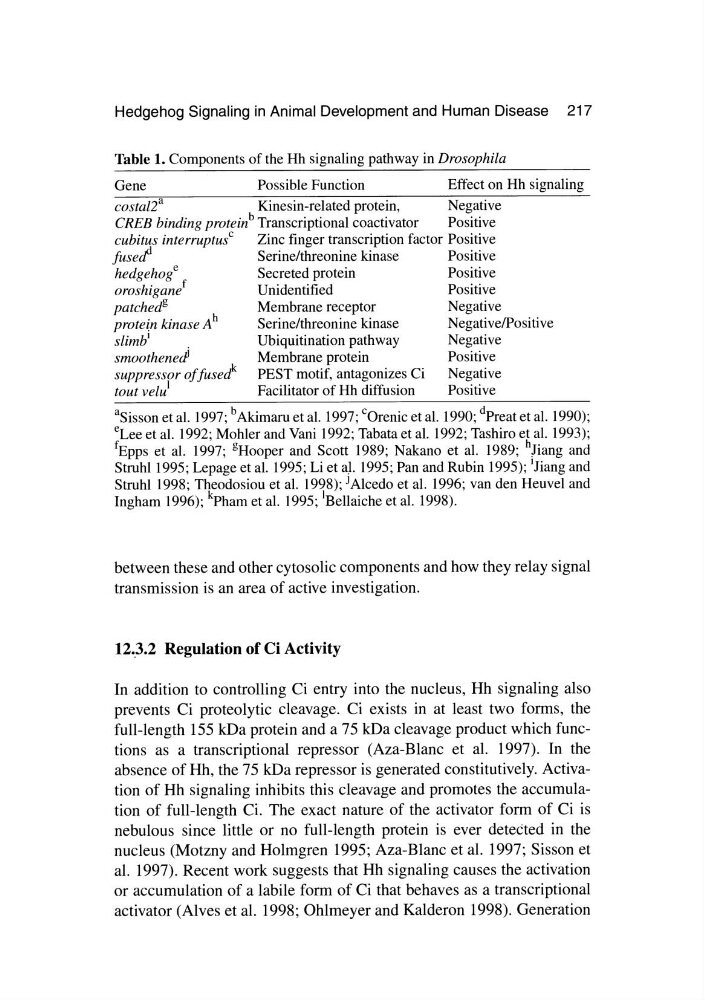
Table 1. Components of the Hh signaling pathway in Drosophila
Gene
Possible Function
Effect on Hh signaling
costal2 a
Kinesin-related protein,
Negative
CREB binding protein b Transcriptional coactivator
Positive
cubitus interruptul
Zinc finger transcription factor Positive
JuseJl
Serine/threonine kinase
Positive
hedgehol
Secreted protein
Positive
oroshigan/
Unidentified
Positive
patched g
Membrane receptor
Negative
prote(n kinase Ah
Serine/threonine kinase
Negative/Positive
slimb'
Ubiquitination pathway
Negative
smootheneJ
Membrane protein
Positive
suppressor oJfuseJ< PEST motif, antagonizes Ci
Negative
tout velu i
Facilitator of Hh diffusion
Positive
aSisson et al. 1997; b Akimaru et al. 1997; cOrenic et al. 1990; dPreat et al. 1990);
eLee et al. 1992; Mohler and Vani 1992; Tabata et al. 1992; Tashiro et al. 1993);
fEpps et al. 1997; gHooper and Scott 1989; Nakano et al. 1989; h)iang and
Struh11995; Lepage et al. 1995; Li et aJ. 1995; Pan and Rubin 1995); 'Jiang and
Struh11998; Theodosiou et al. 1998); JA1cedo et al. 1996; van den Heuvel and
Ingham 1996); kPham et al. 1995; iBellaiche et al. 1998).
between these and other cytosolic components and how they relay signal
transmission is an area of active investigation.
12 .. 3.2 Regulation of Ci Activity
In addition to controlling Ci entry into the nucleus, Hh signaling also
prevents Ci proteolytic cleavage. Ci exists in at least two forms, the
full-length 155 kDa protein and a 75 kDa cleavage product which functions as a transcriptional repressor (Aza-B1anc et al. 1997). In the
absence of Hh, the 75 kDa repressor is generated constitutively. Activation of Hh signaling inhibits this cleavage and promotes the accumulation of full-length Ci. The exact nature of the activator form of Ci is
nebulous since little or no full-length protein is ever detected in the
nucleus (Motzny and Holmgren 1995; Aza-Blanc et al. 1997; Sisson et
al. 1997). Recent work suggests that Hh signaling causes the activation
or accumulation of a labile form of Ci that behaves as a transcriptional
activator (Alves et al. 1998; Ohlmeyer and Kalderon 1998). Generation
Table 1. Components of the Hh signaling pathway in Drosophila
Gene
Possible Function
Effect on Hh signaling
costal2 a
Kinesin-related protein,
Negative
CREB binding protein b Transcriptional coactivator
Positive
cubitus interruptul
Zinc finger transcription factor Positive
JuseJl
Serine/threonine kinase
Positive
hedgehol
Secreted protein
Positive
oroshigan/
Unidentified
Positive
patched g
Membrane receptor
Negative
prote(n kinase Ah
Serine/threonine kinase
Negative/Positive
slimb'
Ubiquitination pathway
Negative
smootheneJ
Membrane protein
Positive
suppressor oJfuseJ< PEST motif, antagonizes Ci
Negative
tout velu i
Facilitator of Hh diffusion
Positive
aSisson et al. 1997; b Akimaru et al. 1997; cOrenic et al. 1990; dPreat et al. 1990);
eLee et al. 1992; Mohler and Vani 1992; Tabata et al. 1992; Tashiro et al. 1993);
fEpps et al. 1997; gHooper and Scott 1989; Nakano et al. 1989; h)iang and
Struh11995; Lepage et al. 1995; Li et aJ. 1995; Pan and Rubin 1995); 'Jiang and
Struh11998; Theodosiou et al. 1998); JA1cedo et al. 1996; van den Heuvel and
Ingham 1996); kPham et al. 1995; iBellaiche et al. 1998).
between these and other cytosolic components and how they relay signal
transmission is an area of active investigation.
12 .. 3.2 Regulation of Ci Activity
In addition to controlling Ci entry into the nucleus, Hh signaling also
prevents Ci proteolytic cleavage. Ci exists in at least two forms, the
full-length 155 kDa protein and a 75 kDa cleavage product which functions as a transcriptional repressor (Aza-B1anc et al. 1997). In the
absence of Hh, the 75 kDa repressor is generated constitutively. Activation of Hh signaling inhibits this cleavage and promotes the accumulation of full-length Ci. The exact nature of the activator form of Ci is
nebulous since little or no full-length protein is ever detected in the
nucleus (Motzny and Holmgren 1995; Aza-Blanc et al. 1997; Sisson et
al. 1997). Recent work suggests that Hh signaling causes the activation
or accumulation of a labile form of Ci that behaves as a transcriptional
activator (Alves et al. 1998; Ohlmeyer and Kalderon 1998). Generation