

138
intracell ular
ephrinA
extracellular
intracellular
Glob
Cys
FNIII
FNIII
Kinase
SAM
N. Holder et al.
POZ
ephrinB
Eph
-p~~e
" ~
GasGV
POZ
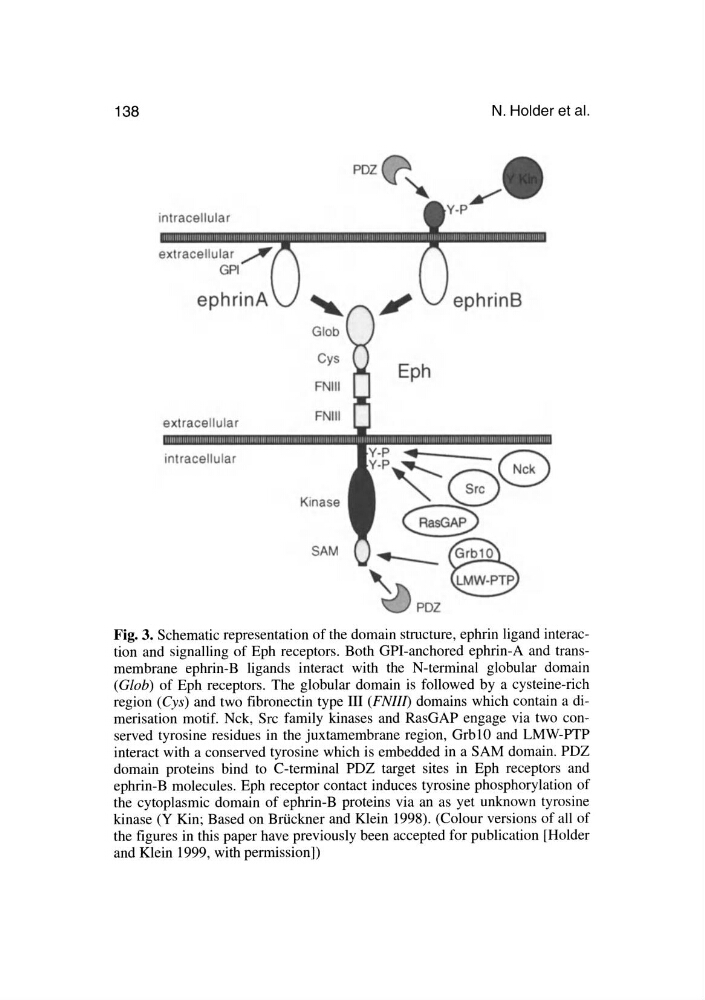
Fig. 3. Schematic representation of the domain structure, ephrin ligand interaction and signalling of Eph receptors. Both GPI-anchored ephrin-A and transmembrane ephrin-B ligands interact with the N-terminal globular domain
(Glob) of Eph receptors. The globular domain is followed by a cysteine-rich
region (Cys) and two fibronectin type III (FNIII) domains which contain a dimerisation motif. Nck, Src family kinases and RasGAP engage via two conserved tyrosine residues in the juxtamembrane region, GrblO and LMW-PTP
interact with a conserved tyrosine which is embedded in a SAM domain. PDZ
domain proteins bind to C-terminal PDZ target sites in Eph receptors and
ephrin-B molecules. Eph receptor contact induces tyrosine phosphorylation of
the cytoplasmic domain of ephrin-B proteins via an as yet unknown tyrosine
kinase (Y Kin; Based on Bruckner and Klein 1998). (Colour versions of all of
the figures in this paper have previously been accepted for publication [Holder
and Klein 1999, with permission))
intracell ular
ephrinA
extracellular
intracellular
Glob
Cys
FNIII
FNIII
Kinase
SAM
N. Holder et al.
POZ
ephrinB
Eph
-p~~e
" ~
GasGV
POZ
Fig. 3. Schematic representation of the domain structure, ephrin ligand interaction and signalling of Eph receptors. Both GPI-anchored ephrin-A and transmembrane ephrin-B ligands interact with the N-terminal globular domain
(Glob) of Eph receptors. The globular domain is followed by a cysteine-rich
region (Cys) and two fibronectin type III (FNIII) domains which contain a dimerisation motif. Nck, Src family kinases and RasGAP engage via two conserved tyrosine residues in the juxtamembrane region, GrblO and LMW-PTP
interact with a conserved tyrosine which is embedded in a SAM domain. PDZ
domain proteins bind to C-terminal PDZ target sites in Eph receptors and
ephrin-B molecules. Eph receptor contact induces tyrosine phosphorylation of
the cytoplasmic domain of ephrin-B proteins via an as yet unknown tyrosine
kinase (Y Kin; Based on Bruckner and Klein 1998). (Colour versions of all of
the figures in this paper have previously been accepted for publication [Holder
and Klein 1999, with permission))