

887
Impacts of Global Warming on Biogeochemical Cycles in Natural Waters
5 Conceptual Model for the Impacts of Global Warming
on Key Biogeochemical Processes
From the previous discussion of the ‘Impacts of global warming on natural waters’
section, it is possible to summarize the key biogeochemical steps that take place
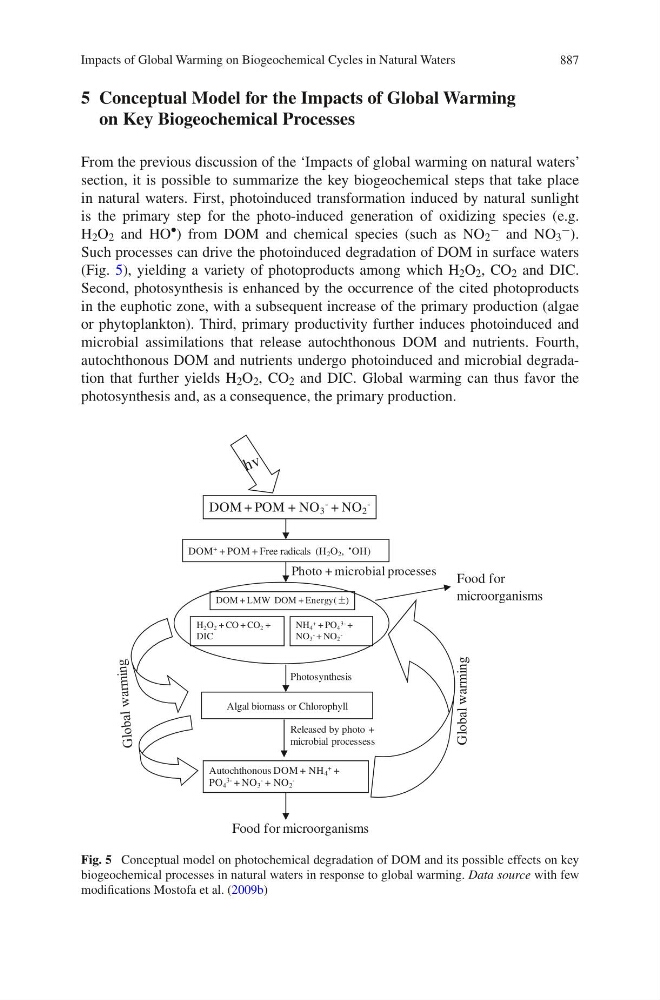
in natural waters. First, photoinduced transformation induced by natural sunlight
is the primary step for the photo-induced generation of oxidizing species (e.g.
H 2 O 2 and HO
• ) from DOM and chemical species (such as NO 2
− and NO 3
− ).
Such processes can drive the photoinduced degradation of DOM in surface waters
(Fig. 5), yielding a variety of photoproducts among which H 2 O 2 , CO 2 and DIC.
Second, photosynthesis is enhanced by the occurrence of the cited photoproducts
in the euphotic zone, with a subsequent increase of the primary production (algae
or phytoplankton). Third, primary productivity further induces photoinduced and
microbial assimilations that release autochthonous DOM and nutrients. Fourth,
autochthonous DOM and nutrients undergo photoinduced and microbial degradation that further yields H 2 O 2 , CO 2 and DIC. Global warming can thus favor the
photosynthesis and, as a consequence, the primary production.
Algal biomass or Chlorophyll
DOM + LMW DOM + Energy( )
H 2 O 2 + CO + CO 2 +
DIC
NH 4
+ + PO 4
3- +
NO 3
- + NO 2
-
Photosynthesis
Released by photo +
microbial processess
Autochthonous DOM + NH 4
+ +
PO 4
3- + NO 3
- + NO 2
-
DOM + POM + NO 3
- + NO 2
-
DOM
+ + POM + Free radicals (H 2 O 2 , . OH)
Global warming
Photo + microbial processes
Food for microorganisms
Food for
microorganisms
Fig. 5 Conceptual model on photochemical degradation of DOM and its possible effects on key
biogeochemical processes in natural waters in response to global warming. Data source with few
modifications Mostofa et al. (2009b)