

866
K. M. G. Mostofa et al.
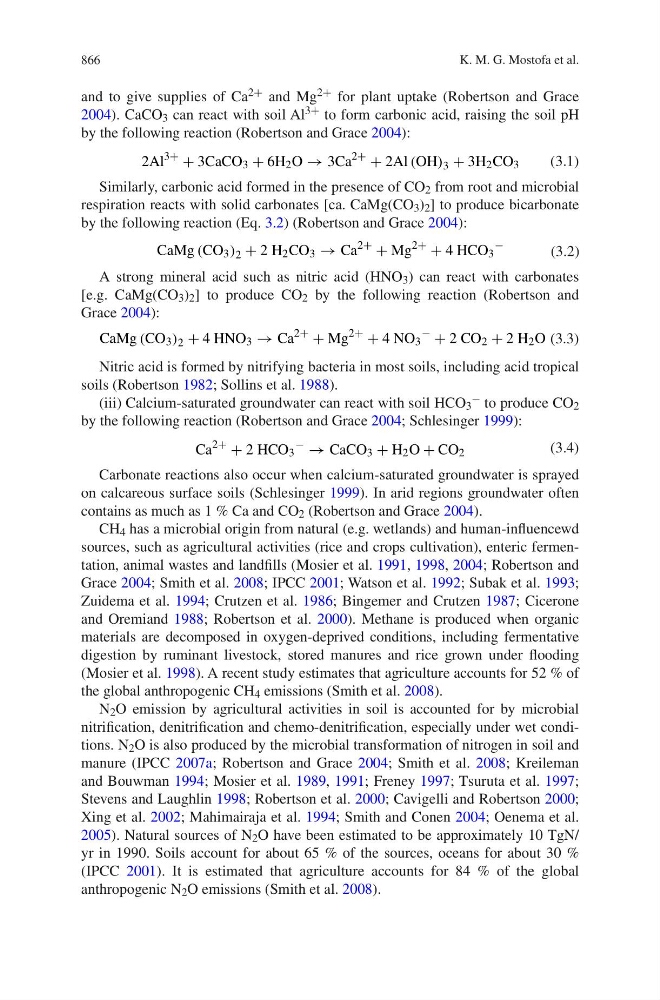
and to give supplies of Ca 2+ and Mg 2+ for plant uptake (Robertson and Grace
2004). CaCO 3 can react with soil Al 3+ to form carbonic acid, raising the soil pH
by the following reaction (Robertson and Grace 2004):
Similarly, carbonic acid formed in the presence of CO 2 from root and microbial
respiration reacts with solid carbonates [ca. CaMg(CO 3 ) 2 ] to produce bicarbonate
by the following reaction (Eq. 3.2) (Robertson and Grace 2004):
A strong mineral acid such as nitric acid (HNO 3 ) can react with carbonates
[e.g. CaMg(CO 3 ) 2 ] to produce CO 2 by the following reaction (Robertson and
Grace 2004):
Nitric acid is formed by nitrifying bacteria in most soils, including acid tropical
soils (Robertson 1982; Sollins et al. 1988).
(iii) Calcium-saturated groundwater can react with soil HCO 3
− to produce CO 2
by the following reaction (Robertson and Grace 2004; Schlesinger 1999):
Carbonate reactions also occur when calcium-saturated groundwater is sprayed
on calcareous surface soils (Schlesinger 1999). In arid regions groundwater often
contains as much as 1 % Ca and CO 2 (Robertson and Grace 2004).
CH 4 has a microbial origin from natural (e.g. wetlands) and human-influencewd
sources, such as agricultural activities (rice and crops cultivation), enteric fermentation, animal wastes and landfills (Mosier et al. 1991, 1998, 2004; Robertson and
Grace 2004; Smith et al. 2008; IPCC 2001; Watson et al. 1992; Subak et al. 1993;
Zuidema et al. 1994; Crutzen et al. 1986; Bingemer and Crutzen 1987; Cicerone
and Oremiand 1988; Robertson et al. 2000). Methane is produced when organic
materials are decomposed in oxygen-deprived conditions, including fermentative
digestion by ruminant livestock, stored manures and rice grown under flooding
(Mosier et al. 1998). A recent study estimates that agriculture accounts for 52 % of
the global anthropogenic CH 4 emissions (Smith et al. 2008).
N 2 O emission by agricultural activities in soil is accounted for by microbial
nitrification, denitrification and chemo-denitrification, especially under wet conditions. N 2 O is also produced by the microbial transformation of nitrogen in soil and
manure (IPCC 2007a; Robertson and Grace 2004; Smith et al. 2008; Kreileman
and Bouwman 1994; Mosier et al. 1989, 1991; Freney 1997; Tsuruta et al. 1997;
Stevens and Laughlin 1998; Robertson et al. 2000; Cavigelli and Robertson 2000;
Xing et al. 2002; Mahimairaja et al. 1994; Smith and Conen 2004; Oenema et al.
2005). Natural sources of N 2 O have been estimated to be approximately 10 TgN/
yr in 1990. Soils account for about 65 % of the sources, oceans for about 30 %
(IPCC 2001). It is estimated that agriculture accounts for 84 % of the global
anthropogenic N 2 O emissions (Smith et al. 2008).
(3.1)
2Al
3+ + 3CaCO 3 + 6H 2 O → 3Ca
2+ + 2Al (OH) 3 + 3H 2 CO 3
(3.2)
CaMg (CO 3 ) 2 + 2 H 2 CO 3 → Ca
2+ + Mg
2+ + 4 HCO 3
−
(3.3)
CaMg (CO 3 ) 2 + 4 HNO 3 → Ca
2+ + Mg
2+ + 4 NO 3
− + 2 CO 2 + 2 H 2 O
(3.4)
Ca
2+ + 2 HCO 3
− → CaCO 3 + H 2 O + CO 2