

856
K. M. G. Mostofa et al.
Halocarbons have increased from a near-zero pre-industrial background concentration, and the increase is primarily due to human activities. The atmospheric
concentrations of many halocarbon gases with ozone depleting and global warming potential (e.g. CFCl 3 and CF 2 Cl 2 ) have been either increasing more slowly
or even decreasing since 1995. This happened in response to reduced emissions
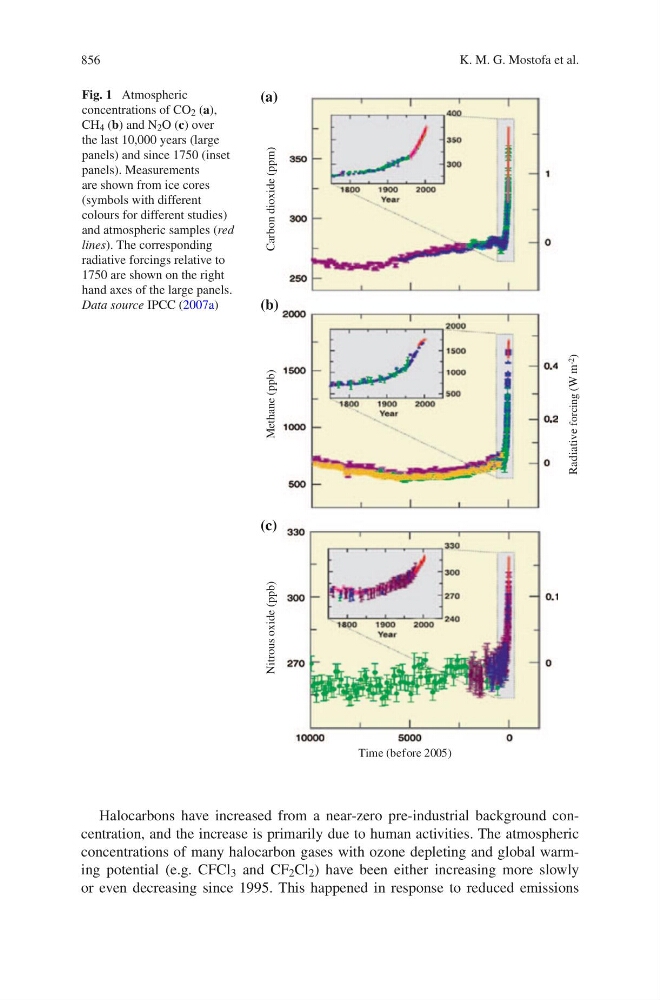
Fig. 1 Atmospheric
concentrations of CO 2 (a),
CH 4 (b) and N 2 O (c) over
the last 10,000 years (large
panels) and since 1750 (inset
panels). Measurements
are shown from ice cores
(symbols with different
colours for different studies)
and atmospheric samples (red
lines). The corresponding
radiative forcings relative to
1750 are shown on the right
hand axes of the large panels.
Data source IPCC (2007a)
Methane (ppb)
Radiative forcing
(W m -2
)
Nitrous oxide (ppb)
Carbon dioxide (ppm)
Time (before 2005)
(a)
(b)
(c)