

822
K. M. G. Mostofa et al.
Tc 4+ ) that are insoluble and less mobile in water, also affecting the M-DOM complexation (Tabak et al. 2005). Another study has shown that the anaerobic spore-forming bacteria Clostridia, ubiquitous in soils, sediments, and wastes, are able to reduce
Fe 3+ to Fe 2+ , Mn 4+ to Mn 2+ , U 6+ to U 4+ , Pu 4+ to Pu 3+ , and Tc 6+ to Tc 4+ . They
also reduce U 6+ associated with citric acid in a dinuclear 2:2 U 6+ :citric acid complex to a biligand mononuclear 1:2 U 4+ :citric acid complex that remains in solution, in contrast to the reduction and precipitation of uranium (Francis and Dodge
2008). The bioreduction of U 6+ to U 4+ also occurs by environmentally relevant
bacteria (Gram-positive and Gram-negative), yielding a phase or mineral composed
of mononuclear U 4+ atoms that can form inner-sphere bonds with C/N/O- or P/Scontaining ligands (Fletcher et al. 2010; Bernier-Latmani et al. 2010).
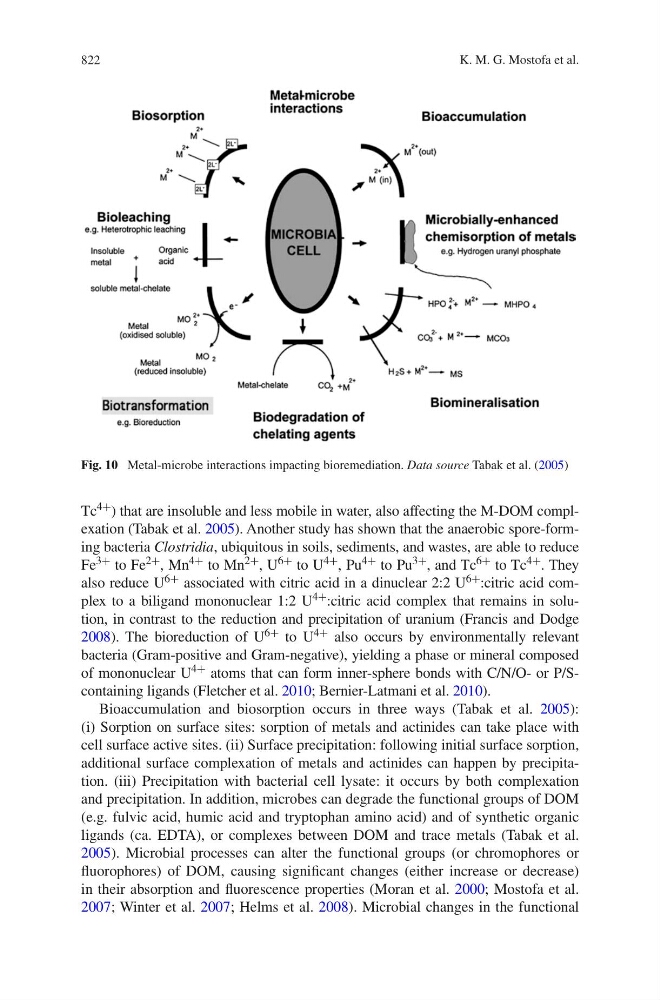
Bioaccumulation and biosorption occurs in three ways (Tabak et al. 2005):
(i) Sorption on surface sites: sorption of metals and actinides can take place with
cell surface active sites. (ii) Surface precipitation: following initial surface sorption,
additional surface complexation of metals and actinides can happen by precipitation. (iii) Precipitation with bacterial cell lysate: it occurs by both complexation
and precipitation. In addition, microbes can degrade the functional groups of DOM
(e.g. fulvic acid, humic acid and tryptophan amino acid) and of synthetic organic
ligands (ca. EDTA), or complexes between DOM and trace metals (Tabak et al.
2005). Microbial processes can alter the functional groups (or chromophores or
fluorophores) of DOM, causing significant changes (either increase or decrease)
in their absorption and fluorescence properties (Moran et al. 2000; Mostofa et al.
2007; Winter et al. 2007; Helms et al. 2008). Microbial changes in the functional
Fig. 10 Metal-microbe interactions impacting bioremediation. Data source Tabak et al. (2005)