

812
K. M. G. Mostofa et al.
DOC-facilitated transport of elements (Reszat and Hendry 2007). The ability of
actinide ions such as uranyl to form complexes with DOC is very variable depending on the occurrence of humic fractions (fulvic and humic acids) in DOM, which
undergo in turn large variations (5–80 %) in the aquatic environments (Mostofa et
al. 2009a; Kim and Czerwinski 1996; Giesy et al. 1986; Kim et al. 1994; Artinger
et al. 2002; Crancon and van der Lee 2003; Jackson et al. 2005). Interestingly, the
complexation of U to DOM is kinetically controlled (Artinger et al. 2002).
Studies on M-DOM complexation suggest that trace metals with high binding
strength are primarily distributed in the larger molecular size fractions, and metals with low binding strength are mostly distributed in the smaller molecular size
fractions (Wu et al. 2004b; Shin et al. 2001; Lakshman et al. 1993; Midorikawa
and Tanoue 1996, 1998; Lin et al. 1995; Rao and Choppin 1995; Sekaly et al.
1998; Sposito et al. 1982). The larger molecular size fractions have a higher affinity for metals such as Al, Cu, UO 2 (II), and Np(V) than smaller molecular size
fractions (Shin et al. 2001; Lakshman et al. 1993; Midorikawa and Tanoue 1998;
Lin et al. 1995; Midorikawa and Tanoue 1996; Rao and Choppin 1995; Sekaly
et al. 1998; Sposito et al. 1982). Kinetic studies show that strong affinity metals
Total DOC
DOC concentration (mmol L -1
)
Metal concentration (mmol L -1 )
Hydrophilic DOC
Hydrophobic DOC
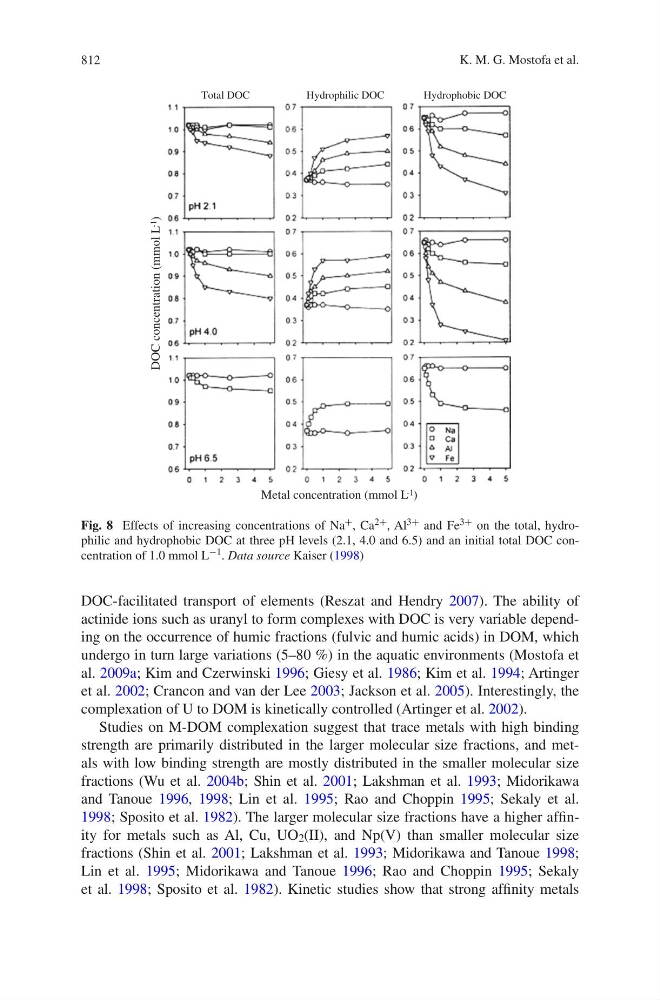
Fig. 8 Effects of increasing concentrations of Na + , Ca 2+ , Al 3+ and Fe 3+ on the total, hydrophilic and hydrophobic DOC at three pH levels (2.1, 4.0 and 6.5) and an initial total DOC concentration of 1.0 mmol L −1 . Data source Kaiser (1998)