

799
Complexation of Dissolved Organic Matter with Trace Metal Ions in Natural Waters
with stronger functional groups for M-DOM complexation. Irradiation of waters
with high contents of DOM is not able to substantially modify the degree of
M-DOM complexation, which is the most likely explanation for the cases where
the same stability constants have been observed before and after irradiation. The
effect of photoinduced degradation on M-DOM complexation will be explained
in details later.
3.6.1 Conditional Stability Constants for Ternary Complexes in Waters
Ternary complexes are operationally defined as complexes involving two newly
successive bonds between a metal ion and two different types of DOM components or organic ligands (e.g. allochthonous fulvic acid and tryptophan). It
is assumed that fulvic acid (FA) acts as a primary ligand to form bonds with a
metal ion (M). Therefore, one initially observes binary complex formation such as
M − FA (M + FA ⇆ M − FA). Then another molecule, e.g. tryptophan (T) acts as
a secondary ligand and forms ternary complexes that can be represented as such as
T − M − FA (M − FA + T ⇆ T − M − FA).
Formation of ternary complexes is observed in aqueous solution (Martin and
Prados 1974; Khalil and Radalla 1998; Khalil and Attia 1999; Khalil 2000a, b;
Khalil and Taha 2004; Khalil and Fazary 2004; Radalla 2010; Rosas et al. 2010).
For the formation of ternary complexes of the selected bivalent metal ions (M)
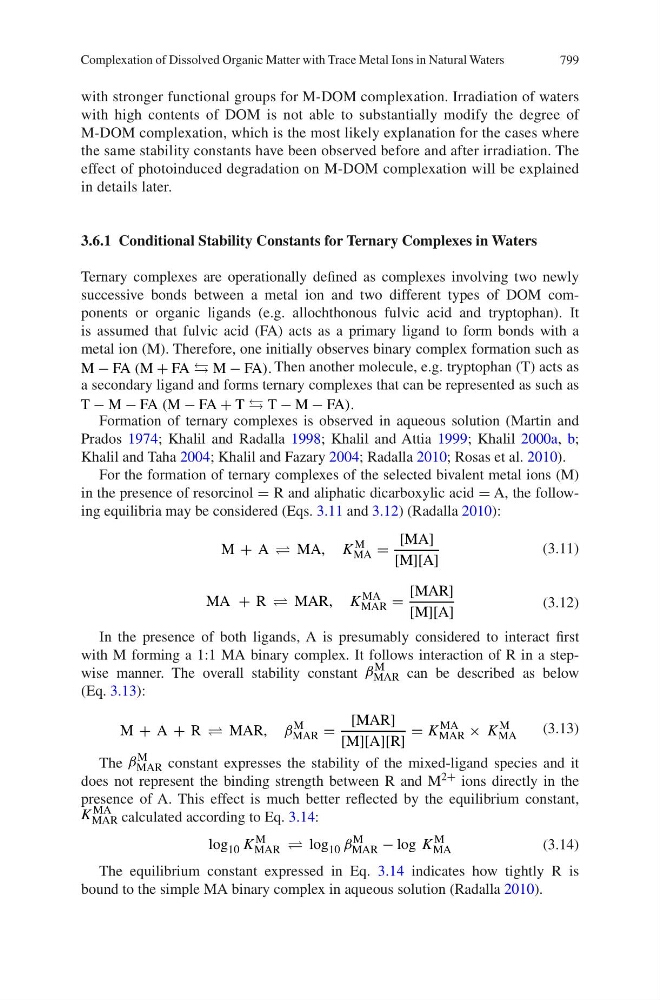
in the presence of resorcinol = R and aliphatic dicarboxylic acid = A, the following equilibria may be considered (Eqs. 3.11 and 3.12) (Radalla 2010):
In the presence of both ligands, A is presumably considered to interact first
with M forming a 1:1 MA binary complex. It follows interaction of R in a stepwise manner. The overall stability constant β M
MAR can be described as below
(Eq. 3.13):
The β M
MAR constant expresses the stability of the mixed-ligand species and it
does not represent the binding strength between R and M 2+ ions directly in the
presence of A. This effect is much better reflected by the equilibrium constant,
K MA
MAR calculated according to Eq. 3.14:
The equilibrium constant expressed in Eq. 3.14 indicates how tightly R is
bound to the simple MA binary complex in aqueous solution (Radalla 2010).
(3.11)
M + A ⇋ MA, K
M
MA =
[MA]
[M][A]
(3.12)
MA + R ⇋ MAR, K
MA
MAR =
[MAR]
[M][A]
(3.13)
M + A + R ⇋ MAR, β
M
MAR =
[MAR]
[M][A][R]
= K
MA
MAR × K
M
MA
(3.14)
log 10 K
M
MAR ⇋ log 10 β
M
MAR − log K
M
MA