

778
K. M. G. Mostofa et al.
concentration of bound metal ion with an organic ligand (ML) is the difference
between total and free metal ion concentration. A titration of naturally occurring
fulvic acid ligand with a metal ion can allow determination of the stability constant (K) and of the complexing capacity (C L ) of the ligand if a stoichiometry is
considered (Hart 1981).
3.2 Theory of Multisite Stern–Volmer Equation
for Determination of M-DOM Complexation
The multisite Stern–Volmer (MSV) equation is modified, simulated, validated
for predictive capability with a suitable model compound set by Hays and his
colleagues (2004), and applied to fluorescence titration data in the complexation of fulvic acid with Cu 2+ (Fig. 4). The MSV approach assumes a simple
1:1 coordination ratio between Cu 2+ and the fluorescent ligand components,
giving the following reversible solution equilibria: M + L1 ⇆ ML1 and
M + L2 ⇆ ML2 where L1 and L2 are the free ligand species (all forms of
metal-free ligand) at sites 1 and 2, respectively, M is free metal, and ML1 and
ML2 are the metal-bound species at these sites. Other reaction stoichiometries
are possible, which rely on metal loading. For example, at low metal loadings, chelation (2:1 = ligand:metal) may be induced, contorting the fulvic acid
shape and affecting fluorescence. Evidences for the effect of these molecular
conformation changes on fluorescence are scarce, inconclusive, and not easily
quantified.
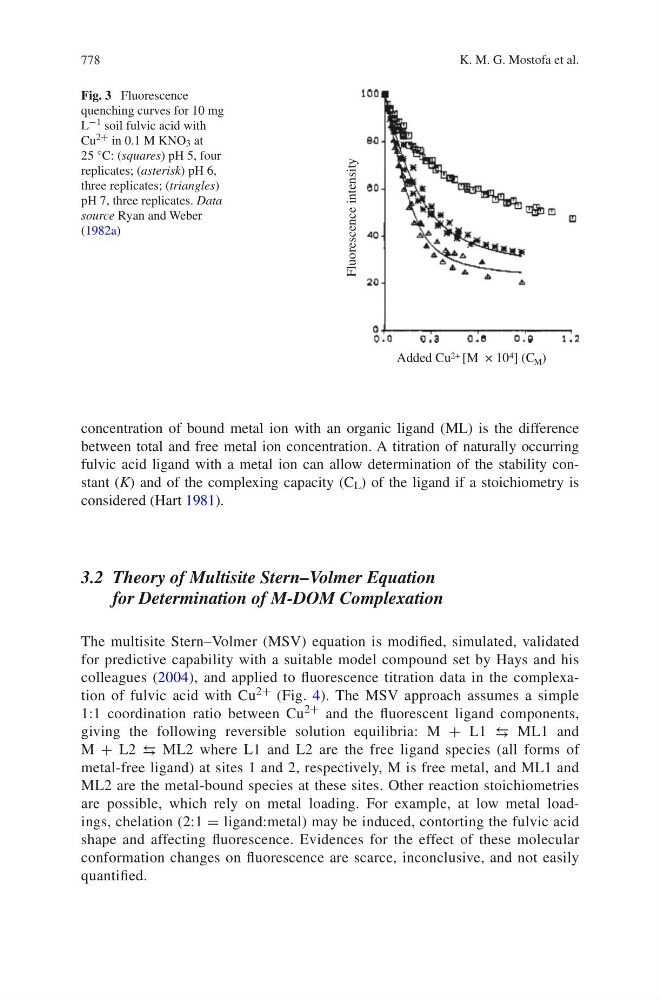
Fig. 3 Fluorescence
quenching curves for 10 mg
L −1 soil fulvic acid with
Cu 2+ in 0.1 M KNO 3 at
25 °C: (squares) pH 5, four
replicates; (asterisk) pH 6,
three replicates; (triangles)
pH 7, three replicates. Data
source Ryan and Weber
(1982a)
Added Cu 2+ [M × 10 4 ] (C M )
Fluorescence intensity