

775
Complexation of Dissolved Organic Matter with Trace Metal Ions in Natural Waters
acid, 5-sulfosalicylic acid, and other organic compounds) that is linked with complexation (Cabaniss 1992; Smith and Kramer 1998, 1999; Cabaniss and Shuman 1988; Fu
et al. 2007; Panak et al. 1995; dasilva et al. 1995; Ohno et al. 2008; Silva et al. 1994;
Lakshman et al. 1993, 1996; Seritti et al. 1994). The increase in fluorescence intensity
upon complexation of Cm 3+ with 5-sulfosalicylic acid, fulvic acid, and humic acid suggests that the salicylic acid-like functional group may present in the molecular structure in allochthonous fulvic and humic acids (Panak et al. 1995). The fluorophores in
(a)
(b)
Peak A
Peak C
Peak M
(e)
Peak T
Peak T UV
Ex wavelength (nm)
(d)
(c)
Peak A
Peak C
Emwavelength (nm)
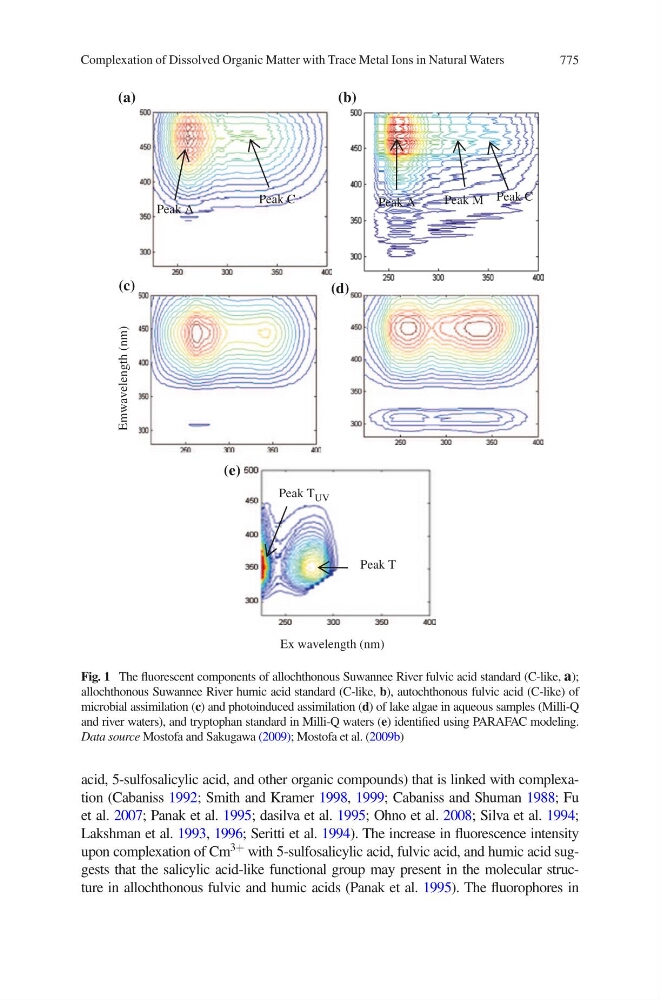
Fig. 1 The fluorescent components of allochthonous Suwannee River fulvic acid standard (C-like, a);
allochthonous Suwannee River humic acid standard (C-like, b), autochthonous fulvic acid (C-like) of
microbial assimilation (c) and photoinduced assimilation (d) of lake algae in aqueous samples (Milli-Q
and river waters), and tryptophan standard in Milli-Q waters (e) identified using PARAFAC modeling.
Data source Mostofa and Sakugawa (2009); Mostofa et al. (2009b)