

733
Chlorophylls and their Degradation in Nature
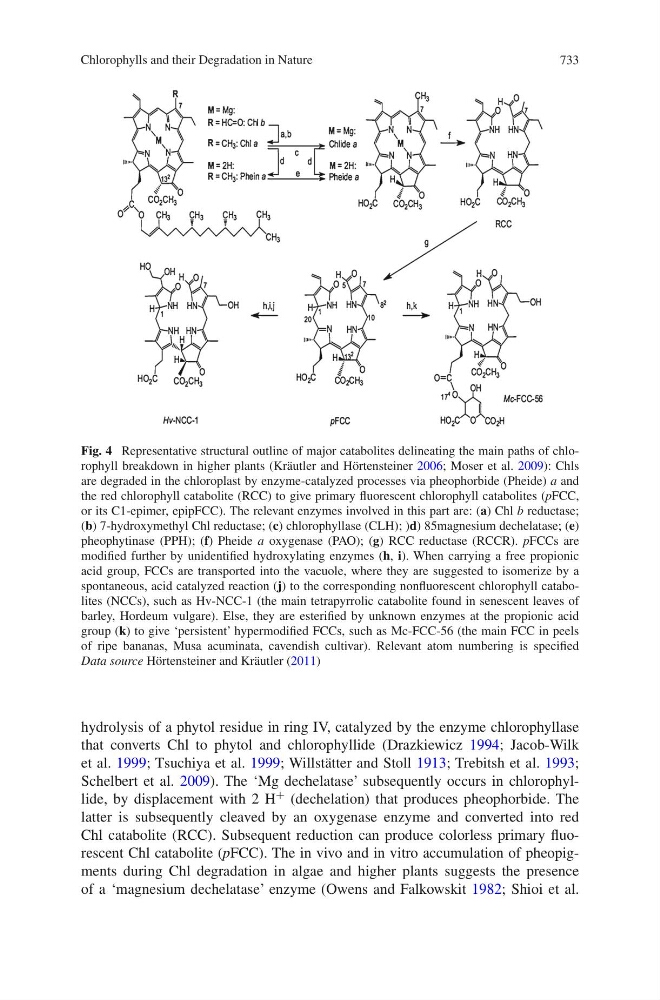
hydrolysis of a phytol residue in ring IV, catalyzed by the enzyme chlorophyllase
that converts Chl to phytol and chlorophyllide (Drazkiewicz 1994; Jacob-Wilk
et al. 1999; Tsuchiya et al. 1999; Willstätter and Stoll 1913; Trebitsh et al. 1993;
Schelbert et al. 2009). The ‘Mg dechelatase’ subsequently occurs in chlorophyllide, by displacement with 2 H + (dechelation) that produces pheophorbide. The
latter is subsequently cleaved by an oxygenase enzyme and converted into red
Chl catabolite (RCC). Subsequent reduction can produce colorless primary fluorescent Chl catabolite (pFCC). The in vivo and in vitro accumulation of pheopigments during Chl degradation in algae and higher plants suggests the presence
of a ‘magnesium dechelatase’ enzyme (Owens and Falkowskit 1982; Shioi et al.
Fig. 4 Representative structural outline of major catabolites delineating the main paths of chlorophyll breakdown in higher plants (Kräutler and Hörtensteiner 2006; Moser et al. 2009): Chls
are degraded in the chloroplast by enzyme-catalyzed processes via pheophorbide (Pheide) a and
the red chlorophyll catabolite (RCC) to give primary fluorescent chlorophyll catabolites (pFCC,
or its C1-epimer, epipFCC). The relevant enzymes involved in this part are: (a) Chl b reductase;
(b) 7-hydroxymethyl Chl reductase; (c) chlorophyllase (CLH); )d) 85magnesium dechelatase; (e)
pheophytinase (PPH); (f) Pheide a oxygenase (PAO); (g) RCC reductase (RCCR). pFCCs are
modified further by unidentified hydroxylating enzymes (h, i). When carrying a free propionic
acid group, FCCs are transported into the vacuole, where they are suggested to isomerize by a
spontaneous, acid catalyzed reaction (j) to the corresponding nonfluorescent chlorophyll catabolites (NCCs), such as Hv-NCC-1 (the main tetrapyrrolic catabolite found in senescent leaves of
barley, Hordeum vulgare). Else, they are esterified by unknown enzymes at the propionic acid
group (k) to give ‘persistent’ hypermodified FCCs, such as Mc-FCC-56 (the main FCC in peels
of ripe bananas, Musa acuminata, cavendish cultivar). Relevant atom numbering is specified
Data source Hörtensteiner and Kräutler (2011)