

714
K. M. G. Mostofa et al.
3.1.1 Mechanism of SCM Formation
SCM is driven by sunlight and it is formed during the summer stratification period
in waters with high contents of DOM and POM and high temperature. High contents of DOM (of both allochthonous and autochthonous origin) and POM (e.g.
algae) along with Chl a or phytoplankton, together with incident light wavelengths
or solar zenith angle are the main limiting factors for sunlight in the surface layer
(see also chapter “Colored and Chromophoric Dissolved Organic Matter (CDOM)
in Natural Waters” for detailed description) (Laurion et al. 2000; Hayakawa and
Sugiyama 2008; Markager and Vincent 2000; Belzile et al. 2002; Shank et al. 2005;
Zhao et al. 2009). High contents of DOM and POM are thus responsible for having most of the sunlight intensity in the upper surface layer. Therefore, most of the
photoinduced degradation processes would occur in the surface layers or in epilimnion. OM including DOM and POM is one of the key factors that can produce nutrients (NO 3
− , NH 4
+ and PO 4
3− ) and various photo- and microbial products (H 2 O 2 ,
CO 2 , DIC, LMW DOM, and so on) (see also chapters “Dissolved Organic Matter
in Natural Waters , Photoinduced and Microbial Degradation of Dissolved Organic
Matter in Natural Waters ”, “Photosynthesis in Nature: A New Look” and “Impacts
of Global Warming on Biogeochemical Cycles in Natural Waters”) (Zepp et al.
1987; Palenik et al. 1987; Palenik and Morel 1988; Cooper and Lean 1992; Miller
and Zepp 1995; Bushaw et al. 1996; Graneli et al. 1996, 1998; Miller and Moran
1997; Sarthou et al. 1997; Gao and Zepp 1998; Jørgensen et al. 1998; Bertilsson et
al. 1999; Bertilsson and Tranvik 2000; Anesio and Granéli 2003; Scully et al. 2003;
Obernosterer and Benner 2004; Ma and Green 2004; Croot et al. 2005; Molot et al.
2005; Johannessen et al. 2007; Kujawinski et al. 2009; Mostofa and Sakugawa 2009;
Finlay et al. 2009; Stets et al. 2009; Jiao et al. 2010; Liu et al. 2010; Lohrenz et al.
2010; Omar et al. 2010; White et al. 2010; Zepp et al. 2011; Borges et al. 2008). All
these species can influence photosynthesis directly and indirectly in waters.
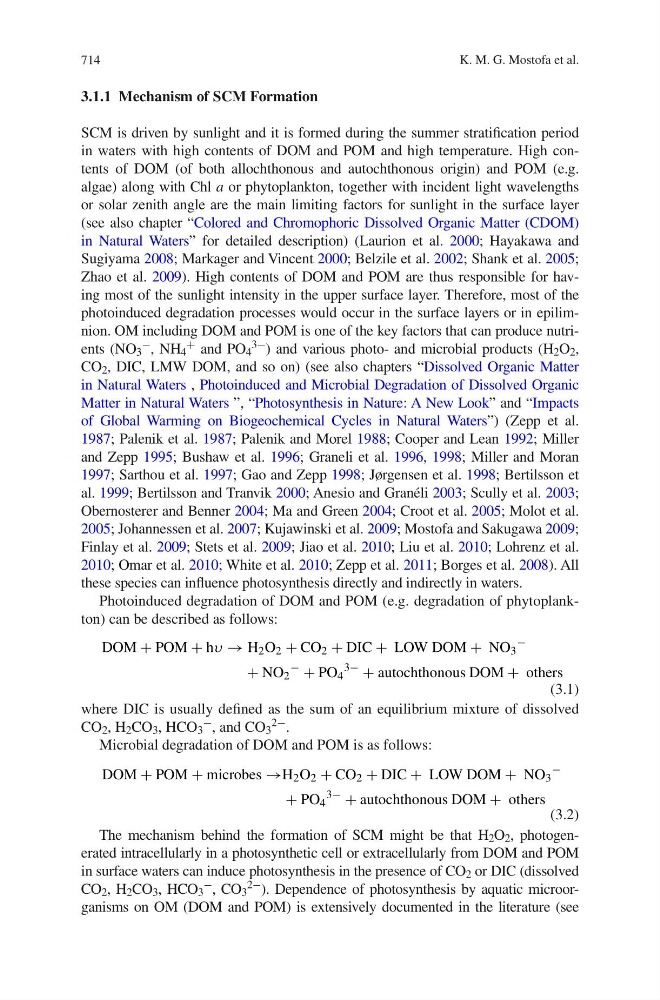
Photoinduced degradation of DOM and POM (e.g. degradation of phytoplankton) can be described as follows:
where DIC is usually defined as the sum of an equilibrium mixture of dissolved
CO 2 , H 2 CO 3 , HCO 3
− , and CO 3
2− .
Microbial degradation of DOM and POM is as follows:
The mechanism behind the formation of SCM might be that H 2 O 2 , photogenerated intracellularly in a photosynthetic cell or extracellularly from DOM and POM
in surface waters can induce photosynthesis in the presence of CO 2 or DIC (dissolved
CO 2 , H 2 CO 3 , HCO 3
− , CO 3
2− ). Dependence of photosynthesis by aquatic microorganisms on OM (DOM and POM) is extensively documented in the literature (see
(3.1)
DOM + POM + hυ → H 2 O 2 + CO 2 + DIC + LOW DOM + NO 3
−
+ NO 2
− + PO 4
3− + autochthonous DOM + others
(3.2)
DOM + POM + microbes →H 2 O 2 + CO 2 + DIC + LOW DOM + NO 3
−
+ PO 4
3− + autochthonous DOM + others