

697
Chlorophylls and their Degradation in Nature
to conditions in lakes. An upper-surface mixed layer commonly occurs in lakes
and oceans, due to mechanical perturbation of surface waters (e.g. by wind, waves
and storms) (Deuser 1987; Venrick 1993; Law et al. 2003; Moum et al. 1989;
Brainerd and Gregg 1995). It is characterized by strong turbulent mixing, up to a
depth of approximately 30–200 m or more. Note that few studies have reported the
occurrence of DCM (or subsurface Chl a maximum) at a depth of 5–25 m or more
(Table 1) (Parab et al. 2006; Sawatzky et al. 2006; Xiu et al. 2009; Hamilton et al.
2010; Fee 1976; Sommaruga and Augustin 2006). Considering the surface mixing
zone of the water column, it might be supposed to have a similar meaning as the
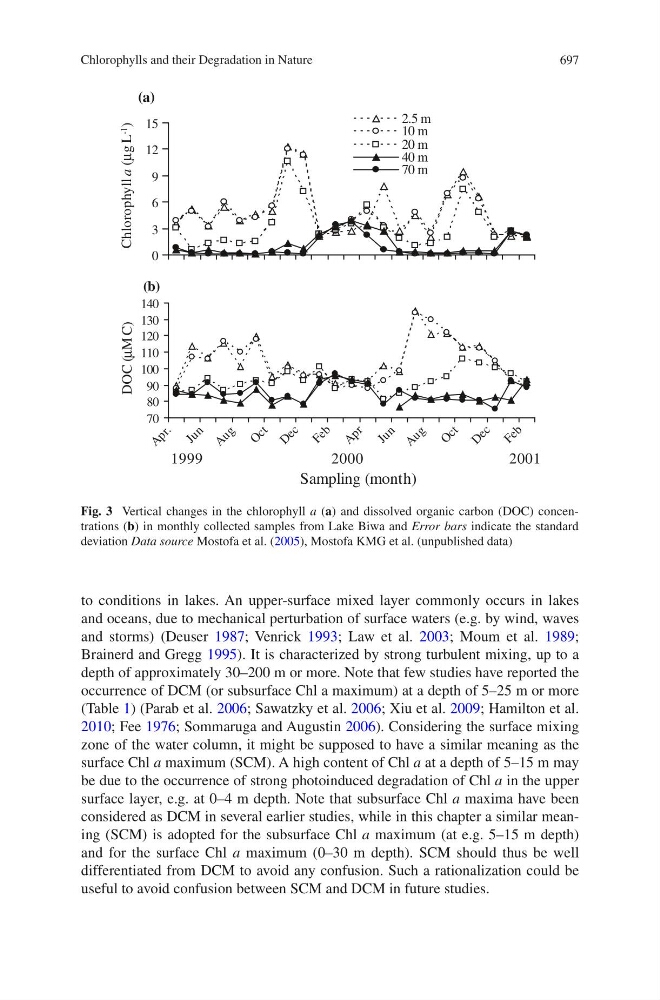
surface Chl a maximum (SCM). A high content of Chl a at a depth of 5–15 m may
be due to the occurrence of strong photoinduced degradation of Chl a in the upper
surface layer, e.g. at 0–4 m depth. Note that subsurface Chl a maxima have been
considered as DCM in several earlier studies, while in this chapter a similar meaning (SCM) is adopted for the subsurface Chl a maximum (at e.g. 5–15 m depth)
and for the surface Chl a maximum (0–30 m depth). SCM should thus be well
differentiated from DCM to avoid any confusion. Such a rationalization could be
useful to avoid confusion between SCM and DCM in future studies.
Sampling (month)
0
3
6
9
12
15
2.5 m
10 m
20 m
40 m
70 m
70
80
90
100
110
120
130
140
A p r .
J u n
A u g
O c t
D e c
F e b
A p r
J u n
A u g
O c t
D e c
F e b
(a)
(b)
Chlorophyll a
(µg L -1
)
DOC (µM C)
1999
2000
2001
Fig. 3 Vertical changes in the chlorophyll a (a) and dissolved organic carbon (DOC) concentrations (b) in monthly collected samples from Lake Biwa and Error bars indicate the standard
deviation Data source Mostofa et al. (2005), Mostofa KMG et al. (unpublished data)