

603
Photosynthesis in Nature: A New Look
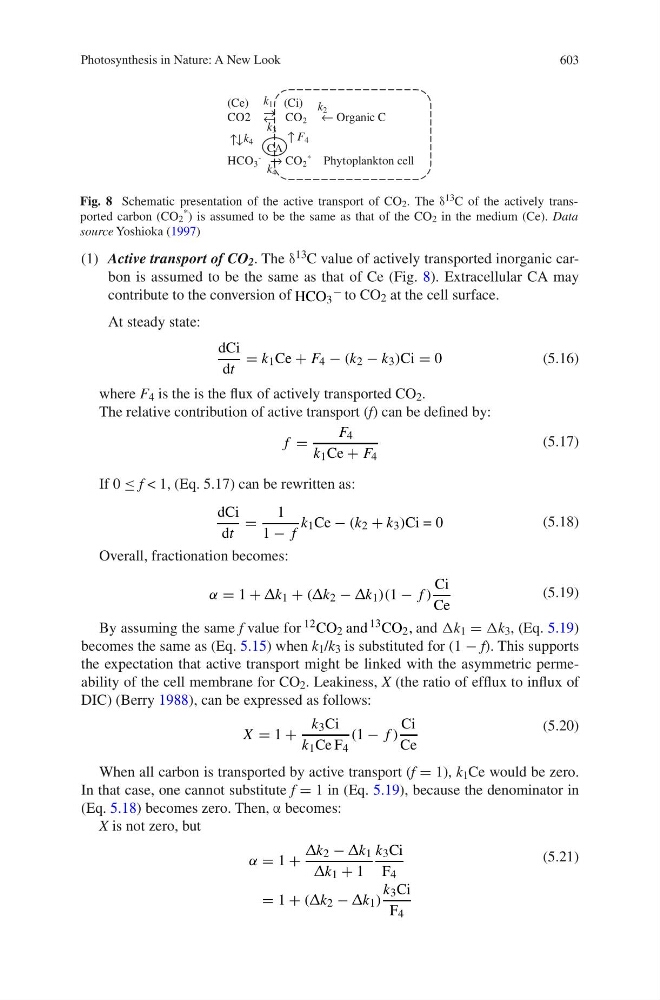
(1) Active transport of CO 2 . The δ 13 C value of actively transported inorganic carbon is assumed to be the same as that of Ce (Fig. 8). Extracellular CA may
contribute to the conversion of HCO 3
− to CO 2 at the cell surface.
At steady state:
where F 4 is the is the flux of actively transported CO 2 .
The relative contribution of active transport (f) can be defined by:
If 0 ≤ f < 1, (Eq. 5.17) can be rewritten as:
Overall, fractionation becomes:
By assuming the same f value for 12 CO 2 and 13 CO 2 , and Δk 1 = Δk 3 , (Eq. 5.19)
becomes the same as (Eq. 5.15) when k 1 /k 3 is substituted for (1 − f). This supports
the expectation that active transport might be linked with the asymmetric permeability of the cell membrane for CO 2 . Leakiness, X (the ratio of efflux to influx of
DIC) (Berry 1988), can be expressed as follows:
When all carbon is transported by active transport (f = 1), k 1 Ce would be zero.
In that case, one cannot substitute f = 1 in (Eq. 5.19), because the denominator in
(Eq. 5.18) becomes zero. Then, α becomes:
X is not zero, but
(5.16)
dCi
dt
= k 1 Ce + F 4 − (k 2 − k 3 )Ci = 0
(5.17)
f =
F 4
k 1 Ce + F 4
(5.18)
dCi
dt
=
1
1 − f
k 1 Ce − (k 2 + k 3 )Ci = 0
(5.19)
α = 1 + ∆k 1 + (∆k 2 − ∆k 1 )(1 − f )
Ci
Ce
(5.20)
X = 1 +
k 3 Ci
k 1 Ce F 4
(1 − f )
Ci
Ce
(5.21)
α = 1 +
∆k 2 − ∆k 1
∆k 1 + 1
k 3 Ci
F 4
= 1 + (∆k 2 − ∆k 1 )
k 3 Ci
F 4
(Ce)
(Ci)
CO2
CO 2 ← Organic C
HCO 3
- → CO 2
* Phytoplankton cell
→
←
k 3
k 1
←
→
k 4
k 4
↑ F 4
k 2
CA
Fig. 8 Schematic presentation of the active transport of CO 2 . The δ 13 C of the actively transported carbon (CO 2
* ) is assumed to be the same as that of the CO 2 in the medium (Ce). Data
source Yoshioka (1997)