

598
K. M. G. Mostofa et al.
In this modified mechanism, the electron is originated mostly from photoinduced excitation of both P680 and P700 (Eq. 5.4). Dissolved O 2 in water is thus
reduced photolytically, differently from the results of earlier studies. The disproportionation of O 2
− to H 2 O 2 and O 2 is catalyzed by superoxide dismutase (Eq.
5.6). H 2 O 2 is then reduced to H 2 O by ascorbate (AsA), a process that is catalyzed
by ascorbate peroxidase (APX). AsA is oxidized to monodehydroascorbate radical, MDA (Eq. 5.7).
Additional electron pathways in chloroplasts that protect the photosynthetic
apparatus from photo-oxidative stress are the Mehler reaction, xanthophyll
cycle–dependent energy, the cyclic electron flow around PSI, the cyclic electron
flow within PSII, and antioxidant metabolism (Mehler 1951; Heber et al. 1978;
Verhoeven et al. 1997; Miyake and Yokota 2001; Miyake et al. 2002; Hirotsu et
al. 2004). Nitrate assimilation is referred to as alternative electron flow (Makino
et al. 2002). The Mehler reaction implies that the photoreduction of O 2 at PSI can
produce superoxide radical
O 2
•−
, which disproportionates to H 2 O 2 (Mehler
1951; Asada 2006). It is estimated that the maximum rate of O 2 photoreduction is approximately 7.5 mmol O 2
•− (mol Chl)
−1 s −1 (30 mol (mg Chl) −1 h −1 )
in washed thylakoids, which corresponds to 5–10 % of the rate of total electron
transport (Asada et al. 1974). It has also been observed that the O 2
•− reduction
rate can reach a maximum around 2.0 kPa O 2 (Heber and French 1968; Takahashi
and Asada 1982).
5.2 CO 2 Forms Used in Phytoplankton Photosynthesis
CO 2 and DIC (CO 2 , H 2 CO 3 , HCO 3
− , and CO
2−
3 ) can be produced either photolytically or microbially from both DOM and POM (e.g. alage or phytoplankton)
in natural waters (see also chapter “Photoinduced and Microbial Degradation of
Dissolved Organic Matter in Natural Waters” and “Impacts of Global Warming
on Biogeochemical Cycles in Natural Waters”) (Jones 1992; Jansson et al.
2000; Meili et al. 2000; Grey et al. 2001; Hernes and Benner 2003; Tranvik
et al. 2009; Ballaré et al. 2011; Zepp et al. 2011; Miller and Zepp 1995; Graneli
et al. 1996; Granéli et al. 1998; Bertilsson and Tranvik 2000; Ma and Green
2004; Xie et al. 2004; Fu et al. 2007). This production varies seasonally and spatially depending on several factors such as contents of DOM and POM, solar
intensity, water temperature and other geological and environmental conditions
(White et al. 2010).
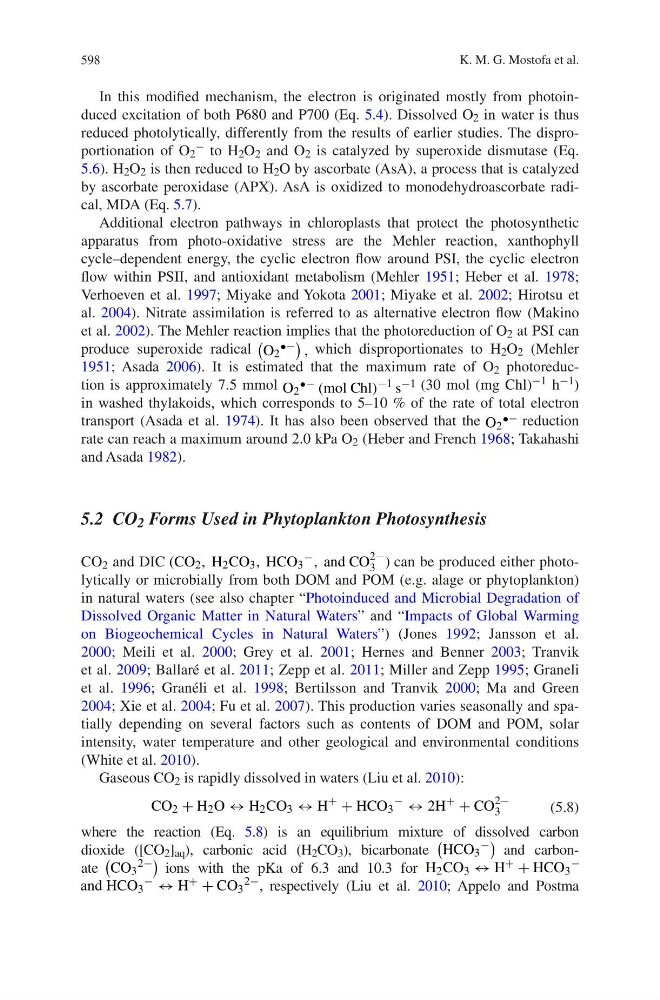
Gaseous CO 2 is rapidly dissolved in waters (Liu et al. 2010):
where the reaction (Eq. 5.8) is an equilibrium mixture of dissolved carbon
dioxide ([CO 2 ] aq ), carbonic acid (H 2 CO 3 ), bicarbonate
HCO 3
− and carbonate
CO 3
2− ions with the pKa of 6.3 and 10.3 for H 2 CO 3 ↔ H + + HCO 3
−
and HCO 3
− ↔ H + + CO 3
2− , respectively (Liu et al. 2010; Appelo and Postma
(5.8)
CO 2 + H 2 O ↔ H 2 CO 3 ↔ H
+ + HCO 3
− ↔ 2H
+ + CO
2−
3