

581
Photosynthesis in Nature: A New Look
(analogous to the accessory bacteriochlorophylls), and two chlorophylloid. Based
on the crystal structures, it is generally assumed that the PSI core complexes, particularly the cofactor arrangement in the reaction centre, are similar in all organisms and plants (Jordan et al. 2001; Ben-Shem et al. 2003).
On the other hand, crystal structure analysis of cyanobacterial photosystem II
(PSII) demonstrates that PSII monomer contains 20 subunits with a total molecular mass of 350 kDa (Umena et al. 2011). It is composed of 19 protein subunits, 32–36 Chl molecules (35 Chls for T. vulcanus) (Umena et al. 2011) including
chlorophyll a dimer (P D1 P D2 ) and monomers (Chl D1 and Chl D2 ), two pheophytins
a (Pheo D1 and Pheo D2 ), 11 ß-carotenes, more than 20 lipids, two plastoquinones
Q A and Q B , two haem irons, one non–haem iron, a tetranuclear manganese cluster
forming Mn 4 CaO 5 (H 2 O) 4 or Mn 4 CaO 4 (OH)(H 2 O) 4 , three or four calcium atoms
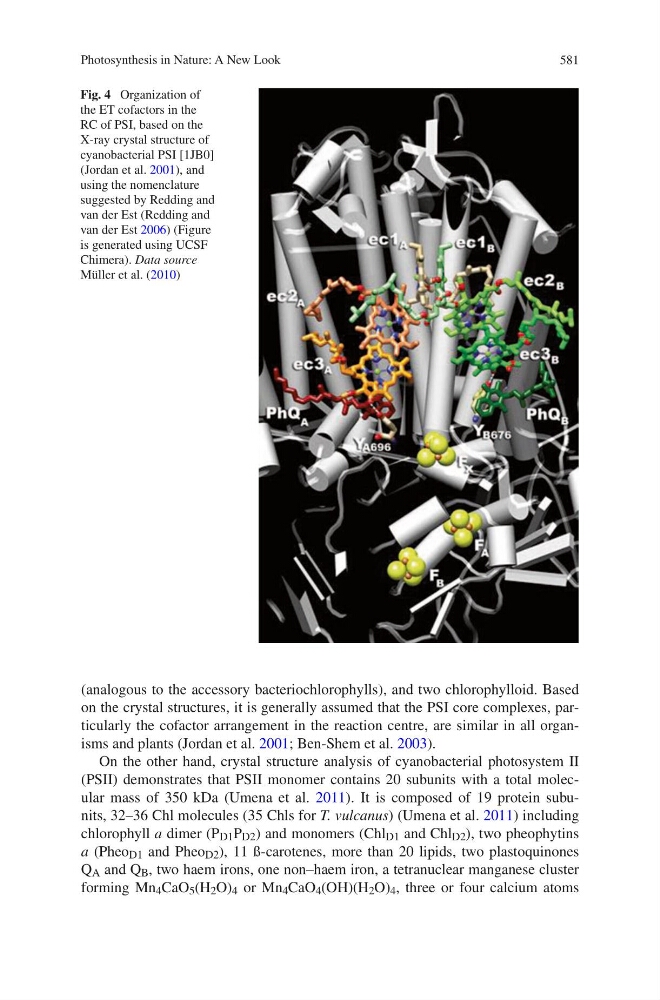
Fig. 4 Organization of
the ET cofactors in the
RC of PSI, based on the
X-ray crystal structure of
cyanobacterial PSI [1JB0]
(Jordan et al. 2001), and
using the nomenclature
suggested by Redding and
van der Est (Redding and
van der Est 2006) (Figure
is generated using UCSF
Chimera). Data source
Müller et al. (2010)