

574
K. M. G. Mostofa et al.
The value of standard electrode potential of the reaction of O 2 formation from
H 2 O 2 (Eq. 3.19) is significantly lower than for H 2 O (Eqs. 3.24, 3.25) (Komissarov
2003):
Therefore, in vivo formation of oxygen would be preferable from hydrogen
peroxide than from water.
3.3 Generation of H 2 O 2 from DOM and POM
The most important source of H 2 O 2 is the photoinduced generation from DOM
and POM (e.g. algae) under solar illumination in natural waters. The mechanism has been discussed in earlier chapters (see “Photoinduced and Microbial
Generation of Hydrogen Peroxide and Organic Peroxides in Natural Waters” and
“Chlorophylls and Their Degradation in Nature”). In addition, DOM can also produce H 2 O 2 under dark incubation. Algae or phytoplankton can produce H 2 O 2 from
superoxide radical anion
O 2
•−
, which can be formed either by photoinduced
generation of electrons from Chlorophyll bound in microorganisms, or via autochthonous DOM. In the latter case, H 2 O 2 generation can take place under photo- and
microbial respiration (assimilations) of phytoplankton (see chapter “Photoinduced
and Microbial Generation of Hydrogen Peroxide and Organic Peroxides in Natural
Waters” and “Chlorophylls and Their Degradation in Nature”). Overall, production
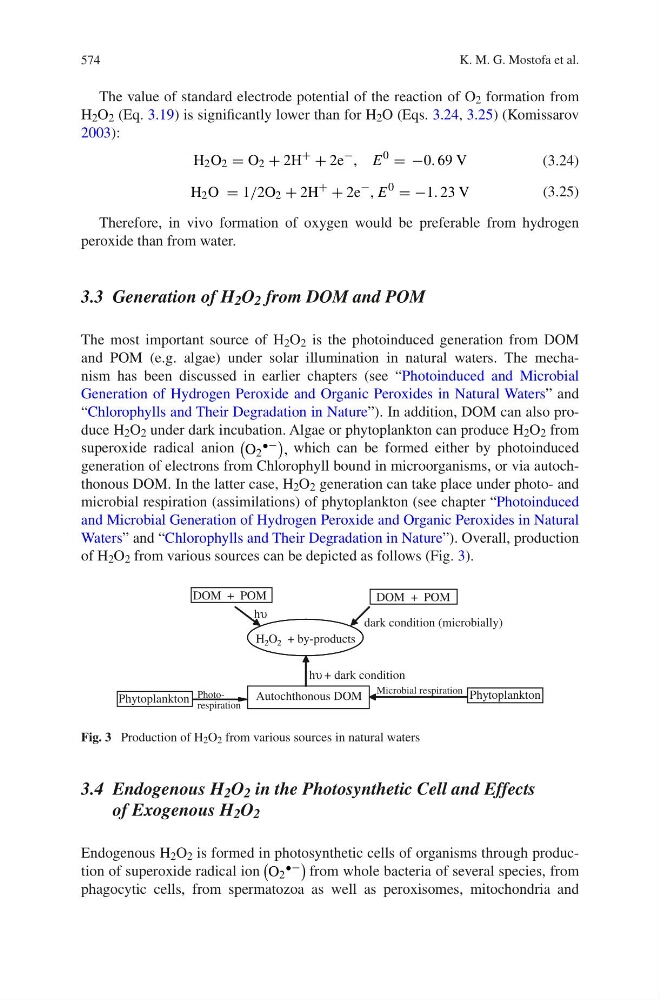
of H 2 O 2 from various sources can be depicted as follows (Fig. 3).
3.4 Endogenous H 2 O 2 in the Photosynthetic Cell and Effects
of Exogenous H 2 O 2
Endogenous H 2 O 2 is formed in photosynthetic cells of organisms through production of superoxide radical ion
O 2
•− from whole bacteria of several species, from
phagocytic cells, from spermatozoa as well as peroxisomes, mitochondria and
(3.24)
H 2 O 2 = O 2 + 2H
+ + 2e
− , E
0 = −0. 69 V
(3.25)
H 2 O = 1/2O 2 + 2H
+ + 2e
− , E
0 = −1. 23 V
Phytoplankton
DOM + POM
H 2 O 2 + by-products
Autochthonous DOM
hυ
dark condition (microbially)
Microbial respiration
DOM + POM
2 2
-
hυ + dark condition
Photorespiration
Phytoplankton
Fig. 3 Production of H 2 O 2 from various sources in natural waters