

562
K. M. G. Mostofa et al.
in 1771 and 1772 firstly hypothesised on photosynthesis that plants can restore to
the air whatever breathing animals and burning candles remove. Jan Ingenhousz in
1779 showed that light is essential to the plant process that somehow purifies air
fouled by candles or animals. Based on the experiments, he concluded that plants
are dependent on light and their green parts for nutrients and energy.
The experiments conducted by J. Senebier and N. Th. de Saussure revealed that
the initial substances of photosynthesis are carbon dioxide (CO 2 ) and water (H 2 O)
(de Saussure 1804; Bay 1931). It has been shown by de Saussure (1804) that H 2 O
is a reactant in photosynthesis. The CO 2 cleavage hypothesis readily accounted
for the deceptively simple overall photosynthesis equation (CO 2 + H 2 O + hυ →
CH 2 O + O 2 ) (de Saussure 1804). The C:2H:O proportion in the reaction made
people assumed that carbon from the photodecomposition of CO 2 can recombine
with the elements of water. In 1905 the British scientist F. Blackmann discovered
that photosynthesis consists of a light reaction, which is rapid, and a slower dark
reaction (Blackman 1905; Blackman and Matthaei 1905). In 1924, O. Warburg
and T. Uyesugi explained the result of Blackman as showing that photosynthesis has two classes of reactions: light and dark reactions (Warburg and Uyesugi
1924). In 1922 the German Scientists O. Warburg and E. Negelein revealed the
minimum quantum requirement (i.e., minimum number of photons) to be 3–4 per
oxygen molecule evolved during the overall process of photosynthesis (Warburg
and Negelein 1922). This was later shown to be in error by a factor of 2–3
(Govindjee 1999). Warburg then was awarded the 1931 Nobel Prize in Physiology
and Medicine for his discoveries concerning respiration. In 1937 the British scientist R. Hill provided the biochemical proof of the existence of these light and dark
phases (Hill 1937, 1939).
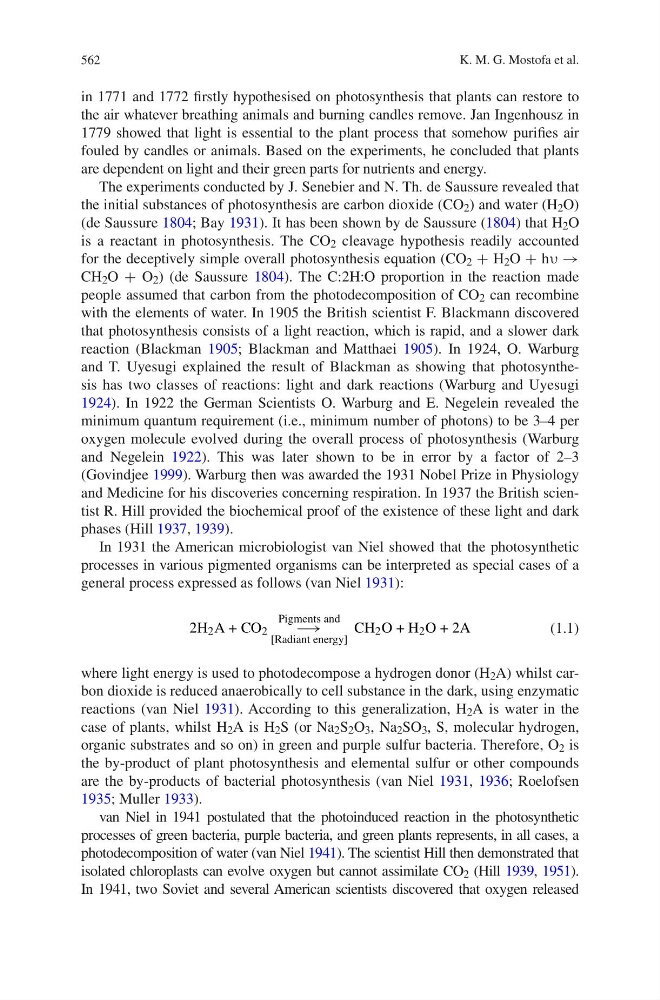
In 1931 the American microbiologist van Niel showed that the photosynthetic
processes in various pigmented organisms can be interpreted as special cases of a
general process expressed as follows (van Niel 1931):
where light energy is used to photodecompose a hydrogen donor (H 2 A) whilst carbon dioxide is reduced anaerobically to cell substance in the dark, using enzymatic
reactions (van Niel 1931). According to this generalization, H 2 A is water in the
case of plants, whilst H 2 A is H 2 S (or Na 2 S 2 O 3 , Na 2 SO 3 , S, molecular hydrogen,
organic substrates and so on) in green and purple sulfur bacteria. Therefore, O 2 is
the by-product of plant photosynthesis and elemental sulfur or other compounds
are the by-products of bacterial photosynthesis (van Niel 1931, 1936; Roelofsen
1935; Muller 1933).
van Niel in 1941 postulated that the photoinduced reaction in the photosynthetic
processes of green bacteria, purple bacteria, and green plants represents, in all cases, a
photodecomposition of water (van Niel 1941). The scientist Hill then demonstrated that
isolated chloroplasts can evolve oxygen but cannot assimilate CO 2 (Hill 1939, 1951).
In 1941, two Soviet and several American scientists discovered that oxygen released
(1.1)
2H 2 A + CO 2
Pigments and
−→
[Radiant energy]
CH 2 O + H 2 O + 2A