

501
Fluorescent Dissolved Organic Matter in Natural Waters
shows an entirely opposite behavior (maximum fluorescence at peak C and low
fluorescence at peak A) (Fig. 3k, l).
2.6 Relationship Between FDOM and DOM
Fulvic acid-like fluorescence intensity (FI) is significantly correlated with DOC
concentration both linearly and non-linearly as a consequence of the effects of
sunlight on river water. However, non-linear correlation is more significant than
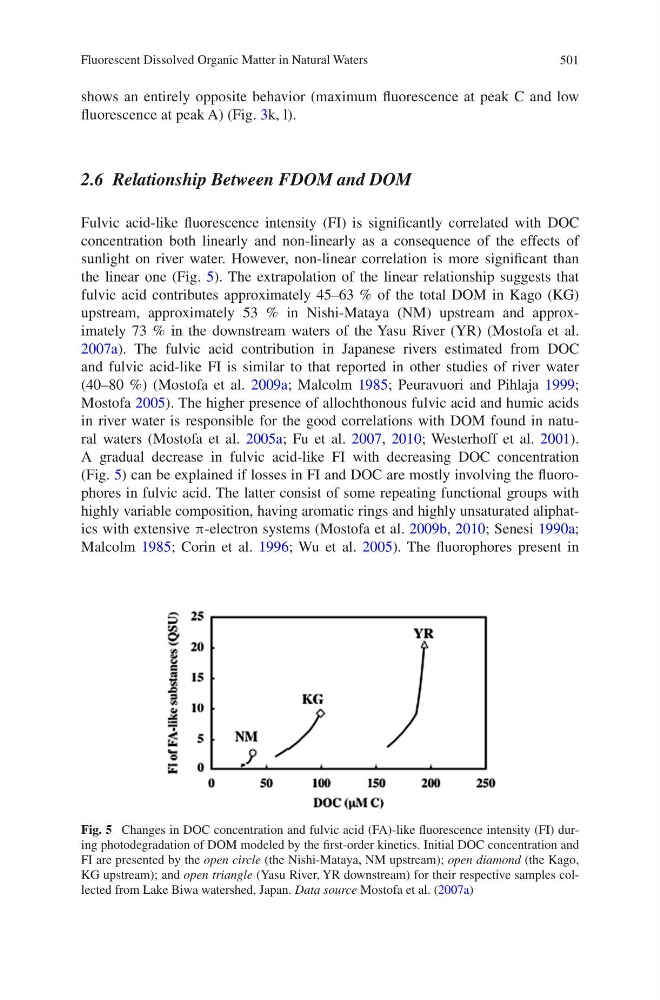
the linear one (Fig. 5). The extrapolation of the linear relationship suggests that
fulvic acid contributes approximately 45–63 % of the total DOM in Kago (KG)
upstream, approximately 53 % in Nishi-Mataya (NM) upstream and approximately 73 % in the downstream waters of the Yasu River (YR) (Mostofa et al.
2007a). The fulvic acid contribution in Japanese rivers estimated from DOC
and fulvic acid-like FI is similar to that reported in other studies of river water
(40–80 %) (Mostofa et al. 2009a; Malcolm 1985; Peuravuori and Pihlaja 1999;
Mostofa 2005). The higher presence of allochthonous fulvic acid and humic acids
in river water is responsible for the good correlations with DOM found in natural waters (Mostofa et al. 2005a; Fu et al. 2007, 2010; Westerhoff et al. 2001).
A gradual decrease in fulvic acid-like FI with decreasing DOC concentration
(Fig. 5) can be explained if losses in FI and DOC are mostly involving the fluorophores in fulvic acid. The latter consist of some repeating functional groups with
highly variable composition, having aromatic rings and highly unsaturated aliphatics with extensive π-electron systems (Mostofa et al. 2009b, 2010; Senesi 1990a;
Malcolm 1985; Corin et al. 1996; Wu et al. 2005). The fluorophores present in
Fig. 5 Changes in DOC concentration and fulvic acid (FA)-like fluorescence intensity (FI) during photodegradation of DOM modeled by the first-order kinetics. Initial DOC concentration and
FI are presented by the open circle (the Nishi-Mataya, NM upstream); open diamond (the Kago,
KG upstream); and open triangle (Yasu River, YR downstream) for their respective samples collected from Lake Biwa watershed, Japan. Data source Mostofa et al. (2007a)
Fluorescent Dissolved Organic Matter in Natural Waters
shows an entirely opposite behavior (maximum fluorescence at peak C and low
fluorescence at peak A) (Fig. 3k, l).
2.6 Relationship Between FDOM and DOM
Fulvic acid-like fluorescence intensity (FI) is significantly correlated with DOC
concentration both linearly and non-linearly as a consequence of the effects of
sunlight on river water. However, non-linear correlation is more significant than
the linear one (Fig. 5). The extrapolation of the linear relationship suggests that
fulvic acid contributes approximately 45–63 % of the total DOM in Kago (KG)
upstream, approximately 53 % in Nishi-Mataya (NM) upstream and approximately 73 % in the downstream waters of the Yasu River (YR) (Mostofa et al.
2007a). The fulvic acid contribution in Japanese rivers estimated from DOC
and fulvic acid-like FI is similar to that reported in other studies of river water
(40–80 %) (Mostofa et al. 2009a; Malcolm 1985; Peuravuori and Pihlaja 1999;
Mostofa 2005). The higher presence of allochthonous fulvic acid and humic acids
in river water is responsible for the good correlations with DOM found in natural waters (Mostofa et al. 2005a; Fu et al. 2007, 2010; Westerhoff et al. 2001).
A gradual decrease in fulvic acid-like FI with decreasing DOC concentration
(Fig. 5) can be explained if losses in FI and DOC are mostly involving the fluorophores in fulvic acid. The latter consist of some repeating functional groups with
highly variable composition, having aromatic rings and highly unsaturated aliphatics with extensive π-electron systems (Mostofa et al. 2009b, 2010; Senesi 1990a;
Malcolm 1985; Corin et al. 1996; Wu et al. 2005). The fluorophores present in
Fig. 5 Changes in DOC concentration and fulvic acid (FA)-like fluorescence intensity (FI) during photodegradation of DOM modeled by the first-order kinetics. Initial DOC concentration and
FI are presented by the open circle (the Nishi-Mataya, NM upstream); open diamond (the Kago,
KG upstream); and open triangle (Yasu River, YR downstream) for their respective samples collected from Lake Biwa watershed, Japan. Data source Mostofa et al. (2007a)