

493
Fluorescent Dissolved Organic Matter in Natural Waters
of two spectral region areas from the emission spectrum scanned for an excitation
at 254 nm. The two areas are calculated between emission wavelengths 300 and
345 nm for L and between 435 and 480 nm for H. The HIX index has recently
been applied to a variety of aquatic samples (Huguet et al. 2009; Vacher 2004).
High HIX values (between 10 and 16) are a sign of strongly humified OM, mainly
of terrestrial origin, whereas low values (<4) are associated with autochthonous
OM (Huguet et al. 2009). However, HIX does not distinguish the allochthonous
fulvic acid from autochthonous fulvic acid (C-like), identified using PARAFAC
modeling on EEM samples in natural waters (Table 3). Indeed, HIX often shows
negative values for autochthonous fulvic acid (C-like), and is thus unable to distinguish them from allochthonous fulvic acid.
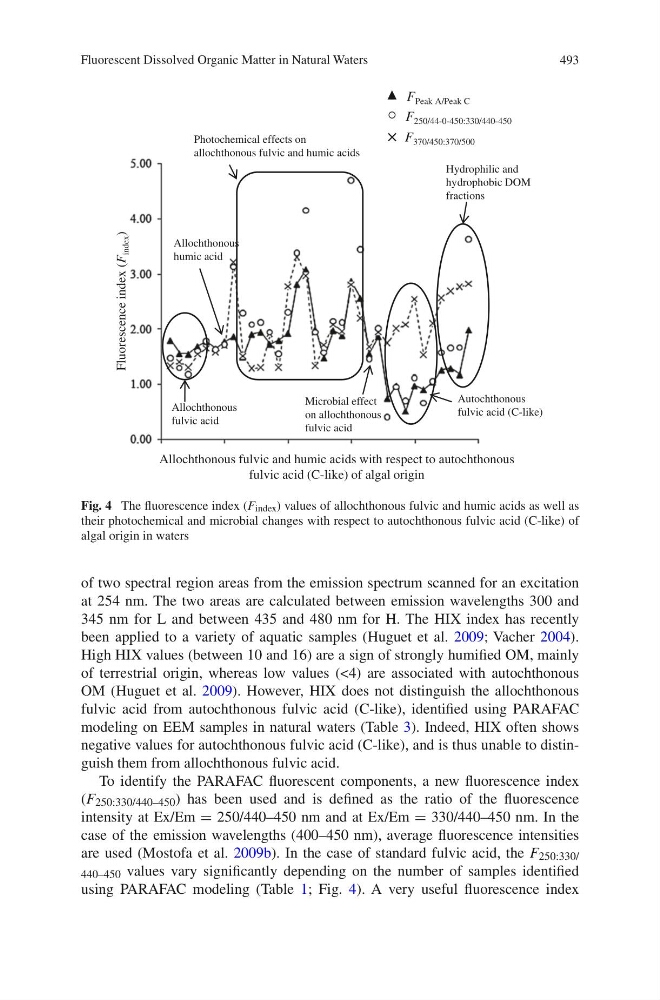
To identify the PARAFAC fluorescent components, a new fluorescence index
(F 250:330/440–450 ) has been used and is defined as the ratio of the fluorescence
intensity at Ex/Em = 250/440–450 nm and at Ex/Em = 330/440–450 nm. In the
case of the emission wavelengths (400–450 nm), average fluorescence intensities
are used (Mostofa et al. 2009b). In the case of standard fulvic acid, the F 250:330/
440–450 values vary significantly depending on the number of samples identified
using PARAFAC modeling (Table 1; Fig. 4). A very useful fluorescence index
Autochthonous
fulvic acid (C-like)
Hydrophilic and
hydrophobic DOM
fractions
Photochemical effects on
allochthonous fulvic and humic acids
Allochthonous
fulvic acid
Allochthonous
humic acid
Microbial effect
on allochthonous
fulvic acid
Allochthonous fulvic and humic acids with respect to autochthonous
fulvic acid (C-like) of algal origin
Fluorescence index (F
index )
F Peak A/Peak C
F 250/44-0-450:330/440-450
× F 370/450:370/500
Fig. 4 The fluorescence index (F index ) values of allochthonous fulvic and humic acids as well as
their photochemical and microbial changes with respect to autochthonous fulvic acid (C-like) of
algal origin in waters
Fluorescent Dissolved Organic Matter in Natural Waters
of two spectral region areas from the emission spectrum scanned for an excitation
at 254 nm. The two areas are calculated between emission wavelengths 300 and
345 nm for L and between 435 and 480 nm for H. The HIX index has recently
been applied to a variety of aquatic samples (Huguet et al. 2009; Vacher 2004).
High HIX values (between 10 and 16) are a sign of strongly humified OM, mainly
of terrestrial origin, whereas low values (<4) are associated with autochthonous
OM (Huguet et al. 2009). However, HIX does not distinguish the allochthonous
fulvic acid from autochthonous fulvic acid (C-like), identified using PARAFAC
modeling on EEM samples in natural waters (Table 3). Indeed, HIX often shows
negative values for autochthonous fulvic acid (C-like), and is thus unable to distinguish them from allochthonous fulvic acid.
To identify the PARAFAC fluorescent components, a new fluorescence index
(F 250:330/440–450 ) has been used and is defined as the ratio of the fluorescence
intensity at Ex/Em = 250/440–450 nm and at Ex/Em = 330/440–450 nm. In the
case of the emission wavelengths (400–450 nm), average fluorescence intensities
are used (Mostofa et al. 2009b). In the case of standard fulvic acid, the F 250:330/
440–450 values vary significantly depending on the number of samples identified
using PARAFAC modeling (Table 1; Fig. 4). A very useful fluorescence index
Autochthonous
fulvic acid (C-like)
Hydrophilic and
hydrophobic DOM
fractions
Photochemical effects on
allochthonous fulvic and humic acids
Allochthonous
fulvic acid
Allochthonous
humic acid
Microbial effect
on allochthonous
fulvic acid
Allochthonous fulvic and humic acids with respect to autochthonous
fulvic acid (C-like) of algal origin
Fluorescence index (F
index )
F Peak A/Peak C
F 250/44-0-450:330/440-450
× F 370/450:370/500
Fig. 4 The fluorescence index (F index ) values of allochthonous fulvic and humic acids as well as
their photochemical and microbial changes with respect to autochthonous fulvic acid (C-like) of
algal origin in waters