

481
Fluorescent Dissolved Organic Matter in Natural Waters
Autochthonous Fulvic Acids (C-like and M-like)
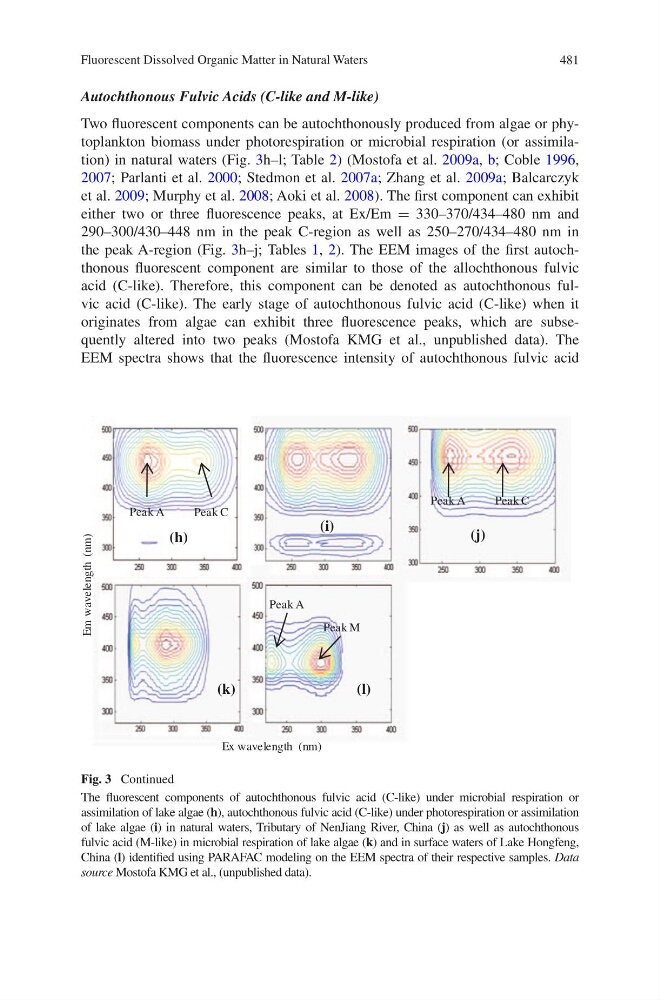
Two fluorescent components can be autochthonously produced from algae or phytoplankton biomass under photorespiration or microbial respiration (or assimilation) in natural waters (Fig. 3h–l; Table 2) (Mostofa et al. 2009a, b; Coble 1996,
2007; Parlanti et al. 2000; Stedmon et al. 2007a; Zhang et al. 2009a; Balcarczyk
et al. 2009; Murphy et al. 2008; Aoki et al. 2008). The first component can exhibit
either two or three fluorescence peaks, at Ex/Em = 330–370/434–480 nm and
290–300/430–448 nm in the peak C-region as well as 250–270/434–480 nm in
the peak A-region (Fig. 3h–j; Tables 1, 2). The EEM images of the first autochthonous fluorescent component are similar to those of the allochthonous fulvic
acid (C-like). Therefore, this component can be denoted as autochthonous fulvic acid (C-like). The early stage of autochthonous fulvic acid (C-like) when it
originates from algae can exhibit three fluorescence peaks, which are subsequently altered into two peaks (Mostofa KMG et al., unpublished data). The
EEM spectra shows that the fluorescence intensity of autochthonous fulvic acid
(k)
(l)
(m)
(i)
(h)
(j)
Ex wavelength (nm)
Em wavelength (nm)
Peak M
Peak A
Peak C
Peak A
Peak C
Peak A
PeakT
PeakT UV
(PZDYHOHQJWKQP
The fluorescent components of autochthonous fulvic acid (C-like) under microbial respiration or
assimilation of lake algae (h), autochthonous fulvic acid (C-like) under photorespiration or assimilation
of lake algae (i) in natural waters, Tributary of NenJiang River, China (j) as well as autochthonous
fulvic acid (M-like) in microbial respiration of lake algae (k) and in surface waters of Lake Hongfeng,
China (l) identified using PARAFAC modeling on the EEM spectra of their respective samples. Data
source Mostofa KMG et al., (unpublished data).
Fig. 3 Continued
Fluorescent Dissolved Organic Matter in Natural Waters
Autochthonous Fulvic Acids (C-like and M-like)
Two fluorescent components can be autochthonously produced from algae or phytoplankton biomass under photorespiration or microbial respiration (or assimilation) in natural waters (Fig. 3h–l; Table 2) (Mostofa et al. 2009a, b; Coble 1996,
2007; Parlanti et al. 2000; Stedmon et al. 2007a; Zhang et al. 2009a; Balcarczyk
et al. 2009; Murphy et al. 2008; Aoki et al. 2008). The first component can exhibit
either two or three fluorescence peaks, at Ex/Em = 330–370/434–480 nm and
290–300/430–448 nm in the peak C-region as well as 250–270/434–480 nm in
the peak A-region (Fig. 3h–j; Tables 1, 2). The EEM images of the first autochthonous fluorescent component are similar to those of the allochthonous fulvic
acid (C-like). Therefore, this component can be denoted as autochthonous fulvic acid (C-like). The early stage of autochthonous fulvic acid (C-like) when it
originates from algae can exhibit three fluorescence peaks, which are subsequently altered into two peaks (Mostofa KMG et al., unpublished data). The
EEM spectra shows that the fluorescence intensity of autochthonous fulvic acid
(k)
(l)
(m)
(i)
(h)
(j)
Ex wavelength (nm)
Em wavelength (nm)
Peak M
Peak A
Peak C
Peak A
Peak C
Peak A
PeakT
PeakT UV
(PZDYHOHQJWKQP
The fluorescent components of autochthonous fulvic acid (C-like) under microbial respiration or
assimilation of lake algae (h), autochthonous fulvic acid (C-like) under photorespiration or assimilation
of lake algae (i) in natural waters, Tributary of NenJiang River, China (j) as well as autochthonous
fulvic acid (M-like) in microbial respiration of lake algae (k) and in surface waters of Lake Hongfeng,
China (l) identified using PARAFAC modeling on the EEM spectra of their respective samples. Data
source Mostofa KMG et al., (unpublished data).
Fig. 3 Continued