

435
Fluorescent Dissolved Organic Matter in Natural Waters
state returns to the ground state. When non-radiative processes are deactivating
the excited state, the measured lifetime (τ) can be expressed as (Eq. 2.4) (Senesi
1990a):
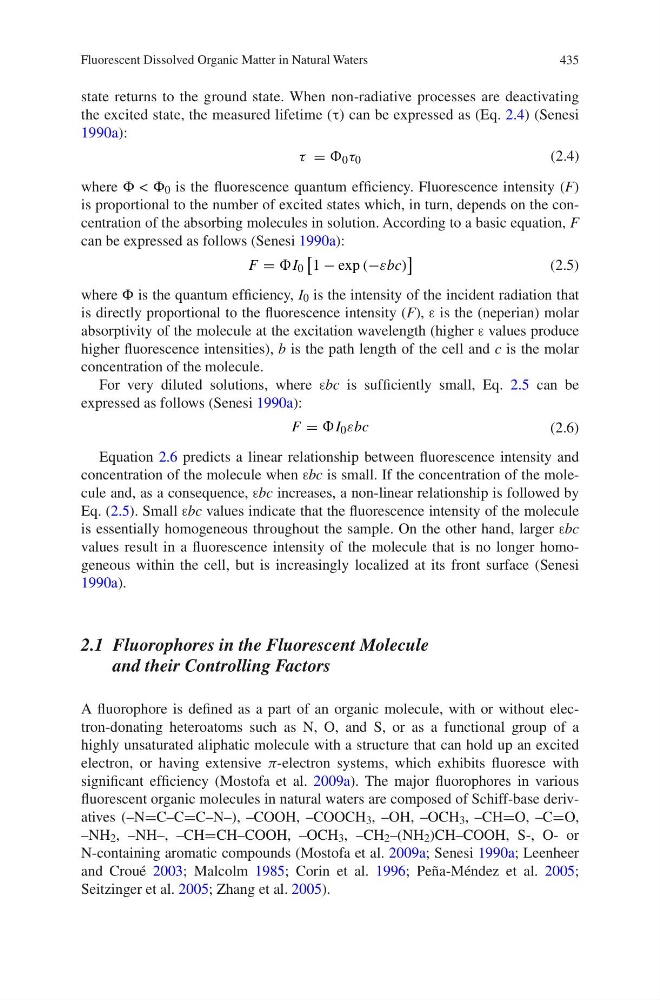
where Ф < Ф 0 is the fluorescence quantum efficiency. Fluorescence intensity (F)
is proportional to the number of excited states which, in turn, depends on the concentration of the absorbing molecules in solution. According to a basic equation, F
can be expressed as follows (Senesi 1990a):
where Ф is the quantum efficiency, I 0 is the intensity of the incident radiation that
is directly proportional to the fluorescence intensity (F), ε is the (neperian) molar
absorptivity of the molecule at the excitation wavelength (higher ε values produce
higher fluorescence intensities), b is the path length of the cell and c is the molar
concentration of the molecule.
For very diluted solutions, where εbc is sufficiently small, Eq. 2.5 can be
expressed as follows (Senesi 1990a):
Equation 2.6 predicts a linear relationship between fluorescence intensity and
concentration of the molecule when εbc is small. If the concentration of the molecule and, as a consequence, εbc increases, a non-linear relationship is followed by
Eq. (2.5). Small εbc values indicate that the fluorescence intensity of the molecule
is essentially homogeneous throughout the sample. On the other hand, larger εbc
values result in a fluorescence intensity of the molecule that is no longer homogeneous within the cell, but is increasingly localized at its front surface (Senesi
1990a).
2.1 Fluorophores in the Fluorescent Molecule
and their Controlling Factors
A fluorophore is defined as a part of an organic molecule, with or without electron-donating heteroatoms such as N, O, and S, or as a functional group of a
highly unsaturated aliphatic molecule with a structure that can hold up an excited
electron, or having extensive π-electron systems, which exhibits fluoresce with
significant efficiency (Mostofa et al. 2009a). The major fluorophores in various
fluorescent organic molecules in natural waters are composed of Schiff-base derivatives (–N=C–C=C–N–), –COOH, –COOCH 3 , –OH, –OCH 3 , –CH=O, –C=O,
–NH 2 , –NH–, –CH=CH–COOH, –OCH 3 , –CH 2 –(NH 2 )CH–COOH, S-, O- or
N-containing aromatic compounds (Mostofa et al. 2009a; Senesi 1990a; Leenheer
and Croué 2003; Malcolm 1985; Corin et al. 1996; Peña-Méndez et al. 2005;
Seitzinger et al. 2005; Zhang et al. 2005).
(2.4)
τ = Φ 0 τ 0
(2.5)
F = ΦI 0
1 − exp (−εbc)
(2.6)
F = ΦI 0 εbc
Fluorescent Dissolved Organic Matter in Natural Waters
state returns to the ground state. When non-radiative processes are deactivating
the excited state, the measured lifetime (τ) can be expressed as (Eq. 2.4) (Senesi
1990a):
where Ф < Ф 0 is the fluorescence quantum efficiency. Fluorescence intensity (F)
is proportional to the number of excited states which, in turn, depends on the concentration of the absorbing molecules in solution. According to a basic equation, F
can be expressed as follows (Senesi 1990a):
where Ф is the quantum efficiency, I 0 is the intensity of the incident radiation that
is directly proportional to the fluorescence intensity (F), ε is the (neperian) molar
absorptivity of the molecule at the excitation wavelength (higher ε values produce
higher fluorescence intensities), b is the path length of the cell and c is the molar
concentration of the molecule.
For very diluted solutions, where εbc is sufficiently small, Eq. 2.5 can be
expressed as follows (Senesi 1990a):
Equation 2.6 predicts a linear relationship between fluorescence intensity and
concentration of the molecule when εbc is small. If the concentration of the molecule and, as a consequence, εbc increases, a non-linear relationship is followed by
Eq. (2.5). Small εbc values indicate that the fluorescence intensity of the molecule
is essentially homogeneous throughout the sample. On the other hand, larger εbc
values result in a fluorescence intensity of the molecule that is no longer homogeneous within the cell, but is increasingly localized at its front surface (Senesi
1990a).
2.1 Fluorophores in the Fluorescent Molecule
and their Controlling Factors
A fluorophore is defined as a part of an organic molecule, with or without electron-donating heteroatoms such as N, O, and S, or as a functional group of a
highly unsaturated aliphatic molecule with a structure that can hold up an excited
electron, or having extensive π-electron systems, which exhibits fluoresce with
significant efficiency (Mostofa et al. 2009a). The major fluorophores in various
fluorescent organic molecules in natural waters are composed of Schiff-base derivatives (–N=C–C=C–N–), –COOH, –COOCH 3 , –OH, –OCH 3 , –CH=O, –C=O,
–NH 2 , –NH–, –CH=CH–COOH, –OCH 3 , –CH 2 –(NH 2 )CH–COOH, S-, O- or
N-containing aromatic compounds (Mostofa et al. 2009a; Senesi 1990a; Leenheer
and Croué 2003; Malcolm 1985; Corin et al. 1996; Peña-Méndez et al. 2005;
Seitzinger et al. 2005; Zhang et al. 2005).
(2.4)
τ = Φ 0 τ 0
(2.5)
F = ΦI 0
1 − exp (−εbc)
(2.6)
F = ΦI 0 εbc