

433
Fluorescent Dissolved Organic Matter in Natural Waters
principles of fluorescence spectroscopy have been summarized in earlier studies
(Senesi 1990a; Hudson et al. 2007; Guilbault 1990; Grabowski et al. 2003; Oheim
et al. 2006). An organic molecule has a series of closely spaced energy levels, and
one of its electrons can be excited from a lower to a higher level upon absorption of
a discrete quantum of light that is equal in energy to the difference between the two
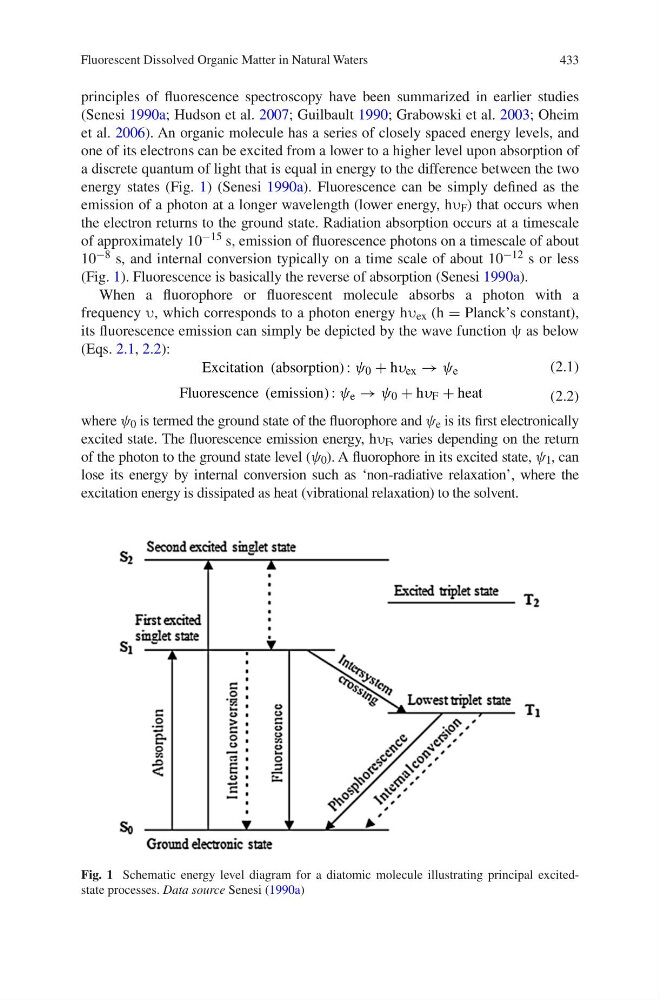
energy states (Fig. 1) (Senesi 1990a). Fluorescence can be simply defined as the
emission of a photon at a longer wavelength (lower energy, hυ F ) that occurs when
the electron returns to the ground state. Radiation absorption occurs at a timescale
of approximately 10 −15 s, emission of fluorescence photons on a timescale of about
10 −8 s, and internal conversion typically on a time scale of about 10 −12 s or less
(Fig. 1). Fluorescence is basically the reverse of absorption (Senesi 1990a).
When a fluorophore or fluorescent molecule absorbs a photon with a
frequency υ, which corresponds to a photon energy hυ ex (h = Planck’s constant),
its fluorescence emission can simply be depicted by the wave function ψ as below
(Eqs. 2.1, 2.2):
where ψ 0 is termed the ground state of the fluorophore and ψ e is its first electronically
excited state. The fluorescence emission energy, hυ F , varies depending on the return
of the photon to the ground state level (ψ 0 ). A fluorophore in its excited state, ψ 1 , can
lose its energy by internal conversion such as ‘non-radiative relaxation’, where the
excitation energy is dissipated as heat (vibrational relaxation) to the solvent.
(2.1)
Excitation (absorption) : ψ 0 + hυ ex → ψ e
(2.2)
Fluorescence (emission) : ψ e → ψ 0 + hυ F + heat
Fig. 1 Schematic energy level diagram for a diatomic molecule illustrating principal excitedstate processes. Data source Senesi (1990a)
Fluorescent Dissolved Organic Matter in Natural Waters
principles of fluorescence spectroscopy have been summarized in earlier studies
(Senesi 1990a; Hudson et al. 2007; Guilbault 1990; Grabowski et al. 2003; Oheim
et al. 2006). An organic molecule has a series of closely spaced energy levels, and
one of its electrons can be excited from a lower to a higher level upon absorption of
a discrete quantum of light that is equal in energy to the difference between the two
energy states (Fig. 1) (Senesi 1990a). Fluorescence can be simply defined as the
emission of a photon at a longer wavelength (lower energy, hυ F ) that occurs when
the electron returns to the ground state. Radiation absorption occurs at a timescale
of approximately 10 −15 s, emission of fluorescence photons on a timescale of about
10 −8 s, and internal conversion typically on a time scale of about 10 −12 s or less
(Fig. 1). Fluorescence is basically the reverse of absorption (Senesi 1990a).
When a fluorophore or fluorescent molecule absorbs a photon with a
frequency υ, which corresponds to a photon energy hυ ex (h = Planck’s constant),
its fluorescence emission can simply be depicted by the wave function ψ as below
(Eqs. 2.1, 2.2):
where ψ 0 is termed the ground state of the fluorophore and ψ e is its first electronically
excited state. The fluorescence emission energy, hυ F , varies depending on the return
of the photon to the ground state level (ψ 0 ). A fluorophore in its excited state, ψ 1 , can
lose its energy by internal conversion such as ‘non-radiative relaxation’, where the
excitation energy is dissipated as heat (vibrational relaxation) to the solvent.
(2.1)
Excitation (absorption) : ψ 0 + hυ ex → ψ e
(2.2)
Fluorescence (emission) : ψ e → ψ 0 + hυ F + heat
Fig. 1 Schematic energy level diagram for a diatomic molecule illustrating principal excitedstate processes. Data source Senesi (1990a)