

396
K. M. G. Mostofa et al.
of the water; (9) Physical mixing in the surface mixing zone; (10) Increasing
UV-radiation during ozone hole events; (11) Global warming and (12) Salinity.
These factors are discussed in chapter “Photoinduced and Microbial Degradation
of Dissolved Organic Matter in Natural Waters”.
4.4 Microbial Degradation of CDOM
Microbial degradation significantly changes the CDOM absorption and spectral slope properties in natural waters (Fig. 1; Table 1) (Helms et al. 2008; Moran
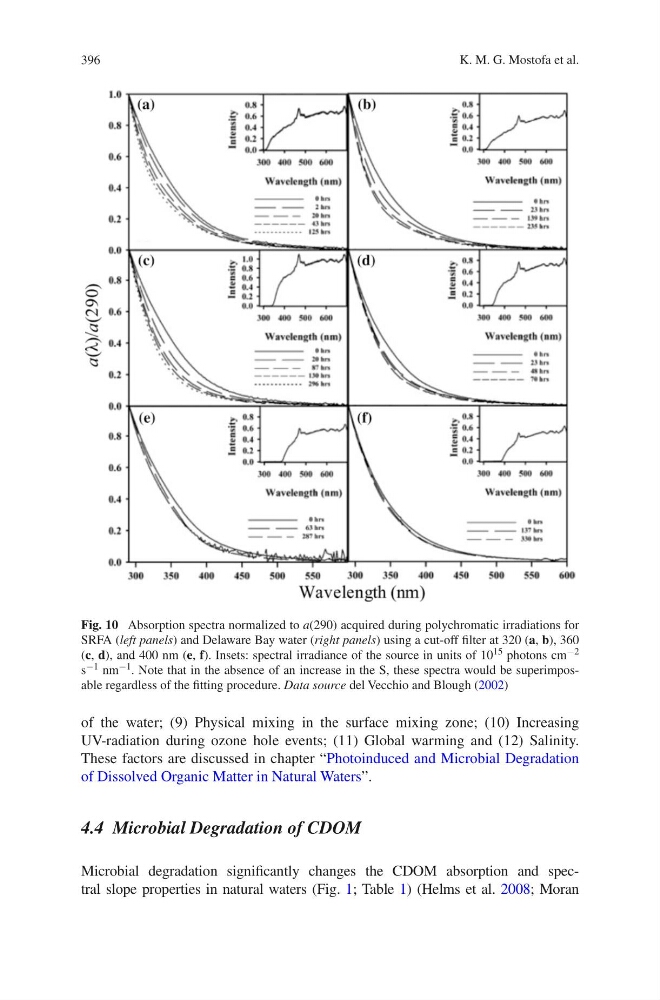
Fig. 10 Absorption spectra normalized to a(290) acquired during polychromatic irradiations for
SRFA (left panels) and Delaware Bay water (right panels) using a cut-off filter at 320 (a, b), 360
(c, d), and 400 nm (e, f). Insets: spectral irradiance of the source in units of 10 15 photons cm −2
s −1 nm −1 . Note that in the absence of an increase in the S, these spectra would be superimposable regardless of the fitting procedure. Data source del Vecchio and Blough (2002)
K. M. G. Mostofa et al.
of the water; (9) Physical mixing in the surface mixing zone; (10) Increasing
UV-radiation during ozone hole events; (11) Global warming and (12) Salinity.
These factors are discussed in chapter “Photoinduced and Microbial Degradation
of Dissolved Organic Matter in Natural Waters”.
4.4 Microbial Degradation of CDOM
Microbial degradation significantly changes the CDOM absorption and spectral slope properties in natural waters (Fig. 1; Table 1) (Helms et al. 2008; Moran
Fig. 10 Absorption spectra normalized to a(290) acquired during polychromatic irradiations for
SRFA (left panels) and Delaware Bay water (right panels) using a cut-off filter at 320 (a, b), 360
(c, d), and 400 nm (e, f). Insets: spectral irradiance of the source in units of 10 15 photons cm −2
s −1 nm −1 . Note that in the absence of an increase in the S, these spectra would be superimposable regardless of the fitting procedure. Data source del Vecchio and Blough (2002)