

388
K. M. G. Mostofa et al.
del Vecchio and Blough 2002; Vähätalo et al. 2000; Bertilsson and Tranvik 2000;
Allard et al. 1994; Amador et al. 1989; Fujiwara et al. 1995; Bertilsson and Allard
1996; Granéli et al. 1996; Granéli et al. 1998; Miller and Moran 1997; Clark et al.
2004; Xie et al. 2004; Johannessen et al. 2007; Fichot and Miller 2010). In surface
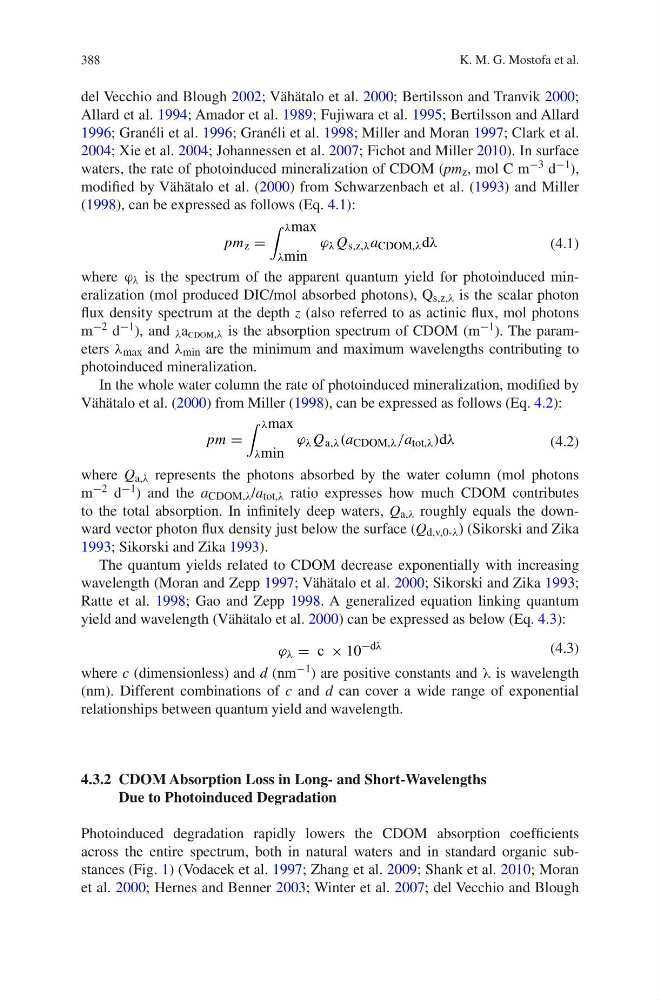
waters, the rate of photoinduced mineralization of CDOM (pm z , mol C m −3 d −1 ),
modified by Vähätalo et al. (2000) from Schwarzenbach et al. (1993) and Miller
(1998), can be expressed as follows (Eq. 4.1):
where ϕ λ is the spectrum of the apparent quantum yield for photoinduced mineralization (mol produced DIC/mol absorbed photons), Q s,z,λ is the scalar photon
flux density spectrum at the depth z (also referred to as actinic flux, mol photons
m −2 d −1 ), and λ a cdom,λ is the absorption spectrum of CDOM (m −1 ). The parameters λ max and λ min are the minimum and maximum wavelengths contributing to
photoinduced mineralization.
In the whole water column the rate of photoinduced mineralization, modified by
Vähätalo et al. (2000) from Miller (1998), can be expressed as follows (Eq. 4.2):
where Q a,λ represents the photons absorbed by the water column (mol photons
m −2 d −1 ) and the a CDOM,λ /a tot,λ ratio expresses how much CDOM contributes
to the total absorption. In infinitely deep waters, Q a,λ roughly equals the downward vector photon flux density just below the surface (Q d,v,0-λ ) (Sikorski and Zika
1993; Sikorski and Zika 1993).
The quantum yields related to CDOM decrease exponentially with increasing
wavelength (Moran and Zepp 1997; Vähätalo et al. 2000; Sikorski and Zika 1993;
Ratte et al. 1998; Gao and Zepp 1998. A generalized equation linking quantum
yield and wavelength (Vähätalo et al. 2000) can be expressed as below (Eq. 4.3):
where c (dimensionless) and d (nm −1 ) are positive constants and λ is wavelength
(nm). Different combinations of c and d can cover a wide range of exponential
relationships between quantum yield and wavelength.
4.3.2 CDOM Absorption Loss in Long- and Short-Wavelengths
Due to Photoinduced Degradation
Photoinduced degradation rapidly lowers the CDOM absorption coefficients
across the entire spectrum, both in natural waters and in standard organic substances (Fig. 1) (Vodacek et al. 1997; Zhang et al. 2009; Shank et al. 2010; Moran
et al. 2000; Hernes and Benner 2003; Winter et al. 2007; del Vecchio and Blough
(4.1)
pm z =
λmax
λmin
ϕ λ Q s,z,λ a CDOM,λ dλ
(4.2)
pm =
λmax
λmin
ϕ λ Q a,λ (a CDOM,λ /a tot,λ )dλ
(4.3)
ϕ λ = c × 10
−dλ
K. M. G. Mostofa et al.
del Vecchio and Blough 2002; Vähätalo et al. 2000; Bertilsson and Tranvik 2000;
Allard et al. 1994; Amador et al. 1989; Fujiwara et al. 1995; Bertilsson and Allard
1996; Granéli et al. 1996; Granéli et al. 1998; Miller and Moran 1997; Clark et al.
2004; Xie et al. 2004; Johannessen et al. 2007; Fichot and Miller 2010). In surface
waters, the rate of photoinduced mineralization of CDOM (pm z , mol C m −3 d −1 ),
modified by Vähätalo et al. (2000) from Schwarzenbach et al. (1993) and Miller
(1998), can be expressed as follows (Eq. 4.1):
where ϕ λ is the spectrum of the apparent quantum yield for photoinduced mineralization (mol produced DIC/mol absorbed photons), Q s,z,λ is the scalar photon
flux density spectrum at the depth z (also referred to as actinic flux, mol photons
m −2 d −1 ), and λ a cdom,λ is the absorption spectrum of CDOM (m −1 ). The parameters λ max and λ min are the minimum and maximum wavelengths contributing to
photoinduced mineralization.
In the whole water column the rate of photoinduced mineralization, modified by
Vähätalo et al. (2000) from Miller (1998), can be expressed as follows (Eq. 4.2):
where Q a,λ represents the photons absorbed by the water column (mol photons
m −2 d −1 ) and the a CDOM,λ /a tot,λ ratio expresses how much CDOM contributes
to the total absorption. In infinitely deep waters, Q a,λ roughly equals the downward vector photon flux density just below the surface (Q d,v,0-λ ) (Sikorski and Zika
1993; Sikorski and Zika 1993).
The quantum yields related to CDOM decrease exponentially with increasing
wavelength (Moran and Zepp 1997; Vähätalo et al. 2000; Sikorski and Zika 1993;
Ratte et al. 1998; Gao and Zepp 1998. A generalized equation linking quantum
yield and wavelength (Vähätalo et al. 2000) can be expressed as below (Eq. 4.3):
where c (dimensionless) and d (nm −1 ) are positive constants and λ is wavelength
(nm). Different combinations of c and d can cover a wide range of exponential
relationships between quantum yield and wavelength.
4.3.2 CDOM Absorption Loss in Long- and Short-Wavelengths
Due to Photoinduced Degradation
Photoinduced degradation rapidly lowers the CDOM absorption coefficients
across the entire spectrum, both in natural waters and in standard organic substances (Fig. 1) (Vodacek et al. 1997; Zhang et al. 2009; Shank et al. 2010; Moran
et al. 2000; Hernes and Benner 2003; Winter et al. 2007; del Vecchio and Blough
(4.1)
pm z =
λmax
λmin
ϕ λ Q s,z,λ a CDOM,λ dλ
(4.2)
pm =
λmax
λmin
ϕ λ Q a,λ (a CDOM,λ /a tot,λ )dλ
(4.3)
ϕ λ = c × 10
−dλ