

372
K. M. G. Mostofa et al.
phenolic groups, carboxyl groups, alcoholic OH, carbohydrate OH, –C=C–,
hydroxycoumarin-like structures, chromone, xanthone, quinoline, and O-, N-, Sand P-containing functional groups. They include aromatic carbon (17–30) and
aliphatic carbon (47–63 %) (Malcolm 1985; Senesi 1990; Leenheer and Croue
2003; Steelink 2002). All of these functional groups can be considered as key
chromophores in fulvic and humic acids in natural waters.
2.3 Theory of CDOM Absorbance
Photon absorption by a CDOM chromophore in aqueous solution firstly induces
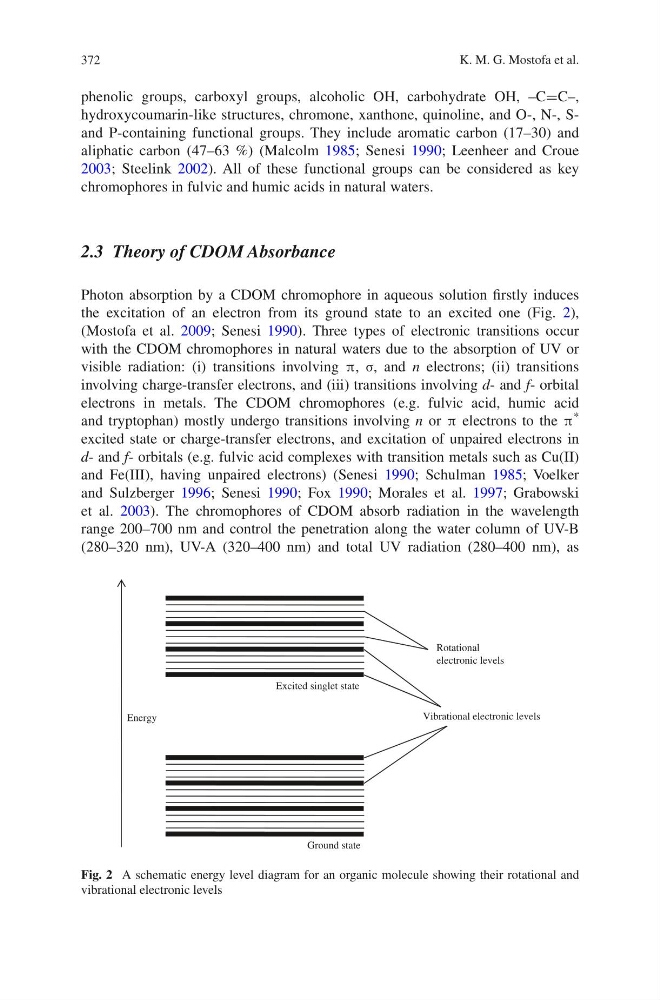
the excitation of an electron from its ground state to an excited one (Fig. 2),
(Mostofa et al. 2009; Senesi 1990). Three types of electronic transitions occur
with the CDOM chromophores in natural waters due to the absorption of UV or
visible radiation: (i) transitions involving π, σ, and n electrons; (ii) transitions
involving charge-transfer electrons, and (iii) transitions involving d- and f- orbital
electrons in metals. The CDOM chromophores (e.g. fulvic acid, humic acid
and tryptophan) mostly undergo transitions involving n or π electrons to the π *
excited state or charge-transfer electrons, and excitation of unpaired electrons in
d- and f- orbitals (e.g. fulvic acid complexes with transition metals such as Cu(II)
and Fe(III), having unpaired electrons) (Senesi 1990; Schulman 1985; Voelker
and Sulzberger 1996; Senesi 1990; Fox 1990; Morales et al. 1997; Grabowski
et al. 2003). The chromophores of CDOM absorb radiation in the wavelength
range 200–700 nm and control the penetration along the water column of UV-B
(280–320 nm), UV-A (320–400 nm) and total UV radiation (280–400 nm), as
Vibrational electronic levels
Rotational
electronic levels
Excited singlet state
Ground state
Energy
Fig. 2 A schematic energy level diagram for an organic molecule showing their rotational and
vibrational electronic levels
K. M. G. Mostofa et al.
phenolic groups, carboxyl groups, alcoholic OH, carbohydrate OH, –C=C–,
hydroxycoumarin-like structures, chromone, xanthone, quinoline, and O-, N-, Sand P-containing functional groups. They include aromatic carbon (17–30) and
aliphatic carbon (47–63 %) (Malcolm 1985; Senesi 1990; Leenheer and Croue
2003; Steelink 2002). All of these functional groups can be considered as key
chromophores in fulvic and humic acids in natural waters.
2.3 Theory of CDOM Absorbance
Photon absorption by a CDOM chromophore in aqueous solution firstly induces
the excitation of an electron from its ground state to an excited one (Fig. 2),
(Mostofa et al. 2009; Senesi 1990). Three types of electronic transitions occur
with the CDOM chromophores in natural waters due to the absorption of UV or
visible radiation: (i) transitions involving π, σ, and n electrons; (ii) transitions
involving charge-transfer electrons, and (iii) transitions involving d- and f- orbital
electrons in metals. The CDOM chromophores (e.g. fulvic acid, humic acid
and tryptophan) mostly undergo transitions involving n or π electrons to the π *
excited state or charge-transfer electrons, and excitation of unpaired electrons in
d- and f- orbitals (e.g. fulvic acid complexes with transition metals such as Cu(II)
and Fe(III), having unpaired electrons) (Senesi 1990; Schulman 1985; Voelker
and Sulzberger 1996; Senesi 1990; Fox 1990; Morales et al. 1997; Grabowski
et al. 2003). The chromophores of CDOM absorb radiation in the wavelength
range 200–700 nm and control the penetration along the water column of UV-B
(280–320 nm), UV-A (320–400 nm) and total UV radiation (280–400 nm), as
Vibrational electronic levels
Rotational
electronic levels
Excited singlet state
Ground state
Energy
Fig. 2 A schematic energy level diagram for an organic molecule showing their rotational and
vibrational electronic levels