

320
K. M. G. Mostofa et al.
that different types of plant material lead to different rates of acetate formation.
There is also a stronger substrate-based coupling of root surface and methanogens
in oligotrophic (bog) than in minerotrophic (fen) sites (Cadillo-Quiroz et al. 2010;
Ström et al. 2003; Öquist and Svensson 2002). Seasonal algal or phytoplankton
blooms might be responsible for formation of acetate and CH 4 in the sediments
of deep lakes (Schulz and Conrad 1995). The acetate concentration profiles show
maxima (~100 μM in 2 or 4 cm depth) in summer and minima (~5 μM over the
entire depth) in winter, when the respective CH 4 concentrations are ~750 μM in
summer and ~120 μM in winter (Schulz and Conrad 1995).
It is evidenced that gas bubbles contain about 60–70 % CH 4 with an average
δ 13 C of –56.2 % and δD of –354 %, and 2 % CO 2 with an average δ 13 C of –14.1 %
(Thebrath et al. 1993). These data indicate that CH 4 is produced from methyl carbon, i.e. mainly using acetate as fermentative substrate (Thebrath et al. 1993).
In anoxic paddy soil, interspecies H 2 transfer within methanogenic bacterial associations (MBA) account for 95–97 % of the conversion of 14 CO 2 to 14 CH 4 , and
only 3–5 % of the 14 CH 4 is produced from the turnover of dissolved H 2 (Conrad
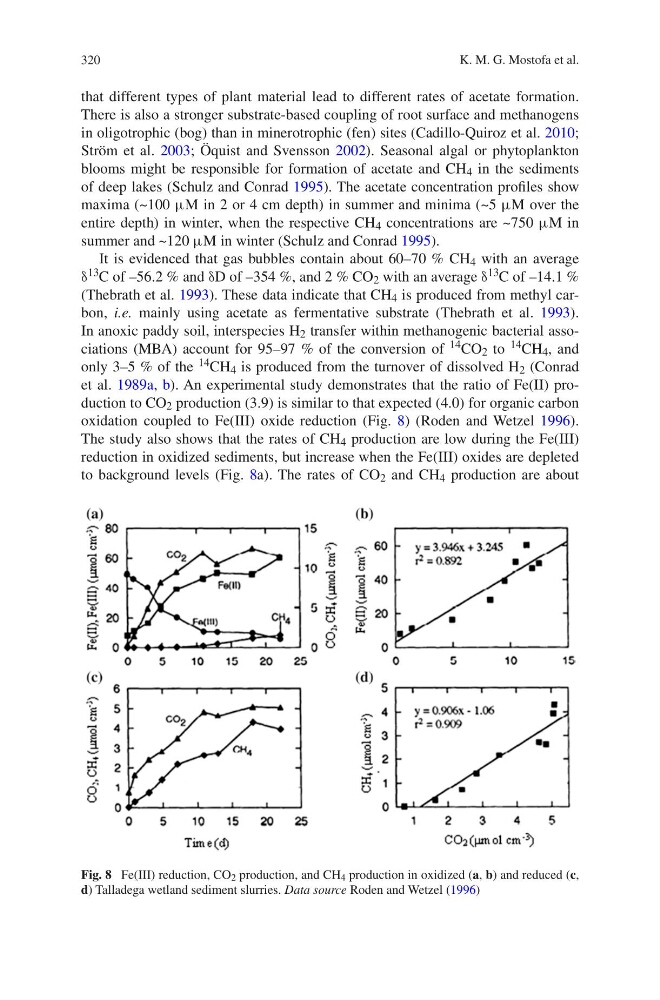
et al. 1989a, b). An experimental study demonstrates that the ratio of Fe(II) production to CO 2 production (3.9) is similar to that expected (4.0) for organic carbon
oxidation coupled to Fe(III) oxide reduction (Fig. 8) (Roden and Wetzel 1996).
The study also shows that the rates of CH 4 production are low during the Fe(III)
reduction in oxidized sediments, but increase when the Fe(III) oxides are depleted
to background levels (Fig. 8a). The rates of CO 2 and CH 4 production are about
Fig. 8 Fe(III) reduction, CO 2 production, and CH 4 production in oxidized (a, b) and reduced (c,
d) Talladega wetland sediment slurries. Data source Roden and Wetzel (1996)
K. M. G. Mostofa et al.
that different types of plant material lead to different rates of acetate formation.
There is also a stronger substrate-based coupling of root surface and methanogens
in oligotrophic (bog) than in minerotrophic (fen) sites (Cadillo-Quiroz et al. 2010;
Ström et al. 2003; Öquist and Svensson 2002). Seasonal algal or phytoplankton
blooms might be responsible for formation of acetate and CH 4 in the sediments
of deep lakes (Schulz and Conrad 1995). The acetate concentration profiles show
maxima (~100 μM in 2 or 4 cm depth) in summer and minima (~5 μM over the
entire depth) in winter, when the respective CH 4 concentrations are ~750 μM in
summer and ~120 μM in winter (Schulz and Conrad 1995).
It is evidenced that gas bubbles contain about 60–70 % CH 4 with an average
δ 13 C of –56.2 % and δD of –354 %, and 2 % CO 2 with an average δ 13 C of –14.1 %
(Thebrath et al. 1993). These data indicate that CH 4 is produced from methyl carbon, i.e. mainly using acetate as fermentative substrate (Thebrath et al. 1993).
In anoxic paddy soil, interspecies H 2 transfer within methanogenic bacterial associations (MBA) account for 95–97 % of the conversion of 14 CO 2 to 14 CH 4 , and
only 3–5 % of the 14 CH 4 is produced from the turnover of dissolved H 2 (Conrad
et al. 1989a, b). An experimental study demonstrates that the ratio of Fe(II) production to CO 2 production (3.9) is similar to that expected (4.0) for organic carbon
oxidation coupled to Fe(III) oxide reduction (Fig. 8) (Roden and Wetzel 1996).
The study also shows that the rates of CH 4 production are low during the Fe(III)
reduction in oxidized sediments, but increase when the Fe(III) oxides are depleted
to background levels (Fig. 8a). The rates of CO 2 and CH 4 production are about
Fig. 8 Fe(III) reduction, CO 2 production, and CH 4 production in oxidized (a, b) and reduced (c,
d) Talladega wetland sediment slurries. Data source Roden and Wetzel (1996)