

306
K. M. G. Mostofa et al.
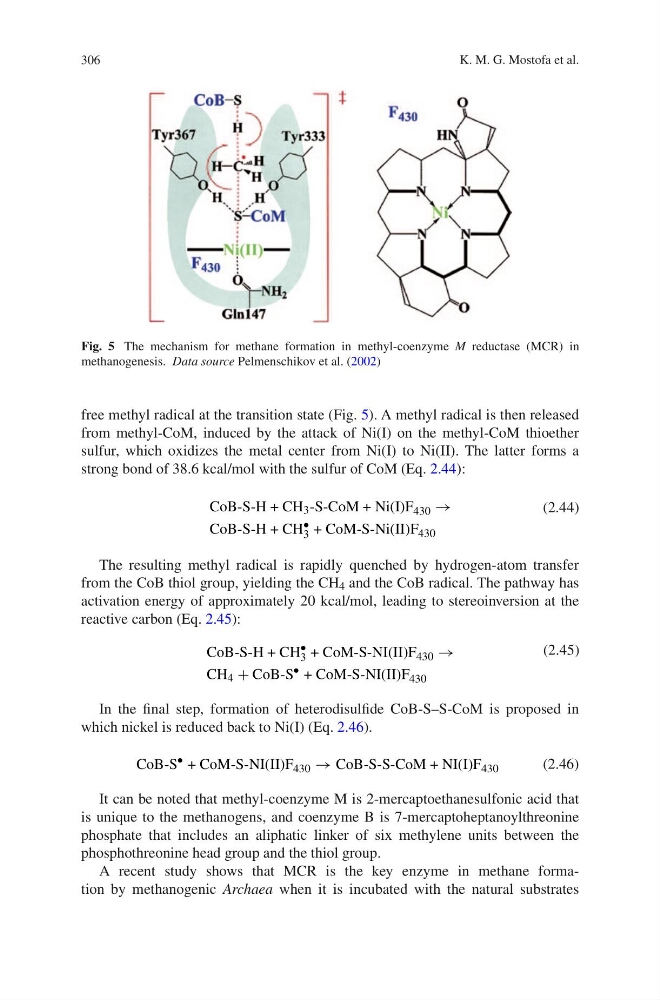
free methyl radical at the transition state (Fig. 5). A methyl radical is then released
from methyl-CoM, induced by the attack of Ni(I) on the methyl-CoM thioether
sulfur, which oxidizes the metal center from Ni(I) to Ni(II). The latter forms a
strong bond of 38.6 kcal/mol with the sulfur of CoM (Eq. 2.44):
The resulting methyl radical is rapidly quenched by hydrogen-atom transfer
from the CoB thiol group, yielding the CH 4 and the CoB radical. The pathway has
activation energy of approximately 20 kcal/mol, leading to stereoinversion at the
reactive carbon (Eq. 2.45):
In the final step, formation of heterodisulfide CoB-S–S-CoM is proposed in
which nickel is reduced back to Ni(I) (Eq. 2.46).
It can be noted that methyl-coenzyme M is 2-mercaptoethanesulfonic acid that
is unique to the methanogens, and coenzyme B is 7-mercaptoheptanoylthreonine
phosphate that includes an aliphatic linker of six methylene units between the
phosphothreonine head group and the thiol group.
A recent study shows that MCR is the key enzyme in methane formation by methanogenic Archaea when it is incubated with the natural substrates
(2.44)
CoB-S-H + CH 3 -S-CoM + Ni(I)F 430 →
CoB-S-H + CH
•
3 + CoM-S-Ni(II)F 430
(2.45)
CoB-S-H + CH
•
3 + CoM-S-NI(II)F 430 →
CH 4 + CoB-S
• + CoM-S-NI(II)F 430
(2.46)
CoB-S
• + CoM-S-NI(II)F 430 → CoB-S-S-CoM + NI(I)F 430
Fig. 5 The mechanism for methane formation in methyl-coenzyme M reductase (MCR) in
methanogenesis. Data source Pelmenschikov et al. (2002)
K. M. G. Mostofa et al.
free methyl radical at the transition state (Fig. 5). A methyl radical is then released
from methyl-CoM, induced by the attack of Ni(I) on the methyl-CoM thioether
sulfur, which oxidizes the metal center from Ni(I) to Ni(II). The latter forms a
strong bond of 38.6 kcal/mol with the sulfur of CoM (Eq. 2.44):
The resulting methyl radical is rapidly quenched by hydrogen-atom transfer
from the CoB thiol group, yielding the CH 4 and the CoB radical. The pathway has
activation energy of approximately 20 kcal/mol, leading to stereoinversion at the
reactive carbon (Eq. 2.45):
In the final step, formation of heterodisulfide CoB-S–S-CoM is proposed in
which nickel is reduced back to Ni(I) (Eq. 2.46).
It can be noted that methyl-coenzyme M is 2-mercaptoethanesulfonic acid that
is unique to the methanogens, and coenzyme B is 7-mercaptoheptanoylthreonine
phosphate that includes an aliphatic linker of six methylene units between the
phosphothreonine head group and the thiol group.
A recent study shows that MCR is the key enzyme in methane formation by methanogenic Archaea when it is incubated with the natural substrates
(2.44)
CoB-S-H + CH 3 -S-CoM + Ni(I)F 430 →
CoB-S-H + CH
•
3 + CoM-S-Ni(II)F 430
(2.45)
CoB-S-H + CH
•
3 + CoM-S-NI(II)F 430 →
CH 4 + CoB-S
• + CoM-S-NI(II)F 430
(2.46)
CoB-S
• + CoM-S-NI(II)F 430 → CoB-S-S-CoM + NI(I)F 430
Fig. 5 The mechanism for methane formation in methyl-coenzyme M reductase (MCR) in
methanogenesis. Data source Pelmenschikov et al. (2002)