

304
K. M. G. Mostofa et al.
The ferrous iron, hydroxyl ions and bicarbonate, produced together in (Eqs.
2.24, 2.25) can combine to form siderite in aquatic sediment porewaters (Eq. 2.26)
(Coleman et al. 1993). Evidences from that research study show that two genera of
sulphate-reducing bacteria, Desulfobacter and Desulfovibrio, can oxidize H 2 and
acetate in aquatic sediment waters (Coleman et al. 1993). It is shown that H 2 is the
most important electron donor for Desulfovibrio (Eq. 2.27), and acetate is the most
environmentally significant electron donor for Desulfobacter (Eq. 2.28) sulphate
reducing bacteria (Coleman et al. 1993):
The study shows that Desulfobulbus propionicus can oxidize S to SO 4
2− with an
electrode serving as the electron acceptor (Lovley 2006). This is an important reaction at the anode surface in sediments, where high concentrations of sulphide can
abiotically react with electrodes producing Sº (Fig. 4) (Lovley 2006). This abiotic
reaction merely yields two out of eight electrons potentially available from sulphide
(S 2− ) oxidation (Fig. 4). Oxidation of Sº to SO 4
2− extracts six electrons and regenerates SO 4
2− as an electron acceptor for further microbial reduction by microorganisms in the family Desulfobulbaceae (Lovley 2006; Holmes et al. 2004).
(2.26)
Fe
2+ + HCO
−
3 + OH
− → FeCO 3 + H 2 O
(2.27)
4H 2 + SO 4
2− → S
2− + 4H 2 O
(2.28)
CH 3 COO
− + SO 4
2− → S
2− + 2HCO
−
3 + H
+
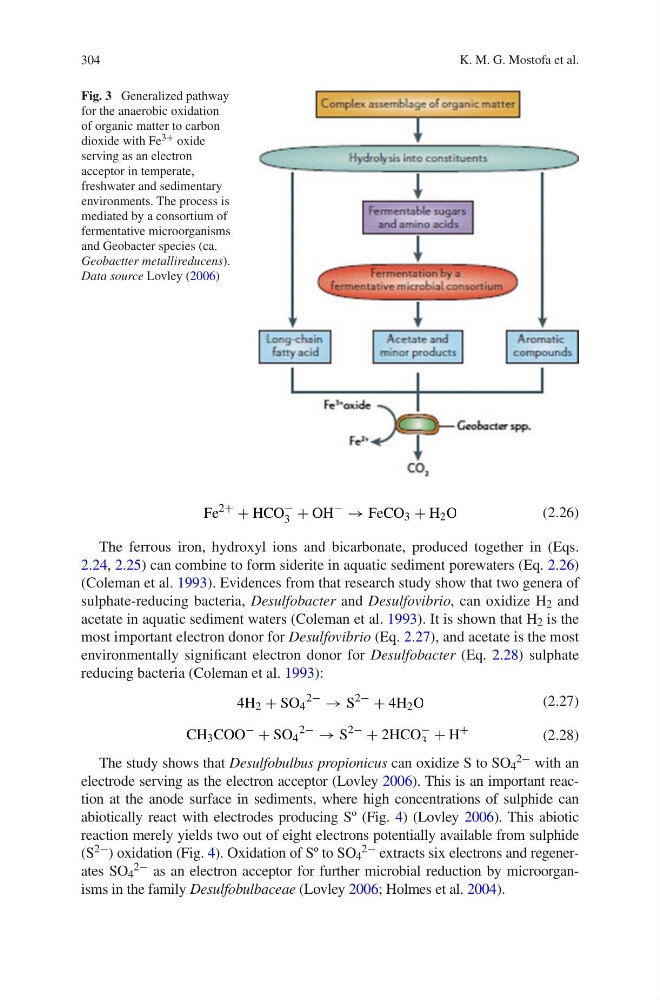
Fig. 3 Generalized pathway
for the anaerobic oxidation
of organic matter to carbon
dioxide with Fe 3+ oxide
serving as an electron
acceptor in temperate,
freshwater and sedimentary
environments. The process is
mediated by a consortium of
fermentative microorganisms
and Geobacter species (ca.
Geobactter metallireducens).
Data source Lovley (2006)
K. M. G. Mostofa et al.
The ferrous iron, hydroxyl ions and bicarbonate, produced together in (Eqs.
2.24, 2.25) can combine to form siderite in aquatic sediment porewaters (Eq. 2.26)
(Coleman et al. 1993). Evidences from that research study show that two genera of
sulphate-reducing bacteria, Desulfobacter and Desulfovibrio, can oxidize H 2 and
acetate in aquatic sediment waters (Coleman et al. 1993). It is shown that H 2 is the
most important electron donor for Desulfovibrio (Eq. 2.27), and acetate is the most
environmentally significant electron donor for Desulfobacter (Eq. 2.28) sulphate
reducing bacteria (Coleman et al. 1993):
The study shows that Desulfobulbus propionicus can oxidize S to SO 4
2− with an
electrode serving as the electron acceptor (Lovley 2006). This is an important reaction at the anode surface in sediments, where high concentrations of sulphide can
abiotically react with electrodes producing Sº (Fig. 4) (Lovley 2006). This abiotic
reaction merely yields two out of eight electrons potentially available from sulphide
(S 2− ) oxidation (Fig. 4). Oxidation of Sº to SO 4
2− extracts six electrons and regenerates SO 4
2− as an electron acceptor for further microbial reduction by microorganisms in the family Desulfobulbaceae (Lovley 2006; Holmes et al. 2004).
(2.26)
Fe
2+ + HCO
−
3 + OH
− → FeCO 3 + H 2 O
(2.27)
4H 2 + SO 4
2− → S
2− + 4H 2 O
(2.28)
CH 3 COO
− + SO 4
2− → S
2− + 2HCO
−
3 + H
+
Fig. 3 Generalized pathway
for the anaerobic oxidation
of organic matter to carbon
dioxide with Fe 3+ oxide
serving as an electron
acceptor in temperate,
freshwater and sedimentary
environments. The process is
mediated by a consortium of
fermentative microorganisms
and Geobacter species (ca.
Geobactter metallireducens).
Data source Lovley (2006)